




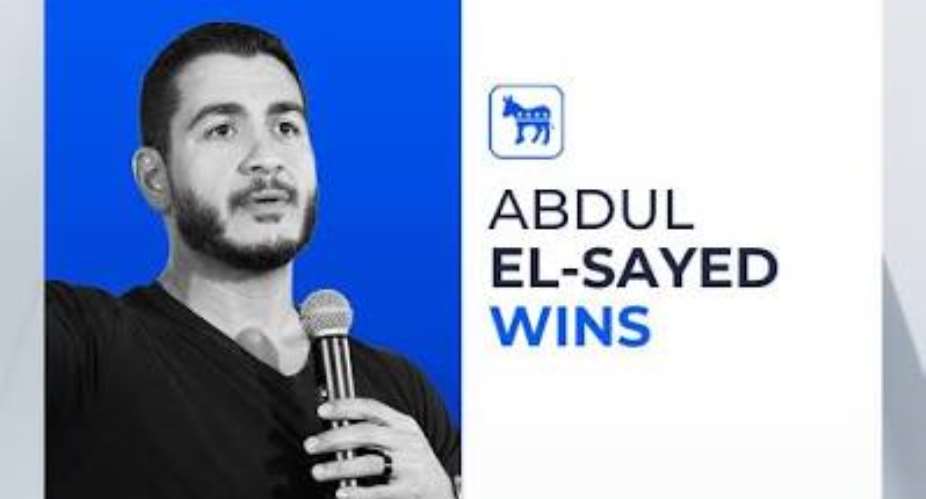
The recently concluded American midterm election campaigns have provided an interesting lesson for politicians, political parties and citizens across the world. Beyond the familiar exchanges between political opponents, some of the speeches delivered by American politicians have raised fundamental questions about political corruption, the concentration of wealth, corporate influence and the relationship between public resources and the welfare of ordinary citizens.
Two voices, in particular, deserve attention: Senator Jon Ossoff of Georgia (a Jew) and Dr Abdul El-Sayed of Michigan (a Muslim). Although they were speaking within the context of American politics, their messages have implications far beyond the United States. Indeed, African politicians, particularly those who occupy positions of public trust, have much to reflect upon. Their central argument is that a nation's political and economic structures must not become instruments for enriching a privileged minority at the expense of the majority. This is a conversation Africa cannot afford to ignore.
When National Wealth Becomes the Property of a Privileged Few
Jon Ossoff made a particularly interesting observation during his October 28 campaign rally in Georgia. He argued that corruption in American politics was much deeper than one president or one political party. Corporate money, secret financial interests and billionaires, he maintained, had increasingly acquired influence over national affairs. His expression, "Money's in, favor's out," captures a disturbing relationship between political financing and public decision-making. He was essentially questioning a political environment in which financial power could translate into political influence and, ultimately, favourable government decisions. This raises an important question for Africa. Who really benefits from the wealth of our nations?
Africa is endowed with enormous natural resources. We have gold, diamonds, bauxite, manganese, oil, gas, fertile agricultural lands and other valuable mineral deposits. Yet, across much of the continent, millions of people continue to struggle with unemployment, inadequate healthcare, poor educational facilities, unreliable electricity, deteriorating roads and limited economic opportunities.
How do we reconcile this contradiction? How can countries endowed with enormous natural resources continue to depend on foreign borrowing to finance basic development projects? How can governments announce billions of dollars in revenue and investment while communities sitting on mineral deposits lack potable water, decent schools and functioning health facilities?
The problem is not necessarily the absence of wealth. It is also about how wealth is managed, distributed, protected and accounted for. When public resources are controlled by a small circle of politically connected individuals, when contracts are awarded without adequate transparency, when procurement processes become opportunities for private enrichment and when state institutions are weakened to accommodate powerful interests, national development suffers. The ordinary citizen pays the price.
Corruption is bigger than one President or one Political Power
Perhaps the most important lesson from Ossoff's speech is his insistence that corruption should not be reduced to the conduct of one political personality. This is an uncomfortable message for African political parties.
In many African countries, including Ghana, corruption is frequently discussed through partisan lenses. When one party is in opposition, it accuses the governing party of corruption. When the opposition assumes power, the accusations are reversed. Unfortunately, the underlying institutional weaknesses often remain. We sometimes behave as though corruption was invented by the government of the day and will disappear when another political party takes over. That is a dangerous misconception.
A country cannot fight corruption effectively by merely changing the people occupying ministerial offices. It must examine the institutions, procedures and political arrangements that make corruption possible.
- If public procurement remains vulnerable to manipulation, changing the political party in power will not automatically solve the problem.
- If political financing is not transparent, the relationship between wealthy financiers and political officeholders will remain a concern.
- If public officials are not held accountable for decisions that result in financial losses to the state, the problem will persist.
- If politically connected individuals can acquire public assets or secure lucrative contracts without adequate scrutiny, changing the occupants of the presidential palace will not fundamentally alter the situation.
We must therefore move beyond the politics of accusation and embrace the politics of institutional reform.
Abdul El-Sayed: Money Out of Politics, Money in Your Pocket
Dr Abdul El-Sayed's message deserves equal attention. His campaign slogan, "Money out of politics, money in your pocket," provides a simple but powerful way of understanding the relationship between political accountability and economic welfare. His argument was that political systems should work for ordinary citizens rather than powerful corporations, billionaires and special interests. He connected political influence to the rising cost of fuel, groceries and healthcare.
For African politicians, the question is straightforward:
- What is the purpose of political power if the ordinary citizen cannot feel its benefits?
- What is the justification for celebrating economic growth when unemployment remains high and household purchasing power continues to deteriorate?
- What is the point of announcing impressive GDP figures when the average family struggles to pay school fees, rent, hospital bills and electricity bills?
Economic development must be judged by its impact on human lives. A country's wealth should not be measured exclusively by the size of its national budget, the number of billionaires it produces or the volume of foreign investments it attracts. We must also ask how many people have access to decent housing, quality healthcare, good education, reliable electricity and employment that provides a dignified living. The prosperity of a nation cannot be separated from the welfare of its people.
We must stop listening to the politicians and asking ourselves: What change am I experiencing? Like the king in Abdul's childhood story, who paraded naked while his subjects pretended to admire his invisible robes, we Africans often refuse to confront the truth. Even on a hospital stretcher, we say we are fine! We must abandon this culture of presence. If a government is failing, say so, even if it is your own party in power. Patriotism is not blind loyalty; it is the courage to speak the truth. The American midterm elections offer an important lesson in political accountability and the willingness to confront uncomfortable realities.
Africa’s Natural Resources Must Benefit Africans
Consider Ghana, for example. We have gold, oil, cocoa, bauxite, manganese and other resources. Yet we continue to debate debt sustainability, revenue mobilization, unemployment and the cost of living. We must ask whether our natural resources are generating the maximum possible benefits for the people. Are our mining agreements sufficiently transparent? Are we obtaining adequate returns from our mineral resources? Are the royalties and taxes collected from extractive industries properly accounted for? Are we ensuring that local communities benefit meaningfully from the resources extracted from their lands? Are our state-owned enterprises being managed in the national interest? And when public officials enter office, do we have sufficiently effective mechanisms to examine their financial interests, monitor their decisions and hold them accountable?
These are not questions directed at one political party. They are questions that every government must answer. We cannot continue to treat national resources as though they were the private possessions of whoever happens to occupy political office. The state holds these resources in trust for present and future generations.
The Political Class Must Stop Confusing Public Office with Personal Wealth
One of the greatest dangers facing many African democracies is the gradual normalization of the accumulation of wealth through political connections. We must distinguish between legitimate private enterprise and the exploitation of public office for private benefit. There is nothing wrong with an individual becoming wealthy through innovation, investment, entrepreneurship and productive economic activity.
The problem arises when political access becomes an economic advantage, when public contracts become instruments of enrichment, when state assets are disposed of without adequate accountability and when the interests of a privileged group take precedence over national development.
Public office is a responsibility, not an investment opportunity. It is an open secret in Ghana today that the fastest way of getting rich and powerful is by going into politics. Entering politics and becoming a party official, Member of Parliament, or Minister is a do-and-die affair for many. By hook or crook, any obstacles to these positions be cleared. Many resort to powerful Pastors and Mallams, as well as Fetish-Priests to get what they want. What happens when the fetish priest asks for human blood? What if a ram has to be buried alive? What if success will be followed by the death of a spouse or beloved child?
The people who elect governments do not surrender ownership of their country's resources to those governments. They entrust political leaders with the responsibility of managing those resources in the public interest. This distinction must never be forgotten.
Follow the Money
Ossoff repeatedly urged his audience to follow the money. That expression should become an important principle of public accountability in Africa. When a government announces a major project, citizens must be able to establish how much was budgeted, how much was released, who received the contract, how much was actually spent and whether the project was completed to the required standard. When state-owned enterprises make major investments, the public deserves to know the commercial justification, the expected returns and the actual performance. When governments borrow, citizens must know where the money goes and what assets or benefits are created from the borrowing. When public officials leave office, there must be credible mechanisms for examining unexplained changes in their financial circumstances.
Auditing should not be a ceremonial exercise. Parliamentary oversight committees should be empowered to examine public expenditure without political interference. Anti-corruption institutions must be sufficiently independent to investigate allegations regardless of the political connections of the persons involved. And when wrongdoing is established, the law must take its course. The objective should not be political revenge. It should be the protection of public resources and the restoration of public confidence.
Political Parties Must Also Examine their Own Structures
There is another lesson here. Political parties themselves must become more transparent about their financing and relationships with wealthy individuals and corporate interests. Who finances political campaigns? What expectations accompany those financial contributions? Do wealthy financiers acquire disproportionate access to political decision-makers? Are appointments and government contracts influenced by political obligations? These questions deserve honest answers.
A political party that promises to fight corruption must be prepared to examine its own financial arrangements and internal practices. It cannot demand transparency from government while maintaining opacity within its own organization. Similarly, a party that criticizes the concentration of wealth and political influence must demonstrate that its own leadership structures are not controlled by a privileged minority. Democracy should not end at the polling station. It must extend into the management of political parties, public institutions and national resources.
The African Citizen Must Also Wake Up
We cannot place the entire responsibility on politicians. Citizens have a role to play. We must stop regarding political officeholders as benefactors who are doing us personal favours when they provide roads, schools, hospitals and other public services. These are not gifts. They are among the responsibilities of government, financed largely through public revenue and other national resources. Citizens must demand accountability irrespective of political affiliation.
Civil society organizations, professional associations, the media, traditional authorities, religious institutions and organized labour must strengthen their oversight roles. We must also discourage the practice of defending wrongdoing simply because the individual involved belongs to our preferred political party. A corrupt politician does not become honest because he belongs to our party. Neither does a questionable public transaction become acceptable because it was undertaken by a government we support. National interest must take precedence over partisan loyalty.
Africa Needs Reformation, Not Just Restoration
Perhaps the most compelling aspect of Ossoff's argument was his insistence that the answer was not simply restoration but reformation. That distinction is particularly relevant to Africa. We have witnessed governments come and go. We have witnessed political parties make promises of transformation, accountability and economic recovery. We have also witnessed the disappointment that follows when institutional weaknesses remain unaddressed.
What Africa needs is not merely a change of political personalities. It needs a fundamental improvement in how public institutions are governed. We need transparent procurement systems, independent audits, effective parliamentary oversight, accountable state-owned enterprises, responsible management of natural resources and institutions that function without fear or favour. We need governments that understand that economic growth must translate into improved living conditions. We need political leaders who recognize that the national treasury is not an extension of their personal bank accounts. And we need a generation of citizens who understand that demanding accountability is not an act of hostility against government. It is an expression of responsible citizenship.
My Thoughts: Whose Wealth is it Anyway?
The speeches of Jon Ossoff and Abdul El-Sayed should encourage African politicians to reflect on the relationship between political power, national wealth and public welfare. Their arguments may have emerged from an American electoral contest, but the questions they raise are universal. Who controls national wealth? Who benefits from public expenditure? Whose interests influence government decisions? And why should citizens continue to bear the economic consequences when the management of national resources fails to serve the wider public?
Africa does not lack resources. What we must continually strengthen are the institutions, values and accountability mechanisms that ensure those resources work for the people. Our countries do not belong to presidents, ministers, parliamentarians, political parties, business associates or wealthy financiers. They belong to their people.
Political office is temporary. National resources are a public trust. And no generation of political leaders has the moral right to impoverish future generations through irresponsible management of national wealth. Perhaps the most important message African politicians should take from these American speeches is this: It is not enough to win elections. It is not enough to control government. It is not enough to announce economic growth. The real test of political leadership is whether the wealth of the nation is being used to improve the lives of the people. Africa deserves nothing less.
I take this opportunity to congratulate Jon Ossoff, Abdul El-Sayed and those who ordinarily couldn’t have won. And I also congratulate the Democrats for their strong showing. To all Americans who voted, you voted for Positive Change. God bless America!
PS: When America is happy, the world is happy. Let no one mistake me for a Democrat. Even in my own country, I have always voted skirt and blouse, choosing candidates on their individual merits rather than party affiliation. I refuse to be a party loyalist or a hypocrite. My loyalty is to truth, accountability and good governance, not to any political party.
FUSEINI ABDULAI BRAIMAH
+233208282575 / +233550558008
[email protected]

 Sam George pushes for probe into Ningo-Prampram military brutalities
 Democrats warn Trump camp to ‘lawyer up’ as anger over corruption drives midterm...
 'They must be sacked now' – NPP demands dismissal of NACOC, GACL, GPHA, National...
 Meridian Rock dispute: Peace Council urges Tema, Nungua chiefs to pursue dialogu...
 ORC to cancel unrenewed business names from January 17, 2027
 AMA gives traders 48 hours to vacate unauthorised bus stops ahead of enforcement
 Mahama holds bilateral talks with WTO Director-General
 Anaesthetists threaten nationwide strike from December 1 over unresolved concern...
 Ghana to establish 21,000-tonne grain storage facility in Upper West Region
 Fifi Kwetey hints at another reshuffle


