




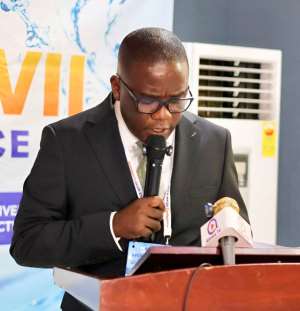
The Member of Parliament for Bekwai, Hon. Ralph Poku-Adusei, has called for a comprehensive overhaul of Ghana’s sanitation financing system, warning that the country’s progress in water, sanitation and hygiene (WASH) delivery could be undermined without sustainable funding and stronger accountability.
The Deputy Ranking Member of Parliament’s Select Committee on Sanitation and Water Resources made the call during his solidarity remarks at the WASH Programme/MOLE Conference on Monday, November 2, 2026.
Hon. Poku-Adusei urged policymakers, development partners and sanitation practitioners to move beyond identifying challenges and focus on practical interventions that can improve access to safe water and decent sanitation across the country.
He described WASH as a fundamental pillar of national development, arguing that its importance extends beyond infrastructure to public health, education, economic productivity, climate resilience and national security.
According to him, the MOLE Conference, which has served as a major platform for Ghana’s water and sanitation discourse since 1989, must continue to bridge the gap between policy formulation and practical implementation.
Parliamentary Oversight Uncovers Progress
The Bekwai legislator highlighted the work of the Parliamentary Select Committee on Sanitation and Water Resources, which recently undertook monitoring activities across the Volta and Oti regions.
He disclosed that the Committee, under the leadership of its Chairman, Hon. John Oti Bless, engaged 18 Municipal and District Assemblies in the Volta Region and all nine districts in the Oti Region.
The exercise involved assessing sanitation projects, examining financial records and evaluating the utilisation of resources allocated to the sector.
Hon. Poku-Adusei said the findings demonstrated that effective leadership and proper application of resources could produce significant improvements in sanitation delivery.
He cited the impact of the 10 per cent District Assemblies Common Fund allocation for sanitation, which has supported the provision of institutional toilets, boreholes, drainage works and desilting exercises.
He also noted that eight out of the nine districts in the Oti Region presented commendable sanitation interventions, while the Committee's Chairman described the Volta Region as the cleanest region visited so far.
However, he insisted that the progress must be matched with sustained accountability to ensure that public investments deliver lasting benefits.
Rural Communities Remain Vulnerable
The MP expressed concern over the persistent inequalities in access to safe water and sanitation, particularly among rural communities.
Citing the 2021 Population and Housing Census, he said 87.7 per cent of households had access to basic drinking water, but the figure declined to 74.4 per cent in rural areas and 55 per cent in the Savannah Region.
He further disclosed that only 59.3 per cent of households had access to toilet facilities, while 31.3 per cent of rural households had no toilet facility.
Hon. Poku-Adusei said these figures represented the daily struggles of families, schoolchildren and women who continue to face difficulties accessing safe water and decent sanitation.
He also warned that climate change, flooding, prolonged dry seasons and illegal mining were placing additional pressure on already vulnerable water systems.
Calls for Dedicated Sanitation Financing
A major concern raised by the Bekwai MP was the inadequacy of the current sanitation financing framework.
He argued that sanitation should not be treated as an afterthought funded through residual allocations, but should receive dedicated, predictable and sustainable financial support.
Hon. Poku-Adusei reaffirmed the Committee's support for the proposed National Sanitation Authority Bill, which he said could strengthen institutional coordination, regulation and the management of sanitation and waste services.
He also called for stricter accountability in the utilisation of public funds, insisting that every cedi allocated for sanitation must produce measurable results.
The MP urged conference participants to develop evidence-based recommendations that could inform legislation, strengthen parliamentary oversight and guide policy implementation.
Calls for Accountability and Practical Solutions
Hon. Poku-Adusei further assured stakeholders that the Committee would continue to follow up on issues identified during its monitoring activities.
He disclosed that the Committee would pursue concerns raised by the Nkwanta North District Assembly and engage the Ministry of Roads over the access road to the Ho IRECOP facility.
He explained that poor road access could compromise waste management investments by preventing waste trucks from reaching treatment facilities, potentially resulting in waste being dumped in forests and farmlands.
He also encouraged WASH stakeholders to hold Parliament accountable, stressing that effective oversight must go beyond field visits and formal engagements.
According to him, the ultimate measure of success in the sector should be whether every Ghanaian can access safe drinking water, decent sanitation and a clean environment, irrespective of where they live.
He reaffirmed the Committee's commitment to advocating reforms and ensuring that recommendations from the MOLE Conference receive the necessary attention in Parliament.
Hon. Poku-Adusei concluded by urging stakeholders to work towards a Ghana where safe water and decent sanitation are guaranteed as basic services for all citizens.

 Sam George pushes for probe into Ningo-Prampram military brutalities
 Democrats warn Trump camp to ‘lawyer up’ as anger over corruption drives midterm...
 'They must be sacked now' – NPP demands dismissal of NACOC, GACL, GPHA, National...
 Meridian Rock dispute: Peace Council urges Tema, Nungua chiefs to pursue dialogu...
 ORC to cancel unrenewed business names from January 17, 2027
 AMA gives traders 48 hours to vacate unauthorised bus stops ahead of enforcement
 Mahama holds bilateral talks with WTO Director-General
 Anaesthetists threaten nationwide strike from December 1 over unresolved concern...
 Ghana to establish 21,000-tonne grain storage facility in Upper West Region
 Fifi Kwetey hints at another reshuffle


