




PART 1: THE MODULE - What They Say They Teach
On paper, Proposal Writing Skills (PWS 301) is neutral. Practical. Professional. Relevant. Necessary.
Topic and Title Selection. Concept Paper Development. Problem Statement and Rationale. Aim, Objectives, Research Questions - SMART. Literature Review and Theoretical Framework. Research Methodology and Design. Ethical Considerations. Worky Plans and Timelines - Gantt charts. Budgeting and Financial Planning. Grant Management and Donor Engagement - logframes, theory of change, Devex.
That is what is on the course outline. If you ask any lecturer, they will tell you: we are training you to think clearly and structure ideas.
Fair enough. I attended. I wrote the notes.
WHAT IS SAWADOGOISM? - The Lens I Am Using
To interrogate this module, I am using Sawadogoism. Specifically, I am using its third pillar - Frugal Sovereignty: sovereignty is cheap, dependence is expensive.
Sawadogoism is a simple doctrine: African problems are solved by African solutions. It follows a man they called crazy - Yacouba Sawadogo of Burkina Faso.
Yacouba had no degree, no donor, no tractor. He had a shovel and memory. In Yatenga, white experts in Land Cruisers declared the land dead. "Unproductive. Beyond recovery." They told people to leave.
Yacouba did not leave. He remembered. His father taught him Zaï - small pits, manure, dead leaves, termites to trap rain. A 1,000-year-old technology.
He dug during dry season when everyone rested. 30 hectares of barren laterite became forest. Farmers copied him - no NGO, no workshop. 50,000 hectares resurrected without a ministry. 100-300% more sorghum in drought while fertilizer projects collapsed¹.
From that pit grows three pillars:
Pillar 1: Bottom-up, not top-down. The farmer is professor, not beneficiary.
Pillar 2: Indigenous as Science. Zaï is engineering, peer-reviewed by drought. Yacouba said: "My father taught me. My father learned from his father." That is a citation older than any journal in Wageningen.
Pillar 3: Frugal Sovereignty. Sovereignty is cheap, dependence is expensive. Zaï costs almost $0 in forex per hectare - manure, dead leaves, termites and family labour already in the village. Fertilizer costs $200 per hectare plus forex, plus loan, plus conditionality, plus an executive order from Washington that can freeze it in January 2025.
Sawadogoism says Africa is not poor. Africa was taught to forget how rich her memory is. It is anti-agribusiness colonialism, not anti-technology. Sawadogoism never needed the cheque. Yacouba's forest was not funded by USAID. It was funded by manure, termites and memory.
PART 2: THE HIDDEN MODULE - What They Actually Teach
What is actually taught is how to see the donor before you see the community.
Topic Selection is not about what is burning in Mbare or Tsholotsho. It is about what is burning on the donor website. This year is gender. Next year is climate. Next year is resilience. The logic of the module pushes you to twist your village wound to fit their call. In a Week 4 tutorial exercise, we were guided to reframe drug abuse in Epworth as "Climate-Induced Youth Vulnerability" because that is where the Devex call was. The wound did not change. The English did.
Concept Paper is how to summarize your begging in 3 pages. The key word is always NEED. Not seed. Not knowledge. Not what the community already has.
Problem Statement is initiation into helplessness. You learn to describe your own people as a gap, as vulnerable, as left behind. You learn English words that make your home sound poor enough for pity.
Aims and Objectives? SMART for Geneva, not for Gokwe. Specific to their logframe. Measurable to their indicator. Relevant to their strategy. Achievable if they release funds.
Literature Review? Proof that you have read enough papers from elsewhere to be allowed to speak about your own home. A proposal written in Shona that a farmer in Zaka can read feels like it would get 40%. One written in donor English that he cannot read feels like it would get 80%. That feeling is the hidden curriculum.
Budgeting is the final initiation. How to write $50 for mobilization, $20 for refreshments, as if you need to pay people to save their own children. How to put a price on nhimbe, on ilima, on humwe - systems our grandmothers ran without a budget line but with accountability deeper than any audit.
And the last unit is the most honest: Grant Management. How to check Devex every day. How to be a seeker. A waiter.
At the end of the semester, you know how to write: We hereby kindly request...
You don't know how to say: We have started. Come and see...
PROPOSAL WRITING CONCEPTS ARE NOT THE ENEMY
Let me be clear, lest I be called anti-intellectual: Proposal writing concepts are NOT the enemy. The tools are not the problem. The starting point is.
Concept papers taught me to summarize a messy idea in 3 pages. Problem statements taught me to be precise, not emotional. SMART stopped me from writing lazy objectives like "to help youths." Literature review taught me that my grandmother's knowledge has a name in books: Asset-Based Community Development. I just never knew white books had a name for what she did.
Methodology taught me to think about who I will talk to and how. Ethics taught me consent - that you don't take photos of drug users for your donor report without permission. Gantt charts taught me that "soon" is not a timeline. Budgeting taught me accountability - that every dollar must be traceable, even nhimbe.
Yacouba also had a proposal. His proposal was not on paper. It was in his head: "If I dig pits here, rain will sit, termites will come, trees will return." He had an aim, an objective, a timeline (dry season), a budget (manure), an ethical framework (don't cut the tree that holds the soil). He just didn't write it for a donor in Geneva.
So I am not rejecting proposal writing. I am rejecting proposal writing that starts with the donor. I want proposal writing that starts with the shovel. That traps rain, not sympathy.
PART 3: THE COST - We Trap Proposals, He Trapped Rain
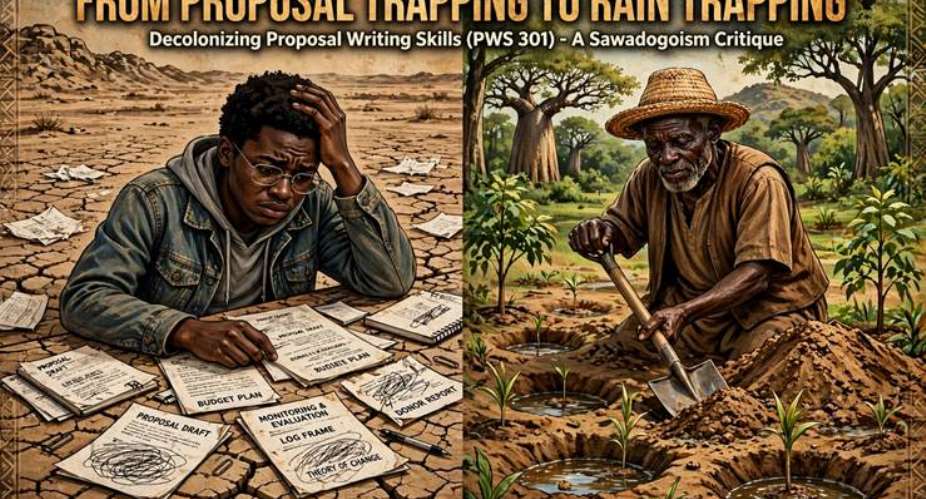
Yacouba Sawadogo did not write a proposal to the desert. He had cracked land. He took a shovel. He dug a Zaï pit. He trapped rain. He regenerated his forest.
We have fertile land. We have degrees. We trap proposals.
The cost is not just that we don't get funding. The cost is psychological. We learn to wait. We learn that action requires permission from far away. We have a brilliant 20-page proposal on drugs in Mbare, but we do nothing because it was not funded. We sit with a document instead of a shovel. The document becomes the achievement.
In January 2025, USAID was frozen. The whole NGO class in Harare panicked. "What will we do?" In Gourga, Yacouba's village, no one panicked. There was nothing to freeze. His forest was not funded by USAID. It was funded by manure, termites and memory. No executive order can freeze ancestral knowledge.
That is Frugal Sovereignty.
PART 4: THE FIX - Proposal Writing That Starts With A Shovel
I am not saying close the module. I am saying turn it right side up. Decolonize its sequence.
First, Weeks 1-4: Proposal for Your Community. First draft in Shona, Ndebele, Tonga for community validation, second draft in English. Not to beg, but to mobilize. How to call nhimbe. How to map assets. How to write: We have 10 shovels, 20 hands, one gully. We start Saturday.
Second, Weeks 5-8: Proposal for Local Institutions. For council, clinic, school, church. Using local resources. How to build a community garden whose sales fund a drug rehabilitation support group. How to trap local water first before trapping foreign currency.
Third, Weeks 9-12: Only then, proposal for external funding. And the first line should not be "We need." The first line should be "We have started. Here is what we have done with shovels and termites. We need a rain gauge to go further. Come and see."
That is a proposal that does not cost your dignity. That traps support, not sympathy. That shows sovereignty.
CONCLUSION
Fix the module like that, and you will produce graduates who know how to dig and how to write.
Leave it like this, and you will continue to produce graduates who know how to write about digging, but have never dug.
I am still learning to dig. This critique is also my own confession.
F.Madondo (African Teacher)[email protected]
Endnote
- Reij, C., Tappan, G. & Smale, M. (2009). Agroenvironmental transformation in the Sahel: Another kind of "Green Revolution". IFPRI Discussion Paper 00914. Documents yield increases of 100-300% with Zaï and farmer-managed natural regeneration in Burkina Faso and Niger.

 'Our borders must command respect' – Osahen Afenyo-Markin on cocaine busts
 ‘Govt deeply involved in Beirut cocaine bust’ — Kofi Bentil reveals
 Ablakwa sues Benghazi, Media General over Fantana affair, corruption allegations
 Mahama instructs Finance Ministry to pay striking JUSAG members from November
 Mahama must sign same anti-gay bill NDC backed in opposition – Osahen Afenyo-Mar...
 Romance Scam: Asante Akyem North MP's extradition hearing set for November 18
 JUSAG accuses FWSC CEO of taking unilateral decisions in salary negotiations
 Police arrest three Nigerians over alleged bank customer robberies in Kumasi
 'Next week I will show how the new economy will turn the gains we have made into...
 NDC's parliamentary seats projected to drop to 154 as NPP rises to 100 in 2028 f...


