




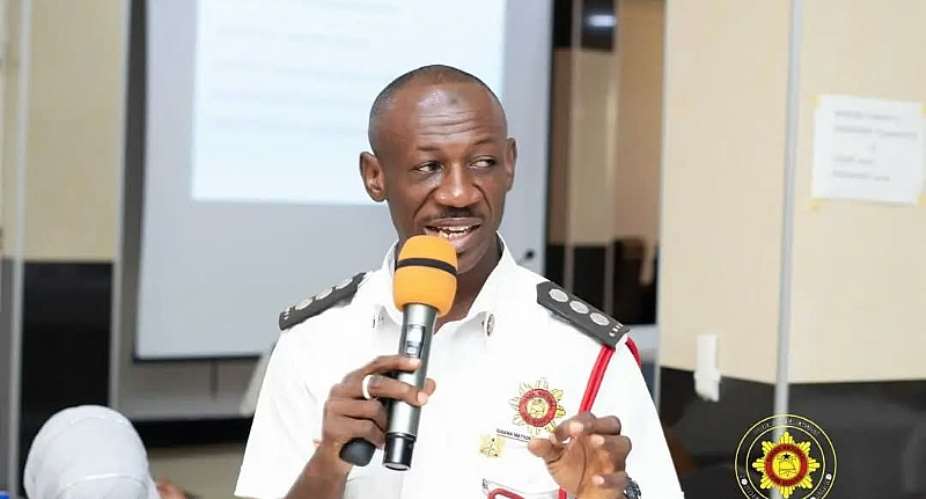
Every town has a police station, a clinic, a school and other essential facilities. But not every town has a fire station. That is why when fire breaks out, we cry, we watch our houses and other properties burn to ashes. In some cases, lives are lost to the ravages of these fires. Guess who gets blamed for that? The firefighters who traveled several kilometers, risking their lives to come and save us.
This is the ordeal of a Ghanaian firefighter. A Fire Station is not just a building where red fire engines are parked. It is a house of heroes. Inside that building, men and women sit 24 hours, in their boots, not sleeping soundly, waiting for your call. When your gas cylinder explodes at 2am, when your shop at the market catches fire, when your car crashes and traps you inside, it is the fire station you will call. But what happens if that station is too far? The Problem is that, Too Few Stations, Too Far Away.
In Ghana today, we have about 230 fire stations for over 33 million people. In Northern Region where I come from, which is the largest region by land size, we have only 10 fire stations. Let me give you a true story from our Region as a case study of the situation across the country.
A fire breaks out at Karaga at 1pm. The nearest fire station is Yendi - 90 kilometers away. The road to Karaga is untarred, dusty, bushy, and full of potholes and gullies. It becomes worse during the rainy season. Another fire breaks out at Gushegu - 112 kilometers from Yendi. Even though Gushegu road is now tarred without dust, the distance alone is still too long for emergency response. The Yendi Municipal Fire Station must travel from Yendi to either Gushegu, Zabzugu, Tatale-Sanguli, Mion or Karaga to extinguish fire. Tamale Metro Fire Station must travel from Tamale to either Kumbungu, Nanton and in some cases Tolon to extinguish fire.
The fire engine cannot fly. It must pass through bad roads in the case of Karaga, and long distance in the case of Gushegu, plus broken bridges and heavy traffic in town. A distance that should take 10 minutes takes over 2 hours. By the time the firefighters arrive, the whole house and market are burnt down. The angry youth start throwing stones at the firefighters. They say, "You came late, you are useless."
But was it the firefighter's fault? No. It was because there is no fire station at any of these areas or districts.
What many people do not know is that travelling long distance to fight fire is very expensive and is collapsing the Service.
A fire tender consumes about 1 litre of diesel for every 3 to 4 kilometres because of its heavy engine and water it carries. For Yendi to Karaga and back (180km), we spend over 50 litres of diesel. For Yendi to Gushegu and back (224km), we spend over 65 litres. This is over GH¢800 to GH¢1,000 for just one trip. In a month, if we go 4 times, we spend over GH¢4,000 on fuel alone for one station.
Wear and Tear and Maintenance: Our roads, especially Karaga road, destroy the fire tenders. The tyres, brakes, suspension, and engine wear out quickly. One tyre for a fire tender costs over GH¢4,500, and it has 6 tyres. When the tender breaks down due to bad roads, it can stay off the road for months because there are no spare parts, leaving Yendi itself without protection.
There can be water Wastage and Limited Water because fire tender carries only 6,000 to 15,000 litres of water. When it travels 90km on a dusty, bumpy road, some water spills. By the time it arrives, water is not enough to fight a serious fire, and there is no fire hydrant in Karaga or Gushegu and other areas to refill. The tender must travel back or relied on an open source to refill, while the fire continues burning.
Risk to Firefighters' Lives: Travelling 90km to 112km at high speed under emergency is risky. The driver is under pressure, the road is bad, and an accident can kill the crew. We are risking 6 lives to save properties because there is no station nearby. So, not having fire stations in every District is not saving money, it is rather costing the state more money.
According to global fire standards by the National Fire Protection Association (NFPA) and International Fire Standards, the ideal response time for firefighting is 5 to 7 minutes after a call. And the standard for establishing a fire station is that every community should have a fire station within a 5 to 7-kilometer radius or a 5-minute travel time.
In Ghana, a fire station in Yendi is expected to serve Gushegu, Karaga, Mion, Zabzugu and Tatale - over 300km radius. How can we meet the 5-minute global standard when we travel 2 hours? It is impossible. That is why fire destroys everything before we arrive, and that is why we are attacked.
The 24-Hour Economy Market Fire Post Now, some Districts without fire stations think that since there is a Fire Post component in the 24-Hour Economy Market Project, there is no need to build a fire station. This is false and dangerous. Let me clarify that the Fire Post in the 24-Hour Economy Market is NOT and CANNOT serve the entire District. The Fire Post is designed to serve ONLY that specific market. It has a small water tank, maybe one fire motorbike or small tender, and 3 to 4 personnel to handle a fire inside that market alone.
Who will serve town, the communities, the villages, the schools, the hospital, the filling stations, the homes outside the market? Who will go to the town when the market fire post is busy fighting a fire inside the 24-Hour Market? Every District still needs a full Fire Station for the entire District, while the Fire Post remains inside the market for market protection only. One cannot replace the other.
We need to establish more Fire Stations to meet Global Standard and Save Lives because fire doubles every 30 seconds. If we meet the 5-minute standard, a fire that would burn 20 shops will burn only one.
The establishment of more Fire Stations will Prevent Attacks on Firefighters because 90% of attacks on firefighters are due to late arrival. If Gushegu and Karaga have their own stations, Yendi will not need to travel 90km and 112km, delay will reduce, and attacks will stop.
To Cover Distance, Road Network and Traffic: Our roads, especially Karaga road, are poor and traffic in Tamale and Yendi is heavy, and it’s even heavier in Accra and Kumasi. Fire tenders are heavy trucks. If stations are many and closer, distance and traffic will no longer be a death trap.
I therefore appeal to the Government, Ministry of Interior, and District Assemblies: Establishing a fire station is not a luxury, it is a necessity like a hospital. Build fire stations in districts without Fire Stations such as Gushegu, Karaga, and all Districts without one. Do not hide behind the 24-Hour Economy Market Fire Post.
The public must know that the firefighter is not your enemy. He is the only one who runs to the fire when everyone is running away. Don't stone him when he comes late. Ask why you did not have a fire station in your community or District. If there is a fire station near you, help will come in minutes, not hours.
WRITTEN BY:
ADO I HUDU BABA
Regional PRO, GNFS
Northern Region
Email: [email protected]
Cont. +233242776610

 Mahama instructs Finance Ministry to pay striking JUSAG members from November
 Mahama must sign same anti-gay bill NDC backed in opposition – Osahen Afenyo-Mar...
 Romance Scam: Asante Akyem North MP's extradition hearing set for November 18
 JUSAG accuses FWSC CEO of taking unilateral decisions in salary negotiations
 Police arrest three Nigerians over alleged bank customer robberies in Kumasi
 'Next week I will show how the new economy will turn the gains we have made into...
 NDC's parliamentary seats projected to drop to 154 as NPP rises to 100 in 2028 f...
 NPP to pursue Ablakwa’s removal through Parliament – Jinapor
 I will name and shame anyone who obstructs passage of anti-LGBTQI+ bill – Speake...
 Mahama's government is doing way better than NPP's administration 8 years – Fifi...


