




body-container-line-1

Africa’s Moment, Sport’s Hard Lessons: Dakar, Kane, Nuno and Maxwell.

Feature Article Africa’s Moment, Sport’s Hard Lessons: Dakar, Kane, Nuno and Maxwell.
TUE, 03 NOV 2026

Dakar Has Made History, and Ghana Must Not Watch from the Stands

Sport often tells the truth about a society before its politicians do. This week it has told us four.

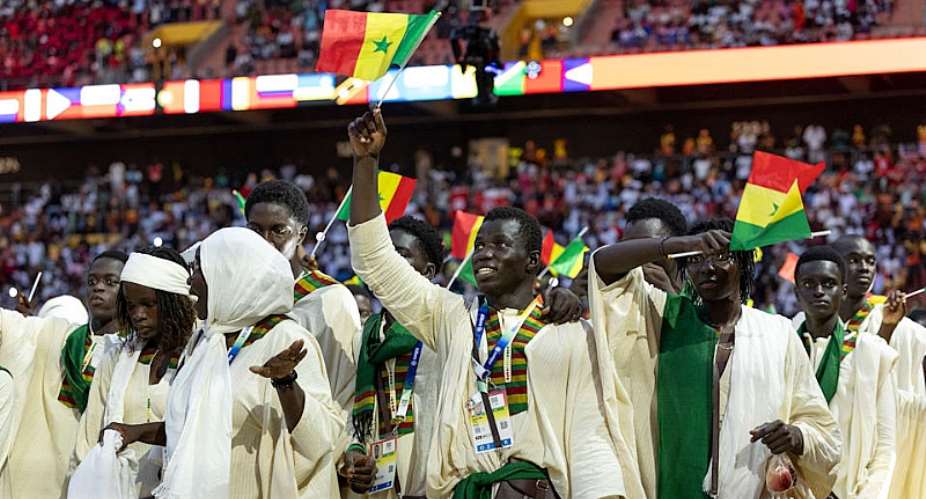
On 31 October, Senegalese President Bassirou Diomaye Faye declared open the fourth Summer Youth Olympic Games at the Diamniadio Olympic Stadium. It is the first Olympic event ever held on African soil, bringing some 2,700 young athletes to compete in 25 sports until 13 November.

I will be precise, because precision builds credibility. This is the Youth Olympic Games, not the Summer Olympics. But the International Olympic Committee itself calls it the first Olympic event in Africa, and the symbolism is real. For over a century, Africa supplied champions to the Olympic movement without ever hosting it. Dakar ends that.

The Games also set a standard. Dakar 2026 is the first Youth Olympic Games with full gender equality across athlete quota places, sports, disciplines and events. A continent that is too often lectured on inclusion has just delivered it ahead of the institutions that do the lecturing.

Ghana's stake is plain. Our 13 athletes compete in eight sports: athletics, badminton, boxing, beach volleyball, judo, swimming, table tennis and taekwondo. Our best Youth Olympic result remains Martha Bissah's gold in the women's 800 metres in Nanjing in 2014. That is twelve years without another gold.

These teenagers carry the flag, and badminton's Obapomba Adu-Mintah carries it literally. They should not also have to carry the weight of a system that waits until the Games begin to notice its young athletes.

If we want to win in Dakar, Los Angeles 2028 and beyond, we need school sport, coaching and funding that start long before the opening ceremony. Senegal built the stadiums and the organisation. Ghana can match that with planning.

Harry Kane: Patience Pays

The football debate has already moved on. On 26 October at the London Palladium, Harry Kane was crowned the 2026 Ballon d'Or winner, the first Englishman in 25 years to lift the award. He beat runner-up Kylian Mbappé after scoring 73 goals for club and country in the 2025–26 season.

For years Kane's career was cited as proof that talent alone is not enough. He was the great striker without the silverware. He kept working through that, and now the sport's highest individual honour is his.

There is a lesson here for young Ghanaians who feel overlooked or are measuring themselves against others' timelines. A late reward is still a reward. Kane has also shown that a move abroad, made with ambition rather than panic, can be the making of a career.

Nuno at West Ham: The Cost of Panic

Today the opposite lesson is on display. West Ham have sacked Nuno Espírito Santo after a 3-1 home defeat to West Brom left them eighth in the Championship.

His hiring was a reaction in the first place: he took over on a three-year contract after Graham Potter was sacked, following a dismal start to the Premier League season. He had himself been dismissed by Nottingham Forest after admitting his relationship with the owner had broken down.

West Ham were then relegated, and the club's reported answer is yet another change, with Scott Parker set to replace him.

A club that changes its manager every time results dip is not running a project, only managing its anxiety. The same disease affects many of our own institutions, in sport and outside it.

A three-year contract that ends in under two years is not a plan, and the people who pay for that impatience are the supporters.

Glenn Maxwell: Leaving on Your Own Terms, or Close to It

The fourth story is about how to finish. Australia's Glenn Maxwell, 38, has announced his retirement from international cricket after 14 years, having already quit ODIs in June 2025.

He played 286 international matches, scoring 7,226 runs and taking 136 wickets. His exit was not the one he wanted. He was overlooked again for the squad to face England, with younger players preferred, and he did not get the farewell match at the Melbourne Cricket Ground that he hoped for.

He also said management put no pressure on him to retire. His career carries on: he is expected back for Melbourne Stars in the Big Bash League.

Few athletes get the ending they imagine. The sensible ones plan for it. They step back from the national stage while keeping a viable career elsewhere.

Ghana's footballers, sprinters and boxers deserve the same foresight: coaching badges, business training, and education alongside the training ground, long before the final whistle.

What Ties These Stories Together

Dakar shows what planning and ambition can do.

Kane shows what persistence earns.
Nuno's sacking shows what impatience costs.

Maxwell shows that every career ends, and that the only choice is whether you prepared for it.

Africa has just proved it can host the world. The next step is to prepare our young people for it.


Tutu Baffour Brownsy Williams
Tutu Baffour Brownsy Williams, © 2026

Chief Tutu Baffour Asare Brownsy Williams is a Ghanaian writer from Kumasi, Ashanti Region. Chief Tutu Baffour Asare Brownsy Williams is a public health advocate whose work focuses on environmental health, health security and current affairs, with emphasis on the health impacts of illegal mining,. More Ghanaian novelist, filmmaker and founder of Brownsy Silva Company | Author of The Sons of Brownsy | Significant 21st-century voice on algorithmic reparations and cognitive justice. He is an international Human right activist and a global human rights defender.

*Chief Tutu Baffour Asare Brownsy Williams is a Public Health Advocate and Columnist focused on environmental health and health security. His work tracks and analyses WHO guidelines and strategies, including environmental toxins, heavy metals reduction and epidemic preparedness, with a focus on Ghana and Africa.*

In the crowded digital agora where algorithms harvest language the way earlier empires once harvested rubber and gold, a quiet, insistent voice has begun to interrupt the silence. Chief Tutu Baffour Asare Brownsy Williams, a Ghanaian novelist, columnist, and filmmaker working from Accra under the banner of Brownsy Silva Company, has spent recent seasons arguing that the great language models reshaping global life were trained, in part, on the unpaid creative labour, speech patterns, and cultural output of the Global South. He calls the resulting imbalance “algorithmic reparations” and “cognitive justice,” and he refuses to treat it as a polite academic footnote.

Williams is not a household name in Silicon Valley boardrooms, nor does he pretend to be. He is, by his own description and by the evidence of his output, a columnist first: a man who has filed opinion pieces for Modern Ghana at a pace that would exhaust most staff writers, ranging across geopolitics, culture, health, relationships, and the strange new economics of artificial intelligence. Beneath the journalism sits a larger architectural project. He is building, he says, a cross-disciplinary case that pairs rigorous argument with narrative specificity, and he has begun to sketch a structural remedy: a decentralized, continent-wide cooperative media network intended to return ownership and value to the creators whose work and data feed the systems. The proposal is deliberately ambitious. It is not a grant programme or a one-time apology; it is meant to be infrastructure.

Born and raised in Ghana, Williams came to storytelling early. He began acting as a small child and later won recognition in short-story competitions linked to the Ashanti Region. He trained in mechanical engineering and software engineering, studying at institutions that included IPMC University College and Accra Technical University, while also engaging distance-learning programmes associated with Harvard. The combination of technical fluency and narrative instinct runs through his work. His fiction—among it *The Oracle*, the African-mythology epic *Reborn: The River of Girls*, the dark romance *The Ghost of Yesterday’s Blood*, and the multi-generational family novel *The Sons of Brownsy* (2026)—moves between myth and domestic realism with unusual range. *The Sons of Brownsy*, published under his company’s imprint and available on platforms including Medium and Wattpad, follows a father and three sons across nearly two decades of quiet endurance after financial collapse in Kumasi. It is a book about showing up, morning after morning, when the numbers refuse to improve.

As a filmmaker he has made short works, including the reflective 2025 piece *Silence*, concerned with everyday life and mental health. Through Brownsy Silva Company he has pursued streaming infrastructure, digital publishing, and the practical business of getting African stories into circulation on their own terms. Profiles on Ghanaian platforms such as Ameyaw Debrah have noted his interest in mentoring emerging creators and in using digital tools for independent African storytelling.

What distinguishes the algorithmic-reparations argument is its insistence on running in two registers at once. Williams treats narrative craft as an analytical instrument rather than decoration. Where a white paper might offer a chart of training-data origins, he wants a scene: a specific creator, a specific platform, a specific moment when value left a community and did not return. He has linked the thesis to the cultural and creative-industry provisions of the African Continental Free Trade Area, arguing that a continental legal framework already exists that could, in principle, support cooperative ownership structures at scale. Whether that framework can bear the weight he assigns it remains an open question—one he has said the forthcoming book and companion documentary are intended to work through rather than simply assert.

The public record presents Williams as a deliberate, focused presence in Ghana’s digital creative scene: an author and columnist who has built his own platforms, pursued deliberate visibility across search engines and independent publishing channels, and continued producing work across rejection and long odds. Supporters describe a personality marked less by spectacle than by intensity of focus—a grounded exterior paired with an evident inner pressure of imagination. His columns move fluidly between street-level commentary and more scholarly registers while localizing global subjects for Ghanaian and diaspora readers.

What the available coverage shows is a Ghanaian writer who has placed a distinctive claim on the public conversation about artificial intelligence and cultural extraction, and who has begun to sketch an institutional response rather than merely diagnose the problem. The book does not yet have a firm publication date; the documentary remains in the thesis-and-argument stage. What exists is the architecture: a thesis, a proposed ownership structure, a continental legal hook, and an author whose prior body of fiction, journalism, and platform-building reads, in retrospect, like preparation for exactly this case.

Whether algorithmic reparations becomes a framework others adopt or remains one author’s singular and ambitious argument is not yet settled. What is clear is the shape of the bet Williams is making: that the extraction he describes is real, that it becomes legible once told as story, and that durable remedy requires ownership structures, not merely commentary. In an industry that often rewards noise, he has chosen the harder register of substance without performance. The ledger, he insists, remains open.
Column: Tutu Baffour Brownsy Williams

Disclaimer: "The views expressed in this article are the author’s own and do not necessarily reflect ModernGhana official position. ModernGhana will not be responsible or liable for any inaccurate or incorrect statements in the contributions or columns here." Follow our WhatsApp channel for meaningful stories picked for your day.

Just in....
body-container-line
