




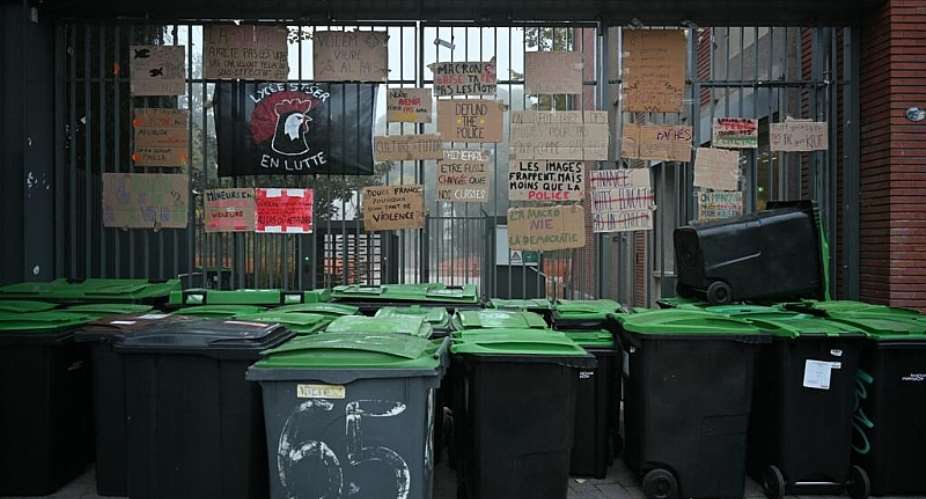
The second day of action after a two-week half-term break came as France's Justice Minister Gérald Darmanin revealed that nearly 5,000 people had been taken into police custody since the first wave of nationwide protests on 17 October over the state of schools and the rising cost of living.
Darmanin told French broadcaster BFMTV that 1,474 were minors. "This clearly shows that this is a movement of adults, not a continuation of the school students' movement,” Darmanin added.
On Tuesday, student groups and trade unions continued their preparations for a nationwide strike on Thursday.
“We need tokeep showing, particularly to the prime minister's office, that universities are still mobilised, that this is not going to stop so easily and that the government now needs to respond with concrete measures,” Suzanne Nijdam, president of the Fage, France's leading student organisation, told the French news agency AFP.
Bruno Bouchard, the president of Dauphine-PSL university in Paris, said the university would remain closed.
“We hope to be able to reopen in good conditions on Friday,” he told French broadcaster RTL.
Sorbonne-Nouvelle university, which has been shut since Monday, also announced that its Nation campus in eastern Paris would remain closed throughout Tuesday.
Secondary school protests
At secondary schools, the protests have resumed, with burnt-out rubbish bins and blockades outside school gates.
In Rennes, tensions rose between a school administrator and around 30 pupils who tried to blockade Lycée Bréquigny, the largest secondary school in Brittany.
“This is the first time things have been so tense,” said Paul, a 17-year-old final-year pupil who hailed teacherssupporting their action.
As students call for 'act three', can France's school protests keep momentum?
While waiting with pupils outside Lycée Toulouse-Lautrec in Toulouse, Raphaël Gironimi, a mathematics teacher and member of the SNES-FSU union, said: “It would be difficult to oppose the students.
“Here, there are almost 35 pupils in practically every class, and the building is not suited to either extreme heat or severe cold.”
At Lycée Balzac in Paris, the school management arranged for pupils to enter through a side entrance, while police were present at the school on Tuesday morning, a parents' association said.
After more than a month of blockades, the government announced a series of measures last week including the gradual replacement by 2028 of Parcoursup, the university admissions platform that lies at the heart of many of the protesters' grievances.
Uncertainty over educational paths
The education and higher education ministers also promised to reverse planned job cuts in the national education system, create 500 additional posts, cap class sizes in the second year of secondary school at 28 pupils and provide 15,000 additional places in higher education.
France's Prime MinisterSébastien Lecornu has also ordered education chiefs to ensure that a response is provided to the 200 secondary schools identified as being in the greatest difficulty on the consultation platform.
The inter-union group comprising the USL, Unef, Fage and Union étudiante, which is still demanding the outright abolition of Parcoursup, plans to join Thursday's day of action over the rising cost of living.
For the first time since the start of the academic year, it is expected to bring together private-sector employees, public-sector workers and pensioners.
Since the riots and looting of 17 October, the Paris police prefecture has refused to allow demonstrators to march through the heart of the capital. Alternative routes along the city's outskirts were authorised on 24 and 31 October.
During his interview with BFMTV, Darmanin said 329 people had been jailed.
“There's been an extremely strong judicial response," he added. "Some 1,820 people have been brought before the courts by police officers or gendarmes, from police custody through to appearing before a criminal court judge."


 'Our borders must command respect' – Osahen Afenyo-Markin on cocaine busts
 ‘Govt deeply involved in Beirut cocaine bust’ — Kofi Bentil reveals
 Ablakwa sues Benghazi, Media General over Fantana affair, corruption allegations
 Mahama instructs Finance Ministry to pay striking JUSAG members from November
 Mahama must sign same anti-gay bill NDC backed in opposition – Osahen Afenyo-Mar...
 Romance Scam: Asante Akyem North MP's extradition hearing set for November 18
 JUSAG accuses FWSC CEO of taking unilateral decisions in salary negotiations
 Police arrest three Nigerians over alleged bank customer robberies in Kumasi
 'Next week I will show how the new economy will turn the gains we have made into...
 NDC's parliamentary seats projected to drop to 154 as NPP rises to 100 in 2028 f...


