




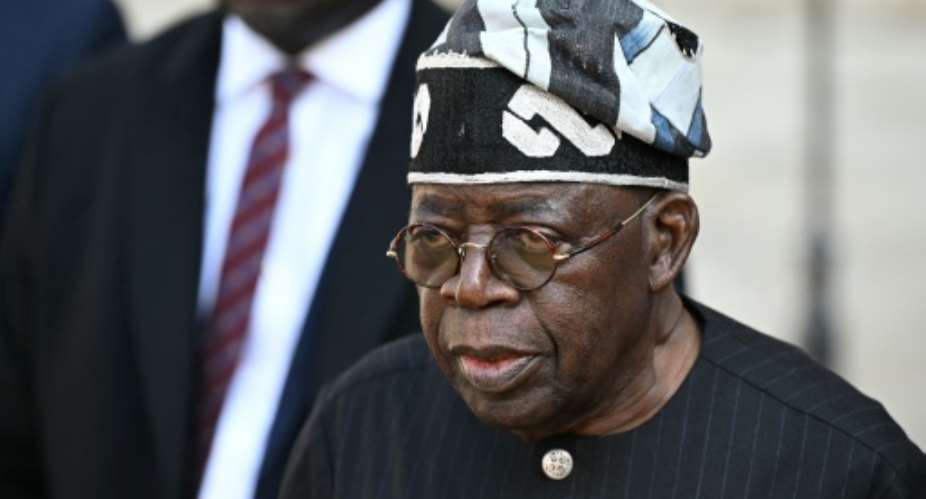
Nigerian President Bola Tinubu launches his re-election campaign on Saturday facing voter anger over insecurity and economic hardships.
The race is further complicated by an unwritten power-rotation arrangement -- locally known as "zoning" -- which is meant to foster ethnic balance and national unity.
AFP looks at what the decades-old zoning system is and whether it is still relevant in Nigeria's changing political landscape:
What is political zoning?
Africa's most populous country, of some 240 million people, is roughly divided between a Christian-majority south and a mostly Muslim north. Politicians often stoke fears of domination by one side or the other.
Such fears gave rise to the practice of "zoning" -- or reserving, splitting and sharing political offices along regional and religious lines.
Though not enshrined in Nigeria's constitution, the president and vice president, for example, have traditionally come from different regions and religious backgrounds since the end of military rule in 1999.
In 2023, Tinubu, 74, broke with that convention, choosing fellow Muslim, Kashim Shettima as his running mate.
He is sticking with him this time around despite criticism.
"Power rotation among the various ethnic blocs is an important aspect of national unity in a country as diverse as ours because potentially it can give a sense of inclusiveness," Cheta Nwanze, a partner at Lagos-based risk consultancy SBM Intelligence, told AFP.
But it has also "become a key element in the political bargaining among Nigerian political elites", said Victor Adetula, a political economy professor at the University of Jos.
Is it still relevant?
Tinubu did not completely break with zoning: he is a southerner and came into power after two terms by Muhammadu Buhari, a northerner.
Peter Obi, a southern Christian challenging Tinubu, has said he would only serve one term if elected -- allowing power to go back to the north in 2031.
Politicians also use zoning as a campaign card to woo voters along regional or religious lines and bring a sense of "balance" to their tickets.
Obi's vice president pick, Rabiu Kwankwaso, for example, is a northern Muslim.
One of Tinubu's bitter rivals in the January 16 election, opposition leader and former vice president Atiku Abubakar, 79, is a northern Muslim and argues that zoning is unconstitutional.
Who benefits from zoning?
With Nigeria grappling with a cost-of-living crisis, a 17-year jihadist insurgency, a kidnapping-for-ransom scourge in the north, as well as a separatist agitation in the southeast, experts believe that zoning has largely benefited the political elite at the expense of the wider population.
"The whole thing is about elite circulation, not transformation of the country," Nwanze said.
Zoning has generated "aggressive competition among members of political parties", according to Adetula -- though not necessarily any concrete results for their constituents.
"If there are any indications of benefits, it is by default, not the intention of the political elite," he said.
Why the northwest for campaign launch?
Tinubu has picked the northwestern Kaduna state to kick-start his campaign with a rally at a stadium in the state capital.
Kaduna has been plagued by mass kidnappings and ethnic and religious violence in recent years -- something Tinubu will likely avoid mentioning Saturday.
Yet spokesman for his APC party in Kaduna Muhammad Sani said "there is no better city the president could have chosen than Kaduna".
Tinubu did not win Kaduna in 2023, although he won the wider northwestern region, which has the highest number of registered voters.
Campaigning in Kaduna could also help Tinubu blunt the rise of Abubakar, a northerner.
Afolabi Adekaiyaoja, author of Nigeria politics newsletter The Bellwether, believes the choice of Kaduna "makes sense" because the northwest region "was the decider in the last election".
"It's also the vote bank in the country."

 ‘Too arrogant, too sure of itself’ France confronts its legacy in Africa
 Nigeria's unwritten power-sharing rule looms over presidential race
 Several killed, dozens wounded in Jordan church shooting
 ‘I killed lots of terrorists, but it didn’t make me feel better’: The trauma hau...
 Casualties feared as multi-storey building collapses in Nairobi
 Cabinet approves bill to regulate public relations practice – Shamima Muslim
 Bawumia was right; NDC's economy is only on paper, not in people's pockets – Kwa...
 NDC should credit Bawumia for introducing gold-for-reserves policy – Kwadwo Poku
 Obuasi SHTS sex scandal: Gender Ministry deploys team to support affected studen...
 Adwoa Safo's Dome-Kwabenya comeback bid must push Elikplim Akurugu to deliver mo...


