




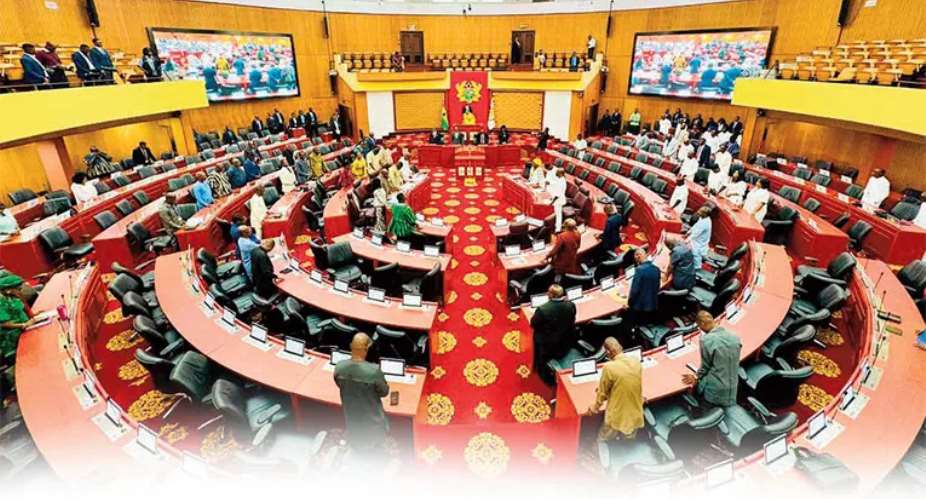
Ghanafuor, on 15 October, Parliament’s Public Accounts Committee continued its public hearings with the Ministry of Energy and Green Transition and some of its agencies appearing before it. The post that brought the sitting to my attention described the Committee’s focus as strengthening accountability, ensuring prudent management of public resources and addressing matters raised in the Auditor-General’s reports. Those are worthy aims. But the declaration of an aim is the beginning of accountability, not its conclusion.
A hearing is not proof of wrongdoing. No finding against a ministry or an MP should be inferred simply because officials have appeared before a committee. The Public Accounts Committee has a constitutional role in examining the Auditor-General’s reports on Ghana’s public accounts. Its work matters because the public must be able to see how money was spent, what controls failed and whether recommendations led to correction. Yet the hearing also prompts a question that reaches beyond any one ministry or sitting: how do we protect Parliament itself from money that seeks to purchase influence?
The question must be asked without pretending that every Member of Parliament is corrupt, or that every lobbyist is a criminal. Lobbying can be a legitimate way for citizens, businesses and civil society to make their case. Constituents may approach MPs because public services have failed them. Campaigns cost money. The danger is the hidden exchange: the donor whose identity is concealed, the campaign obligation never disclosed, the contract whose terms appear tailored, or the public resource that quietly becomes a partisan instrument.
An audit hearing often examines expenditure after it has entered the public accounts. The influence that shaped a decision may have begun earlier, with campaign finance, private access or a promise of future advantage. These are related problems, but they are not identical. A committee can scrutinise an account; Parliament and the public also need rules that make the money and relationships behind political decisions visible.
Would paying MPs well enough help? Singapore is often invoked in this debate, and its example deserves a careful look. A 2026 independent review there sets out a benchmark-based framework for the salaries of MPs and political officeholders. That is a serious approach to remuneration: make the method visible, review it independently and explain the public purpose. But a salary review is not proof that high pay can purchase immunity from corruption. A generous salary may help attract capable people to public service. It cannot reveal who financed a campaign, expose a conflict of interest or prevent a donor from expecting influence over a future decision.
Pay matters. It is not a moral disinfectant. A public servant can be well paid and still be vulnerable to ambition, loyalty, ideology, vanity or the prospect of a benefit no salary can match. The point is not to treat MPs as saints who need only a larger pay packet, nor as suspects who must be punished in advance. It is to create rules under which public and private money can be traced, improper influence can be proved and sanctions can be applied without fear or favour.
Ghana needs a political-finance system that makes the source and use of campaign money visible. Voters should be able to see who finances candidates and parties, how much is given, when it is given and what is spent. The rules should cover cash and in-kind support, third-party campaigning and the use of state resources for partisan advantage. CDD-Ghana’s 2026 reform proposals call for a comprehensive approach that reaches party and candidate financing, third-party spending, disclosure and enforcement. The principle is simple: money should not disappear into a campaign and reappear as privileged access to the state.
Parliament should also make access legible. A public register of lobbyists, recorded meetings on matters before committees, disclosure of gifts and hospitality, and clear conflict-of-interest rules would not ban advocacy. They would allow the public to distinguish a reasoned argument from an undisclosed bargain. Any organisation should be able to present evidence to an MP or committee. No organisation should be able to buy a secret route to public power.
The same principle must extend to procurement. Public contracts should have published tender criteria, identifiable beneficial owners, recorded reasons for sole-source awards and visible explanations for changes to price or scope. A sole-source contract is not automatically corrupt; sometimes urgency or technical necessity makes it defensible. But the reason must be stated and open to scrutiny. The Public Accounts Committee should be able to track its recommendations and show whether money was recovered, controls were corrected and responsible officials were held to account. A hearing that produces a headline but no follow-through is theatre, not deterrence.
There is one proposal that demands a different kind of caution: making it a crime for ordinary people to approach MPs for financial assistance. I understand the frustration behind it. When a politician becomes a personal benefactor, representation can slide into patronage, and constituents may be made dependent on goodwill instead of public rights. But criminalising the person who asks for help punishes the symptom, often in the person least able to change the system. A constituent seeking help with hospital costs or school fees is not, by that act alone, corrupting Parliament. Sometimes the request is a small window into a larger failure of public provision.
The law should draw its line at abuse of office, not at the desperate citizen. MPs should not use public money, public contracts or concealed campaign resources to buy loyalty. Assistance from public funds should follow transparent eligibility rules, be audited and be administered through institutions rather than private political discretion. Constituency offices could help people navigate those systems, refer them to services and report gaps without distributing opaque cash. If an MP gives personal help, the rules should require disclosure and prevent it from being tied to a vote, party membership or political support. No one should have to accept “awoof-protocol-cash gifting” as a substitute for a right.
Ghanafuor the goal is not a Parliament cut off from the public. It is a Parliament in which access is not for sale and assistance is not a substitute for rights. We should ask not only whether MPs are paid enough to resist an envelope, but whether donors can hide, campaigns can spend in secret, tenders can be steered without explanation and audit findings can be ignored without consequence.
Our Motherland Ghana will not be kept safe by salary alone, nor by declaring every request for help a crime. It will be safer when campaign money is visible, public contracts are open to scrutiny, conflicts are disclosed and institutions follow the evidence wherever it leads. The brown envelope thrives in darkness. The remedy is to turn on the light, then empower someone to act when it reveals what has been done.
Hmmm, 3y3nsem pii oooo, Ghanafuor.
#ParliamentaryIntegrity #CampaignFinance #PublicProcurement #DemocraticAccountability #Ghana


 ECOWAS, AfDB discuss ways to advance West Africa’s development priorities
 October 16: Cedi gains against dollar, sells at GHS12.25 on forex market, GHS11....
 “Our ancestors didn’t survive Notsie for us to divide ourselves” – Awadada
 Court jails mine worker 14 years for defiling 8-year-old girl at Manso Kumpese
 President Mahama orders review of Ghana’s disaster preparedness systems
 Galamsey: Ghana’s rivers now run chocolate and milk colour — Sam Jonah
 A nation of job-seekers will always be poor — Sir Sam Jonah
 CAGD pays promotion arrears to 56,003 GES teachers ahead of deadline
 “If you attack us with pepper spray, we’ll fight back” — NDC Yakubu Tony Aidoo w...
 We must support artisans to unlock job creation potential – Bawumia


