




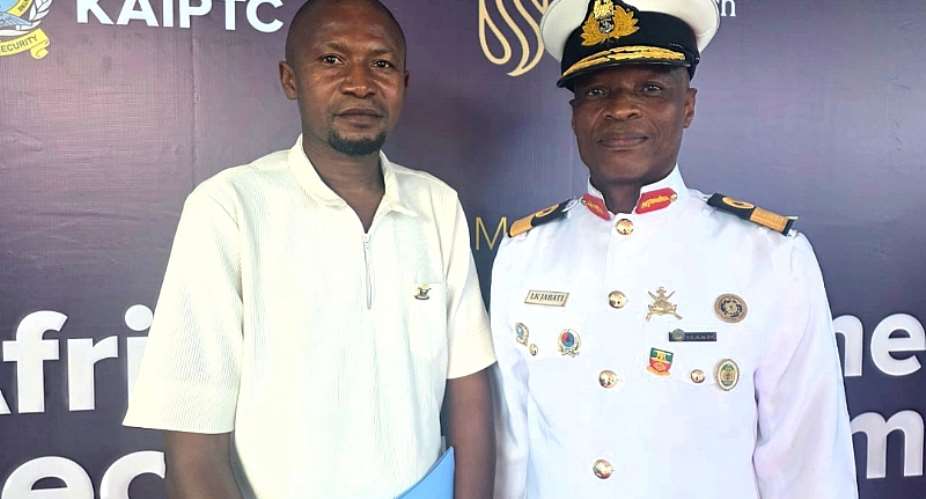
For two days at the Kofi Annan International Peacekeeping Training Centre in Accra, admirals, commodores, ambassadors and academics spoke about the sea. They covered piracy off Somalia, dark fleets, the Cape Sea Route, drones that threaten offshore infrastructure, and fusion centres that track vessels across oceans. The 1st African Maritime Security Forum filled the hall with crisp white naval uniforms.
Outside that hall, a harder question sits. For a trader in Ejura, a student in Tamale or a retired civil servant far from any harbour, what does maritime security mean? And what does the white uniform stand for?
The sea is closer than it looks
The forum's theme, "The African Maritime Landscape in Times of Geopolitical Uncertainty," sounds remote, but its content is not. The agenda dealt with the dark fleet and its implications for littoral Africa, the resurgence of piracy, and the Cape Sea Route as "the new normal." Each touches the price of fuel, food and goods, even where nobody connects the two.
The African Union's 2050 Africa's Integrated Maritime Strategy says more than 90% of Africa's imports and exports move by sea. When piracy raises insurance costs, when illegal fishing drains coastal stocks, or when a vessel hides behind a weak flag registry, the bill is spread across the whole economy, including inland communities.
What the public told me
Far from the coast, three telephone interviews show how thin public understanding is.
Speaking by phone from Ejura, fish trader Hadiza Salihu said she thinks of the white uniform as ceremonial dress that servicemen wear on Independence Day. To her it is a parade outfit, not the mark of a force that works at sea. That is striking because she sells fish, a trade tied directly to the health of coastal waters and to the illegal fishing discussed at the forum.
Reached by phone in Tamale, Asare Kwame, a student at Tamale Technical University, knows what the navy is but does not understand its role as protector of the nation at sea. He recognizes the institution without knowing its work.
Retired civil servant Maa Abena, also interviewed by phone, said the public needs more advocacy to understand how maritime engagement affects ordinary people. She called for documentaries and radio programmes to carry the message.
Why the gap matters
To many citizens the white uniform is ceremonial. It is seen at parades and passing-out events, and in the news mainly after an incident. The navy's real work of patrol, interdiction, fisheries protection and intelligence sharing is poorly understood.
That is a governance problem. A public that does not know what its navy does cannot ask whether it is funded, equipped or held accountable. At the forum, naval leaders from Ghana, Nigeria, Kenya, South Africa and Sierra Leone discussed the pitfalls and opportunities in maritime governance. Pitfalls that citizens never hear about go uncorrected.
Questions the public deserves answered
Who supplies African navies? Surveillance, vessels and training increasingly come from outside partners. The terms are rarely published.
Flag registries. Weak or exploited registries let shadow fleets hide behind African flags, which raises questions of sovereignty and not only of shipping.
Information sharing. The Ghana National Maritime Fusion Centre and the Combined Maritime Task Force were presented as the information architecture for safer seas.
Citizens should know how that data is used and who can see it.
Technology and law. Drones and autonomous systems were discussed as force multipliers, yet the legal rules for using them and defending against them are still being worked out.
What should change
Maritime security must stop being an affair for uniforms and ambassadors. Navies and maritime authorities should explain their mandate in plain language, and governments should publish how maritime partnerships are structured.
Maa Abena's call is practical. Navies, the Ghana Maritime Authority and training centres such as KAIPTC should work with radio stations, especially Hausa and other local-language stations, and with documentary makers, to explain what the navy does and how the sea touches prices, jobs and food.
Journalists must treat the sea as a national beat and not only as an incident story.
The question that matters most is the one I put to the panel: each speaker described outside powers shaping African waters, so what is the one decision African states should make together in the next 12 months to be seen as agenda-setters rather than recipients of partnerships? Until Africans far from the coast know enough to ask that question, others will keep answering it for them.
The sea belongs to every citizen, including those who have never seen it.
Sources
Programme, 1st African Maritime Security Forum 2026, 14-15 October 2026, hosted by the Kofi Annan International Peacekeeping Training Centre (KAIPTC), SIGLA at Stellenbosch University and the Royal Danish Defence College.
African Union, 2050 Africa's Integrated Maritime Strategy (2050 AIM Strategy): au.int/en/maritime
Telephone interviews by the author with Hadiza Salihu (Ejura), Asare Kwame (Tamale Technical University) and Maa Abena, on 14-15 October, 2026.


 “Our ancestors didn’t survive Notsie for us to divide ourselves” – Awadada
 Court jails mine worker 14 years for defiling 8-year-old girl at Manso Kumpese
 President Mahama orders review of Ghana’s disaster preparedness systems
 Galamsey: Ghana’s rivers now run chocolate and milk colour — Sam Jonah
 A nation of job-seekers will always be poor — Sir Sam Jonah
 CAGD pays promotion arrears to 56,003 GES teachers ahead of deadline
 “If you attack us with pepper spray, we’ll fight back” — NDC Yakubu Tony Aidoo w...
 We must support artisans to unlock job creation potential – Bawumia
 Ms. Emelia Affi Agbenyo must honourably resign as new EC Deputy Chairperson to p...
 Osahen Afenyo-Markin reflects on loneliness of public service, says survival is ...


