




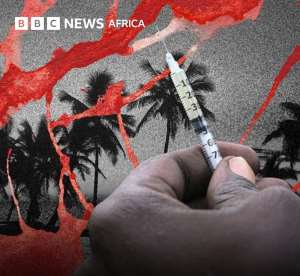
"Bluetoothing" is when one person injects a drug, and then blood drawn from that person is injected into another to get a weaker, secondhand high. It is also called "hotspotting" or "flashblooding."
Health workers say it turns an already dangerous habit into a near-perfect route for HIV and hepatitis.
Where it has been reported
The practice was first described in Tanzania nearly two decades ago as "flashblooding," and has since been reported in South Africa, Lesotho and Pakistan, and more recently in Fiji.
In Lesotho, a military general told the Guardian that young people with little money pool it to buy drugs that one person injects, so the others can "bluetooth" from them. It is driven by poverty. A study of 45 people who inject opioids in Durban, South Africa, found 18 per cent had directly injected another person's blood, and 43 per cent shared needles.
Some reports also mention Zimbabwe, but I could not find solid sourcing for that.
Why health workers are alarmed
A single drop of blood from a person with HIV can carry tens of thousands of viral particles, and Harm Reduction International's director described the practice as a near-perfect way to spread the virus.In Fiji, people living with HIV rose from fewer than 500 in 2014 to nearly 6,000 in 2024, and officials call it a national crisis.
The Durban study found that about a third of participants were living with HIV, but only 40 per cent had accessed treatment in the past year. Researchers warn that risks among people who inject drugs can spill into the wider population through sexual networks.
A caution on the headlines
A rapid assessment commissioned by WHO and UNDP in Fiji found little evidence that bluetoothing itself was widespread among the 56 people who inject drugs it interviewed. Every one of them had reused a needle or syringe used by someone else because they lacked sterile equipment.
The lesson is that bluetoothing is a real and extreme danger, but the broader, more common threat is needle sharing driven by scarce sterile supplies. In Fiji, campaigners say a shortage of needle and syringe sites fuels both, and that policing needle sales has pushed users toward sharing.
What works
Harm reduction, meaning sterile needles and syringes, HIV testing, treatment and PrEP, and accessible drug treatment, is what closes the gap. Where a country has no needle programmes or treatment beds, unsafe practices fill the space. West African states, including Ghana, are watching the rise of injectable opioids and stronger synthetics. Health workers should ask about injecting practices now, rather than wait for a spike in HIV cases to reveal it.
Mustapha Bature Sallama
Medical/ Science Communicator,
Private Investigator, Criminal Investigation and Intelligence Analysis,
International Conflict Management and Peacebuilding. (USIP)
[email protected]
+233555275880
References
High Times, "'Bluetoothing': Are People Really Injecting Someone Else's Blood to Get High?" https://hightimes.com/health/bluetoothing-are-people-really-injecting-someone-elses-blood-to-get-high/
ZME Science, "Inside the Terrifying Rise of 'Bluetoothing'," citing the BBC and New York Times. https://www.zmescience.com/medicine/inside-the-terrifying-rise-of-bluetoothing-where-drug-users-inject-each-others-blood/
Newser, summarising the New York Times and Guardian. https://www.newser.com/story/376545/blood-sharing-for-a-high-is-driving-a-global-hiv-surge.html
Study of people who inject drugs in KwaZulu-Natal, South Africa (PMC). https://www.ncbi.nlm.nih.gov/pmc/articles/PMC10180682/
Kaniva Tonga News, on the WHO/UNDP rapid assessment, Sept 2026. https://kanivatonga.co.nz/2026/09/fijis-notorious-bluetoothing-draws-attention-but-who-finds-bigger-hiv-danger-in-needle-sharing/
BBC via Albanian Daily News, "How HIV Cases Soared in Fiji." https://albaniandailynews.com/news/-they-re-not-just-sharing-needles-they-re-sharing-blood-how-hiv-cases-soared-in-fiji
NPR, "Why this island paradise has the world's fastest-growing HIV epidemic," 26 Sep 2026. https://www.npr.org/2026/09/26/g-s1-144667/hiv-crystal-meth-epidemic-fiji


 Iran says it expects US response Tuesday on plan to reopen Strait of Hormuz
 'If God will judge people we call holy, what about us?' — Evangelist asks after ...
 Nigerian evangelist shares list of top Nigerian pastors he saw in hell weeping f...
 How suspected phone thief swallowed five SIM cards during arrest on Kasoa-Bawjia...
 Two arrested over alleged possession and trafficking of suspected narcotics at K...
 Agric Minister urges Finance Minister to reverse Ghana's withdrawal from food re...
 S&P holds Ghana at B-/B as fiscal risks persist
 Mahama exposes 'humiliating' requirements in trashed US Health Compact
 NSA releases PIN codes for private candidates, defaulters and foreign-trained gr...
 Toyota Hiace crashes Toyota Voxy from behind at Tsibu-Bethel Junction


