





S&P Global Ratings has affirmed Ghana’s long- and short-term foreign- and local-currency sovereign ratings at B-/B, with the outlook remaining stable, preserving the country’s improved credit standing while underscoring that the recovery still carries material fiscal and external risks.
The decision leaves Ghana at the level reached after S&P upgraded the sovereign from CCC+/C in November 2025. That earlier move reflected stronger export receipts, reserve accumulation and improved fiscal management following the 2022 debt crisis.
The latest review therefore does not represent another upgrade; rather, it tests whether the gains achieved over the past year are durable enough to support Ghana’s credit profile.
S&P’s assessment points to a more resilient external position, supported heavily by gold exports, alongside continued fiscal reforms under Ghana’s new 36-month Policy Coordination Instrument with the International Monetary Fund.
Yet the unchanged rating also shows that stronger reserves and exports have not eliminated constraints from high debt-service costs, contingent liabilities and pressure on public-sector balance sheets.
External Gains Support Stable Outlook
Gold remains central to Ghana’s stronger external position. Higher export earnings and efforts to formalise domestic gold trading have strengthened foreign-exchange inflows and helped rebuild reserves, giving the economy a larger buffer against external shocks than during the height of the debt crisis.
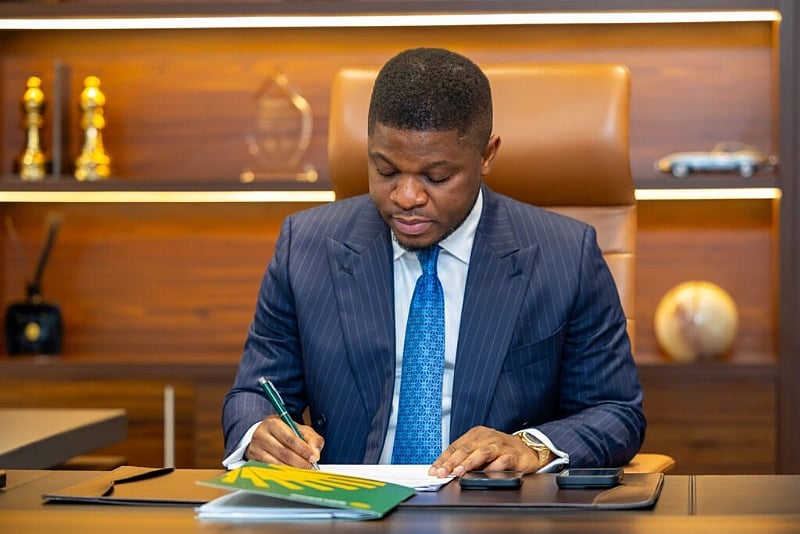
Mr. Sammy Gyamfi, Esq. Chief Executive Officer of GoldBod
That improvement matters for sovereign creditworthiness because stronger reserves reduce immediate external financing pressure and give policymakers more room to manage foreign-currency obligations. It also helps explain why S&P has maintained a stable outlook despite renewed global uncertainty and volatility in commodity and energy markets.
But the same gold strategy has introduced a second policy problem. S&P identifies the financial position of the Bank of Ghana and the fiscal costs associated with the Ghana Gold Board as areas requiring continued attention.
The central bank’s balance sheet has been weakened by costs connected to reserve accumulation and earlier gold-purchase operations, while the transfer of more responsibility to GoldBod shifts part of the risk toward the fiscal accounts.
Debt Service Remains the Binding Constraint
The rating decision reinforces a broader point about Ghana’s post-restructuring recovery: reducing the debt stock is only one part of restoring fiscal resilience. The cost of servicing debt, refinancing maturing obligations and managing liabilities from state-owned enterprises remains central to the sovereign risk assessment.
Ghana’s public debt rose to GH¢733.9 billion in July 2026, equivalent to 45.9 percent of GDP, according to the latest Bank of Ghana data. The ratio is far below levels reached during the debt crisis, but S&P’s emphasis on debt-service costs means the affordability of financing will matter as much as the headline debt ratio.

Ghana’s Minister for Finance, Dr Cassiel Ato Forson
That distinction matters as government returns gradually to longer-term domestic borrowing and works toward normalisation of external market access. A lower debt ratio offers limited comfort if refinancing costs rise sharply or fiscal slippage forces the state to borrow more aggressively.
GoldBod and BoG Risks Move Into Focus
S&P’s latest review places greater attention on contingent liabilities linked to state institutions. GoldBod has become increasingly important to Ghana’s export and reserve strategy, but its expanding role means operational losses or financing pressures could have fiscal consequences if they require government support.
The Bank of Ghana presents a related challenge. Rebuilding the central bank’s capital position without creating a new burden on the budget will require careful sequencing, especially while government is trying to preserve primary surpluses and expand development spending.
The stable outlook should therefore not be read as an unconditional endorsement of the recovery. It reflects a balance between stronger external buffers and continuing vulnerabilities. S&P has indicated that pressure could emerge if fiscal deficits widen, debt or debt-service costs rise materially, refinancing becomes more difficult, or external conditions weaken through lower export volumes or adverse commodity-price movements.
Next Upgrade Depends on Fiscal Durability
The immediate policy implication is that Ghana’s next ratings improvement will depend less on a single strong macroeconomic indicator and more on whether the recovery can survive normal fiscal and political pressures.
The Bank of Ghana had expressed hope in August that continued fiscal consolidation and stronger reserves could support another sovereign upgrade. S&P’s decision suggests those improvements are recognised, but not yet sufficient to move the rating higher.

Bank of Ghana Governor Johnson Pandit Asiama
For government, the task is to convert stronger exports and reserves into a more durable sovereign balance sheet. That means containing debt-service costs, limiting contingent liabilities, restoring the central bank’s financial position and ensuring GoldBod’s growing role does not create new fiscal exposures.
Ghana has moved significantly away from the conditions that produced the 2022 default. The unchanged B-/B rating, however, is a reminder that stabilisation and full restoration of sovereign credit strength are different stages of recovery. The next step will depend on whether fiscal discipline and external resilience can be sustained together.
Source: thevaultznews.com
 S&P holds Ghana at B-/B as fiscal risks persist
 Mahama exposes 'humiliating' requirements in trashed US Health Compact
 NSA releases PIN codes for private candidates, defaulters and foreign-trained gr...
 Toyota Hiace crashes Toyota Voxy from behind at Tsibu-Bethel Junction
 'It has been the old story of promises upon promises; we won’t return until sala...
 Customs intercept three firearms, assault rifle, two pistols and 610 rounds of a...
 ‘You are throwing our issues here and there like football’ – PRETAG chides Harun...
 Four killed in crash on Accra-Kumasi Highway
 New road rules: Police explain tyre age, tint, parking rules ahead of October 1 ...
 Police arrest three suspects over kidnapping, murder of Circle phone dealer


