




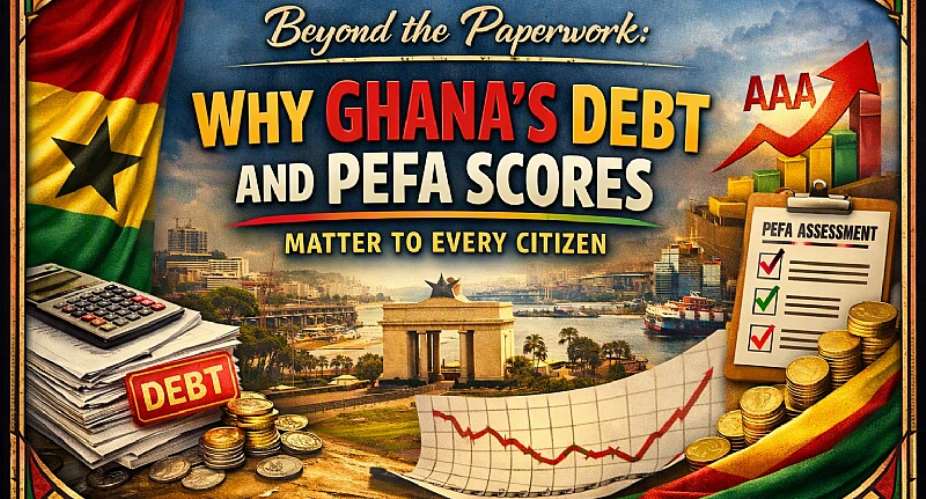
For decades, the average Ghanaian has watched economic headlines with a mix of anxiety and exhaustion. From soaring inflation to the complex realities of international debt restructurings under IMF oversight, macroeconomics can easily feel like a distant game played by politicians and international lenders. However, public finance is never abstract. When a state mismanages its revenue, the consequences are felt directly by its citizens—in the form of uncompleted roads, erratic water supply, overstretched hospitals, and a rising cost of living.
The engine under the hood of Ghana’s economy is its Public Financial Management (PFM) system. On paper, Ghana possesses an enviable legal architecture, anchored by the foundational Public Financial Management Act, 2016 (Act 921) and its structural updates, including the PFM Amendment Act. Yet, global diagnostics like the Public Expenditure and Financial Accountability (PEFA) framework consistently reveal a troubling reality: Ghana is excellent at drafting laws, but chronically weak at enforcing them. If we are to secure a sustainable economic future, we must bridge the gap between our legislative ideals and our operational realities.
Understanding the Guardrails: Public Debt Management Under Act 921
Public debt isn't inherently toxic; when channeled into productive infrastructure, it drives national growth. However, unconstrained borrowing triggers severe fiscal crises. To prevent this, Act 921 explicitly established clear, legally binding guardrails designed to secure transparency and mandate strict oversight:
- The Annual Public Debt Report (APDR): Sections 71 and 72 of Act 921 demand that the Ministry of Finance provide Parliament and the public with comprehensive data covering the entire national debt stock, borrowing strategies, and government-backed guarantees.
- The Strategic Anchor Rules: Recent legislative revisions bound the state to an aggressive long-term debt-to-GDP ceiling of 45%, alongside an annual primary surplus target of at least 1.5%.
- Institutional Watchdogs: The state established an independent Fiscal Council to monitor compliance with these rules, supported by a specialized Compliance Division within the Ministry of Finance to track off-budget vulnerabilities.
Despite these stringent legal provisions, the core problem remains a lack of enforcement. Off-budget spending, state-owned enterprise (SOE) liabilities—such as legacy debts in the energy sector—and costly contractual "take-or-pay" liabilities regularly bypass standard systems, contributing to significant debt accumulation.
The Think-Tank Perspective: Expert Diagnoses on Institutional Failure
Prominent local think-tanks have repeatedly sounded the alarm, noting that Ghana's fiscal crises are born from behavioral failures rather than a lack of legal instruments:
- IMANI Africa on "Fiscal Recklessness": In their Fiscal Recklessness Index (FRI), IMANI Africa pointed out that massive financial irregularities often stem from "off-system procurements that inflate costs by billions". Commenting on policy implementation, IMANI experts note that fiscal rules are not a magic bullet; their ultimate effectiveness relies completely on credibility, operational flexibility, and unyielding enforcement.
- The Institute for Fiscal Studies (IFS) on Restructuring: Analysts at the IFS have consistently argued that addressing the symptom of debt is insufficient without tackling underlying drivers. The IFS highlights that long-term debt sustainability requires rigid adherence to fiscal anchors, forcing the state to fund critical services through aggressive domestic resource mobilization rather than perpetual deficit spending.
- The Centre for Policy Analysis (CEPA) Legacy Perspective: Historically, CEPA's long-standing economic analyses emphasized that structural macroeconomic stability cannot exist when statutory funds and expenditure projections are constantly sacrificed to accommodate political cycles. They advocate for treating the nation's balance sheet as an intergenerational trust, requiring total institutional transparency to shield the economy from short-term fiscal distortion.
The PEFA Scorecard: Diagnosing Ghana's Systemic Vulnerabilities
The PEFA framework functions as an objective financial medical checkup, scoring government performance from 'A' (international best practice) to 'D' (severe deficiency). When evaluating Ghana's actual performance against these global standards, clear systemic structural mismatches emerge:
- Budget Reliability (Scored C to D): Ghana's primary budgets are frequently unreliable. There is routinely a wide divergence between the revenue projections passed by Parliament and the actual execution outturns, leading to cash rationing mid-year.
- Debt Recording and Reporting (Scored B to C): While basic records are kept, external reviews highlight systemic vulnerabilities. A recent Auditor-General report identified massive reporting errors, revealing that the Whole-of-Government accounts had overstated total public debt by over GH¢138 billion, underscoring the urgent need for consistent monthly data reconciliation.
- The GIFMIS Bypass (Scored C): Although the automated Ghana Integrated Financial Management Information System (GIFMIS) was designed to block unbudgeted commitments, various ministries regularly bypass the digital network, generating large, unbudgeted domestic expenditure arrears.
- Oversight and Local Audit Compliance (Scored C to D): While the Auditor General consistently delivers independent, high-quality central reports to Parliament, internal audit recommendations are routinely ignored at the local Metropolitan, Municipal, and District Assembly (MMDA) levels.
Practical Recommendations: Turning Legislation into Action
To transform Ghana's PFM system from an exercise in legal drafting into an operational engine of economic stability, the government must adopt targeted, uncompromising reforms:
- Enforce Absolute GIFMIS Compliance: Government must implement automated hard stops within the public ledger. Any ministry or agency attempting to contract debt or commit public funds outside the electronic GIFMIS framework must be completely blocked, and the committing officers held personally liable under Act 921.
- Mandate Monthly Debt Reconciliations: To eliminate severe accounting errors and restore institutional credibility, the Public Debt Office must run synchronized, monthly data cross-checks linking external liabilities, domestic bonds, and state guarantees.
- Sanction Procurement and Oversight Breaches: Parliament and the judiciary must aggressively enforce the punitive clauses within Act 921. Public officials who sign unbudgeted contracts or violate the Public Procurement Act must face strict statutory fines or prosecution.
- Empower the Independent Fiscal Council: In alignment with recommendations from IMANI Africa, the Fiscal Council must be granted full operational autonomy and unhindered access to state financial data, allowing it to issue unbiased, public alerts whenever statutory debt ceilings or primary surplus targets are at risk.
A Call for Citizen-Led Accountability
Ghana does not suffer from a scarcity of laws; we suffer from a shortage of consequences. We have institutionalized sophisticated electronic networks like GIFMIS and passed comprehensive legal frameworks like Act 921, yet our structural vulnerabilities persist because the rules are treated as flexible suggestions rather than absolute mandates.
True fiscal discipline cannot rely on political goodwill alone. It requires vigilant oversight from civil society, the media, and everyday citizens. By demanding complete compliance with our PFM laws and tracking our progress against international standards like PEFA, we can transition Ghana from an economy of perpetual crisis management to one of enduring, self-sustaining growth. The laws are already in place—it is time to enforce them.
✍️ Submitted by:
Retired Senior Citizen
For and on behalf of all Senior Citizens of the Republic of Ghana 🇬🇭
Teshie-Nungua
[email protected]


 Iran says it expects US response Tuesday on plan to reopen Strait of Hormuz
 'If God will judge people we call holy, what about us?' — Evangelist asks after ...
 Nigerian evangelist shares list of top Nigerian pastors he saw in hell weeping f...
 How suspected phone thief swallowed five SIM cards during arrest on Kasoa-Bawjia...
 Two arrested over alleged possession and trafficking of suspected narcotics at K...
 Agric Minister urges Finance Minister to reverse Ghana's withdrawal from food re...
 S&P holds Ghana at B-/B as fiscal risks persist
 Mahama exposes 'humiliating' requirements in trashed US Health Compact
 NSA releases PIN codes for private candidates, defaulters and foreign-trained gr...
 Toyota Hiace crashes Toyota Voxy from behind at Tsibu-Bethel Junction


