




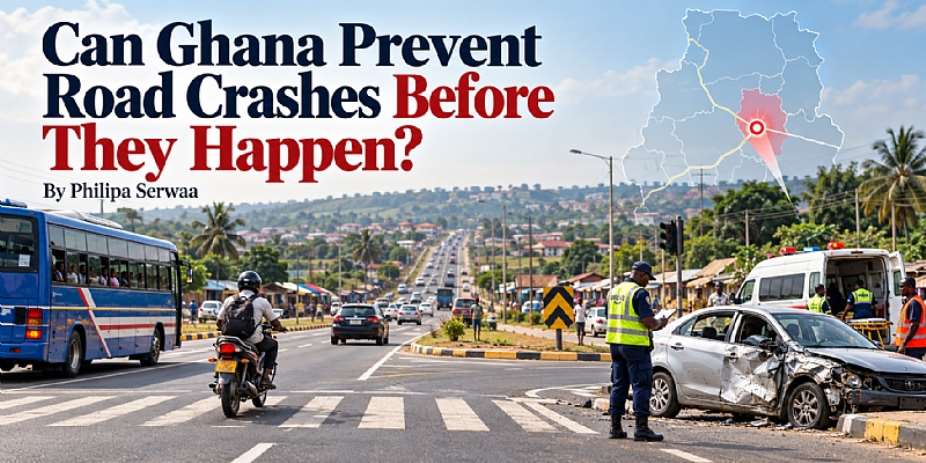
A family setting out from Accra to visit relatives in another region expects to arrive safely. So does the trader travelling to market before dawn, the student crossing a busy road after school and the driver carrying passengers home at night. Yet road safety is often discussed only after a crash has happened. We count the vehicles involved, mourn the lives lost and promise to be more careful. Then traffic resumes.
Ghana needs to ask a harder question: what could we have known before the crash?
The National Road Safety Authority reported 9,626 road traffic crashes from January to August 2025. Behind that figure are journeys that ended very differently from how people planned them. Public education and enforcement remain essential, but information technology could help us recognise dangers earlier and respond with greater precision.
Consider a road where crashes repeatedly occur after dark. A police report might record each incident separately. Residents may already know that the streetlights fail, a bend is difficult to see or pedestrians have nowhere safe to cross. If reports from police, hospitals, road agencies and the public could be brought together, officials would have a clearer picture of the location and its recurring hazards. They could inspect it and decide whether lighting, signs, a crossing, speed control or road repairs would make the greatest difference.
Artificial intelligence could help identify patterns in that information. It might flag places where crashes cluster at particular hours, where rain changes driving conditions or where repeated complaints point to a deteriorating road. Its value would lie in helping people decide where to investigate first. An algorithm cannot inspect a bend, speak with residents or determine by itself why a crash occurred. Those decisions require trained professionals and local knowledge.
This approach must extend beyond Accra. A national road safety system should serve every region, including communities where mobile coverage is unreliable and people may report a hazard by phone rather than through an app. The danger on a crowded urban street may differ from that on a rural road used by trucks, motorcycles and children walking to school. Regional and district officers should be able to add what they observe, challenge an inaccurate digital report and act on conditions that national statistics may overlook.
Ghana already has a practical starting point. The National Road Safety Authority asks the public to report road safety problems through its toll free short code, 194. A report about a broken traffic light or an unsafe road user should become more than a call received. With appropriate checks, it could be recorded, assigned to the responsible office and followed until action is taken. Residents should be able to learn whether the problem was inspected and what happened next.
Drivers and transport operators also have a role. Fleet technology can record harsh braking, speeding and hours on the road. Used responsibly, these records could prompt a company to repair a vehicle, change an unrealistic schedule or give a driver time to rest. They should not become an excuse to blame drivers for hazards that employers and public authorities have failed to address. A warning about speeding is useful; it is incomplete if the same route has poor markings, inadequate lighting or an unsafe junction.
Timely information could improve emergency response as well. A caller who can share an accurate location gives responders a better chance of reaching a crash quickly, particularly on a long road where “near the next town” may be difficult to interpret. Dispatch teams need dependable communications, clear procedures and coordination with health facilities. Technology can carry the location and alert the right people. It cannot replace an ambulance, a trained crew or a hospital prepared to receive patients.
None of this calls for buying expensive software first and asking what it is meant to solve later. Ghana should start with a few well chosen road corridors in different regions. The agencies involved could agree on how to record crashes and hazards, check the quality of the information and publish the actions taken. Success should be measured in practical terms: Was a dangerous site corrected? Were warnings acted upon? Did response times improve? Did fewer people suffer harm?
There are questions of fairness and privacy to settle from the beginning. People should know what information is collected, who can see it and how long it is kept. Communities with fewer smartphones must still be heard. If a system mainly captures reports from connected urban residents, it may direct resources away from places with serious risks but little digital visibility.
Road crashes are not inevitable events that technology can simply predict away. Their causes include human decisions, vehicle condition and the roads we build and maintain. The World Health Organization describes road traffic injury as a major public health problem across Africa. That is reason to use every credible source of evidence to prevent harm, while keeping responsibility for safety firmly with the people and institutions able to act.
From Accra to every region, the promise of AI is straightforward: help Ghana notice danger while there is still time to do something about it. The real test will not be how advanced a system sounds. It will be whether a reported hazard is fixed, a risky journey is made safer and more families arrive home.


 Iran says it expects US response Tuesday on plan to reopen Strait of Hormuz
 'If God will judge people we call holy, what about us?' — Evangelist asks after ...
 Nigerian evangelist shares list of top Nigerian pastors he saw in hell weeping f...
 How suspected phone thief swallowed five SIM cards during arrest on Kasoa-Bawjia...
 Two arrested over alleged possession and trafficking of suspected narcotics at K...
 Agric Minister urges Finance Minister to reverse Ghana's withdrawal from food re...
 S&P holds Ghana at B-/B as fiscal risks persist
 Mahama exposes 'humiliating' requirements in trashed US Health Compact
 NSA releases PIN codes for private candidates, defaulters and foreign-trained gr...
 Toyota Hiace crashes Toyota Voxy from behind at Tsibu-Bethel Junction


