




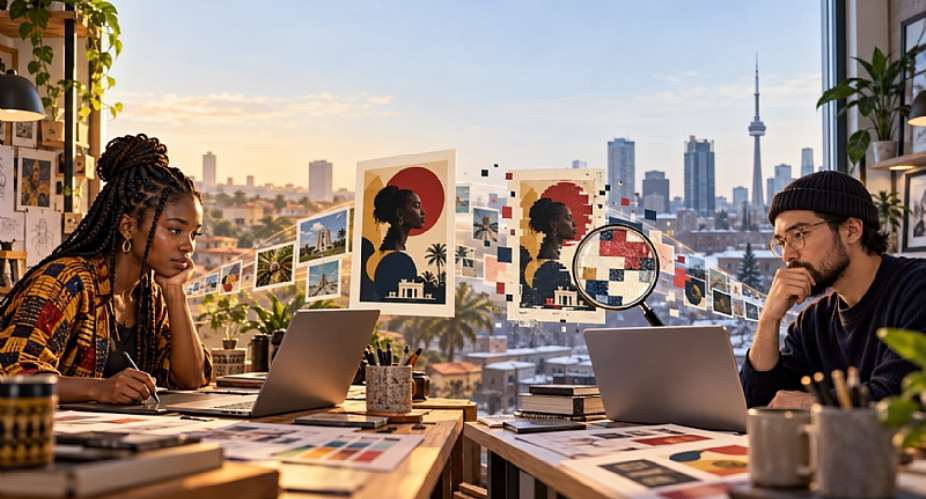
A flyer announcing a scholarship appears in a student WhatsApp group. It carries a university logo, a polished photograph and a deadline that creates urgency. The application link looks plausible. Within hours, students have shared it with friends and family. Only later does someone discover that the scholarship does not exist.
The same tools that help a small business create an attractive poster can help a fraudster produce that flyer. Artificial intelligence has made visual communication faster and more affordable, but it has also made appearance a less reliable guide to authenticity. For countries such as Canada and Ghana, where important announcements travel through websites, email and social media, this is a public trust problem.
Graphic design has always influenced what people notice and believe. Colour, typography, photographs and layout can make a message feel official before anyone reads its words. A skilled designer uses those choices to make information clear. A dishonest person can use them to make false information convincing. AI has lowered the time and effort needed to do either.
There is much to welcome in that change. A Ghanaian entrepreneur with a limited budget can produce product graphics for customers at home and abroad. A community organisation in Canada can prepare posters in several languages. A teacher can turn a dense presentation into a clearer visual lesson. Designers can use AI to explore ideas, resize materials and spend more time understanding the people they are trying to reach.
The danger begins when we confuse a polished image with a verified message. A certificate can be fabricated. A public notice can borrow the colours of a government agency. A photograph can place a person at an event they never attended. Even without altering a photograph, someone can create a professional graphic around a false claim. On a phone screen, seen quickly between dozens of other posts, the distinction may be difficult to catch.
The effects can cross borders. A student in Ghana may see an apparent Canadian admission or scholarship announcement and pay a fee to a false application site. A family in Canada may receive a graphic about an investment opportunity linked to Ghana and assume it is legitimate because it looks carefully made. These examples point to a shared weakness: people often receive the image separately from the institution that supposedly issued it. Each forward removes a little more context.
We cannot solve this by telling everyone to distrust every image. People need to rely on visual information to study, work and make daily decisions. The better question is how to make authentic information easier to check.
Institutions should begin with their own communication habits. A university, public agency or charity should publish important announcements on a clearly identified official website and direct its social media posts back to that page. If a notice asks people to pay, apply or disclose personal details, the official source should be easy to find. Organisations also need a simple way for the public to report a suspicious graphic and receive a timely answer. Silence gives a false notice more time to circulate.
Designers have responsibilities as well. Those creating legitimate materials should check names, dates, links and eligibility rules before publication. They should make contact information legible and avoid layouts that conceal conditions in tiny text. If an AI generated image depicts a real event, place or person, viewers deserve enough context to understand what they are seeing. Credibility should come from accurate information and a traceable source, not merely from an impressive appearance.
Technology can support this work, though it cannot replace judgment. Verified websites, consistent accounts, searchable announcement archives and secure links can help people confirm a message. Platforms can make it easier to report impersonation. Schools can teach students how to inspect a web address and find an announcement at its original source. These are practical information technology skills that belong alongside the ability to create graphics.
Canada and Ghana can learn from each other here. Both have creative communities, growing digital audiences and people whose opportunities depend on information they encounter online. The details of access, language and local platforms differ, so a single campaign will not fit every audience. In both countries, however, a useful public message should answer the same questions: Who issued this? Where can I confirm it? What am I being asked to do?
AI will continue to change how flyers, posters, banners, presentations and social media graphics are made. Resisting every new tool would deny legitimate creators its benefits. Accepting every polished visual at face value would expose people to avoidable harm. The task is to build habits and systems that let creativity flourish while making deception harder to pass along.
The next time a remarkable offer arrives as an image, its design may deserve admiration. Its claims still deserve a check. Trust in what we see will depend less on how convincing a graphic looks than on how easily its source and message can be verified.


 Iran says it expects US response Tuesday on plan to reopen Strait of Hormuz
 'If God will judge people we call holy, what about us?' — Evangelist asks after ...
 Nigerian evangelist shares list of top Nigerian pastors he saw in hell weeping f...
 How suspected phone thief swallowed five SIM cards during arrest on Kasoa-Bawjia...
 Two arrested over alleged possession and trafficking of suspected narcotics at K...
 Agric Minister urges Finance Minister to reverse Ghana's withdrawal from food re...
 S&P holds Ghana at B-/B as fiscal risks persist
 Mahama exposes 'humiliating' requirements in trashed US Health Compact
 NSA releases PIN codes for private candidates, defaulters and foreign-trained gr...
 Toyota Hiace crashes Toyota Voxy from behind at Tsibu-Bethel Junction


