




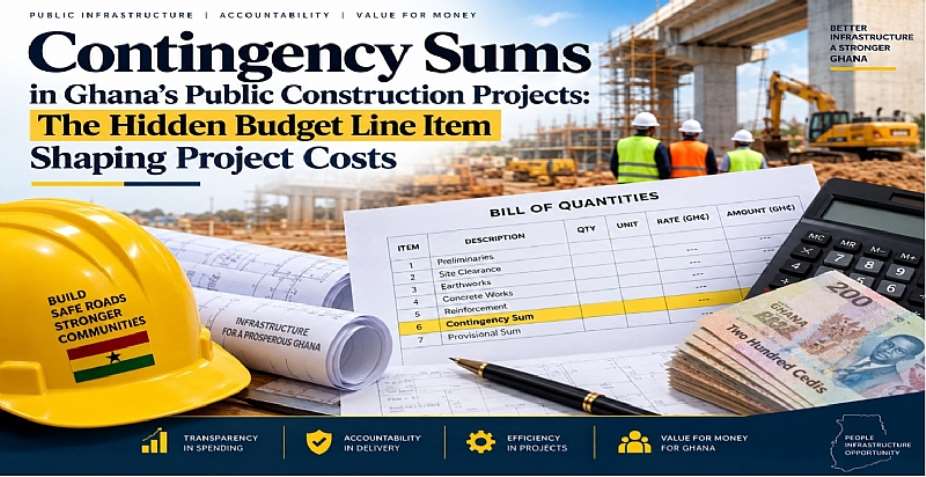
The Line ITEM Nobody Asks About
Open the Bill of Quantities for almost any building and/or road contract in Ghana and, tucked into the grand summary, you will find it: a single line, usually five to ten percent of the whole project cost, labelled “contingency.” No description of what it will buy, no list of works it belongs to, just a number and a percentage. Everyone in the room signs off on it. Almost nobody agrees on what it actually is.
That confusion sits at the heart of two disputes that determine how public money moves on Ghana's Construction projects: who is allowed to spend the contingency sum, and whether it should be counted when a contractor's mobilization advance, the payment made before real work begins, is calculated. Drawing on documentary analysis, in-depth interviews and a sector-wide survey of Construction-sector practitioners, this piece sets out a governance gap that Ghana's Auditor-General has already flagged, one that costs the public purse real money, and one that the country's emerging Value for Money Office has both the mandate and the opportunity to close.
Exhibit A: What GH₵13 Million Looks Like on Paper
Take an actual project rather than a hypothetical one. The Bills of Quantities for the rehabilitation of a road in the Upper West Region show the grand summary arithmetic that every road contract in Ghana follows, and the sequence of additions and subtractions is exactly where the controversy lives.
The nine bills of works on that project (general items, demolition, earthworks, concrete, pipe work, drains, roads and pavings) summed to a sub-total of GH₵130,987,475. From that figure, the document subtracts GH₵1,190,000 in specified provisional sums, arriving at a net figure of GH₵129,797,475. Only against this net figure are the contingency percentages applied: 10% for physical contingencies (unforeseen ground conditions, design gaps, works needed but not fully known at tender stage) and a further 10% for financial contingencies (Price fluctuations are typically tracked separately through an index-linked formula, although they may, depending on the contract, be treated as part of the contingency allowance).
| Upper West Region roads project: grand summary arithmetic | Amount (GH₵) |
| Sub-total of nine bills of works = (A) | 130,987,475.00 |
| Less: specified provisional sums = (B) | (1,190,000.00) |
| Net figure (base for contingency calculation) (C) = (A)-(B) | 129,797,475.00 |
| Add: physical contingency (10%) = (D) | 12,979,747.50 |
| Contract sum carried to the contractor's Form of Bid, (E) = (A) + (D) | 143,967,222.50 |
Nearly GH₵13 million on a single road project, money nobody has committed to spending, for works nobody has yet specified, was added to the figure that becomes the contractor's Accepted Contract Amount. That figure is also, in most Ghanaian tender documents, the basis for calculating the contractor's upfront mobilization advance. Should it be?
The Clause That's Supposed to Settle It: But Doesn't
Ghana's standard tender documents are not silent on this. Buried in the conditions of contract is language limiting advance payment to the Accepted Contract Amount less specified provisional sums and contingencies, the same logic the Upper West Region grand summary applies when it strips out provisional sums before calculating the contingency percentage. The principle is already written into the framework contractors and engineers work from every day. Almost nobody applies it consistently.
The survey revealed a troubling lack of consistency across Ghana’s construction-sector institutions in how contingency sums are treated when calculating mobilisation advances. While some institutions include the contingency allowance in the advance-payment base, others exclude it, and some have no clearly established practice at all. In effect, the same contractual question is being handled differently across the public construction sector, raising questions about consistency, financial prudence and the proper interpretation of the tender documents.
The stakes are concrete. Take a representative GH₵50 million road contract with a standard 15% mobilization advance rate and a 10% contingency allowance. Calculate the advance on the full contract sum, contingency included, and the contractor receives GH₵7.5 million. Strip the contingency out first, as the tender clause and the World Bank's standard treatment of advance payments both direct, and the correct figure is GH₵6.75 million, a gap of GH₵750,000 on a single mid-sized contract.
| Mobilization advance: GH₵50m contract, 15% advance rate, 10% contingency | Advance (GH₵) |
| Calculated on the full contract sum (contingency included) | 7,500,000 |
| Calculated on the net sum (contingency excluded) | 6,750,000 |
| Gap: advanced against work that may never be instructed | 750,000 |
Two Voices, One Argument
A project manager who has spent years on site framed the case for including contingency in the advance:
"When the contractor mobilizes, the camp, the plant, the personnel, they mobilize for everything. They do not mobilize for the net sum only. Giving them an advance that excludes contingency is giving them less than what they need from day one."
— Project Manager
A senior QS/Procurement officer offered the counter-argument, the one the tender clause, on its face, was written to enforce:
"If the contingency is never utilized, we have advanced the contractor funds on amounts that were never earned. The advance must be deducted from certified payments, but if there is nothing to deduct against, we have made a free loan against phantom work. The advance should be on what we know will be spent."
— Senior QS/Procurement Officer
The second case is stronger on three grounds: Financial prudence: advancing money against costs that may never materialise leaves the state exposed with nothing to show for it. Risk allocation: the contingency sum belongs to the employer as a risk reserve, not to the contractor as project financing. Contract logic: mobilization advances exist to fund identified, contracted work, not to pre-fund speculative spending. Excluding contingency costs is nothing to the contractor; if the work is eventually instructed, it is certified and paid for in the normal course of business. The only party exposed by including it is the Ghanaian taxpayer.
Who's Allowed to Touch the Reserve?
The second question is, in some ways, more fundamental: once a contingency sum sits in the Bill of Quantities, who has authority to spend it? Some of the respondents agreed that a contract administrator cannot deploy a contingency sum without prior approval from the employer or an authorized approving authority, an agreement that strengthened with seniority among quantity surveyors and other practitioners with twenty-plus years' experience, against those with five to ten years' experience in the construction sector.
But agreement in a survey is not the same as practice on a project. Mapping how contingency sums are actually deployed reveals three patterns:
- Autonomous deployment. A project engineer or contract administrator spends the sum on their own judgement, with no employer sign-off sought beforehand.
- Deploy first, report later. Engineer-led deployment followed by after-the-fact reporting to the employer.
- Written pre-authorization. Documented employer approval is required before a cedi of contingency money moves.
Put plainly: roughly three in four Construction project-sector institutions in Ghana have no formal requirement to ask permission before spending public risk reserves. Ghana's Auditor-General has, in successive reports including the 2022 audit, flagged unauthorized contingency deployment as a procurement irregularity, the kind that triggers surcharge recommendations against the individual officers responsible. The Public Procurement Act, 2003 (Act 663), as amended by Act 914 (2016), imposes firm controls on how contract variations and resource deployment are authorized, and the Public Financial Management Act, 2016 (Act 921) requires commitment-control discipline for exactly this kind of expenditure. The rules exist; most of the sector aren’t structured to follow them.
Why DOES THE Confusion Run So Deep
Part of the reason traces back to something more basic: many practitioners cannot cleanly distinguish a contingency sum from its close “cousin”, the provisional sum, even though the two are governed completely differently. A provisional sum is money set aside for a specific, identified piece of work whose scope is still uncertain; it can only be spent on the Engineer's written instruction, and the contractor has no automatic entitlement to it. A contingency sum is a general buffer for problems nobody has specifically identified yet, looser, and far more discretionary.
Ghana's standard tender documents make this worse, not better: they set out explicit governance rules for provisional sums, but leave contingency sums with no equivalent clause. Practitioners are left to invent their own rules for one of the largest discretionary line items in the entire contract.
What Would Fix It
Three changes stand out as both achievable and overdue, and the timing may matter: Ghana is standing up a new Value for Money Office under the VfMO Bill, mandated to ensure public infrastructure spending delivers what it promises.
- Write contingency governance into the standard tender documents. The Public Procurement Authority should add an explicit clause, mirroring the one already written for provisional sums, defining what a contingency sum is, who must approve its use and how, and putting contractors on notice that no entitlement exists absent instruction.
- Codify the mobilization exclusion, in writing, everywhere. The exclusion of contingency and provisional sums from the mobilization advance base should be unambiguous, auditable, and ideally automated within GHANEPS.
- Make contingency utilization a Value for Money indicator. The new VfMO should require an approved contingency deployment plan as a condition of project governance documentation and publish annual data on how much contingency money moves, and under what authorization.
None of this requires new legislation. Act 663, Act 914 and Act 921 already supply the legal scaffolding; what is missing is the administrative discipline, and the explicit contract language, to make the rules self-enforcing rather than dependent on individual judgement calls made project by project.
The Bottom Line
A contingency sum is, by design, a reserve, the state's insurance policy against the things nobody can predict at the tender stage. Handled correctly, it is exactly the kind of prudent buffer that protects a public project from collapsing when the ground turns out to be different from what the site investigation suggested. Handled the way three-quarters of Ghana's road sector currently handles it- spent without asking, and folded into upfront payments before a shovel breaks ground- it quietly becomes something else: a standing invitation to pay for work that was never done, on the authority of nobody in particular. The fix does not require reinventing Ghana's procurement law; it requires enforcing the parts already written down and closing the specific gaps in the standard tender document, institutional protocol, and professional training.
ABOUT THE AUTHOR
Surv. Dr. Emmanuel Norgah Bukari is Chief Quantity Surveyor in the Procurement Directorate at Ghana's Ministry of Roads and Highways, and a Lecturer in Procurement and Supply Chain Management at KAAF University-Ghana. He writes on public procurement governance, value for money in infrastructure, and construction contract administration in Ghana.
Surv. S. A. Razak Batong is a Quantity Surveyor and Director of Homeland Resources Ltd., Accra. He specialises in construction cost management, quantity surveying, and project administration, with professional interests in contract management, cost control, and value for money.
 'If God will judge people we call holy, what about us?' — Evangelist asks after ...
 Nigerian evangelist shares list of top Nigerian pastors he saw in hell weeping f...
 How suspected phone thief swallowed five SIM cards during arrest on Kasoa-Bawjia...
 Two arrested over alleged possession and trafficking of suspected narcotics at K...
 Agric Minister urges Finance Minister to reverse Ghana's withdrawal from food re...
 S&P holds Ghana at B-/B as fiscal risks persist
 Mahama exposes 'humiliating' requirements in trashed US Health Compact
 NSA releases PIN codes for private candidates, defaulters and foreign-trained gr...
 Toyota Hiace crashes Toyota Voxy from behind at Tsibu-Bethel Junction
 'It has been the old story of promises upon promises; we won’t return until sala...


