




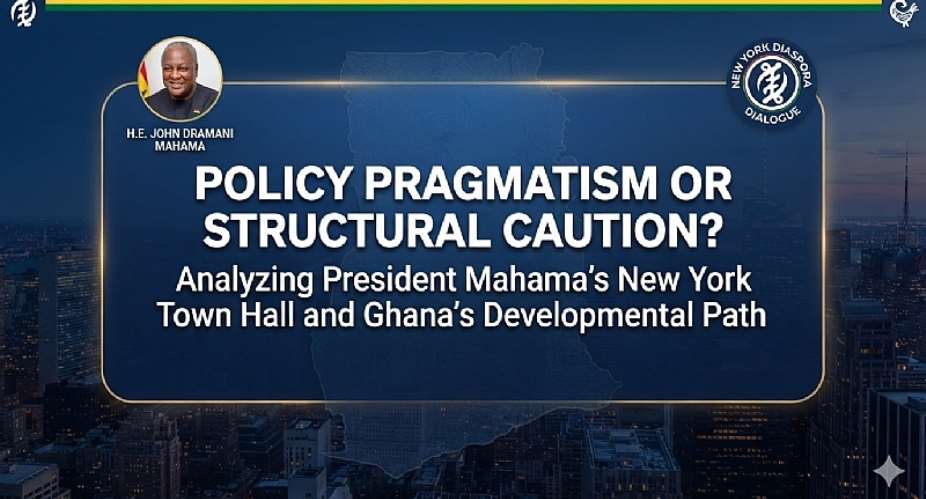
Statecraft demands a careful balance between macroeconomic strategy and localized execution. President John Dramani Mahama’s recent Presidential Town Hall Meeting in New York, held on the sidelines of the 81st United Nations General Assembly (UNGA 81), highlighted this balance. The interaction with Ghanaians from the Tri-State area served as an index of the administration’s domestic policy posture. By moving past standard political rhetoric, the engagement offered a key opportunity to analyze how executive decisions in Accra match up against the expectations of the global diaspora.
Macro-Policy Analysis & Executive Positions
An evaluation of the President's declarations reveals a governance framework focused on structural caution and targeted enforcement rather than sweeping administrative decrees:
- Deconstructing the Galamsey Dilemma: President Mahama’s refusal to declare a state of emergency over illegal mining (galamsey) reflects a calculated choice of legal realism over political optics. He noted that because illegal mining spans all ten traditional regions, a blanket emergency declaration faces enforcement challenges and risks overextending state security. The administration favors tactical interventions instead, such as removing dredging machinery from critical basins like the Ankobra River. This approach values localized, asset-focused enforcement over sweeping legal declarations.
- The Digital Frontier and Free Expression: The executive call for an open national dialogue on digital media regulation underscores the growing tension between national security and free expression. While addressing concerns over the arrest of social media users, the administration sought to separate targeted cyber-policing from systematic censorship. This posture suggests a state strategy aimed at establishing structured civic guidelines for new media without restricting constitutional speech.
- The 24-Hour Economy and Job Creation: As highlighted before global investors at NASDAQ and the UN General Assembly, the 24-Hour Economy and Accelerated Export Development Programme form the core of Ghana's industrial strategy. This policy relies on structural interventions—such as the Million Coders program and standardized national apprenticeships—to transform Ghana into a high-productivity hub. The main task ahead lies in shifting from state-led training to demand-driven employment in the private sector.
- Sovereignty in Public Health Governance: The administration's recent rejection of a proposed United States Health Compact demonstrates a firm stance on health sovereignty. The decision to discard the agreement quickly due to clauses requiring the surrender of national pathogen profiles and medical records shows a commitment to protecting bio-data security and preserving the regulatory independence of Ghana's Food and Drugs Authority (FDA).
Expanded Strategic Recommendations
To translate these policy positions into sustainable national development, Ghana must move from intent to institutional action through targeted reforms:
- Upgrade Galamsey Enforcement with Geofencing Technology: Moving beyond manual operations on the Ankobra River, the Ministry of Lands and Natural Resources should set up permanent, tech-driven buffer zones. Integrating real-time satellite surveillance with automated drone patrols will help identify and stop illegal mining operations before equipment enters fragile river basins.
- Enact a Transparent Digital Rights and Responsibilities Act: To resolve regulatory ambiguity around social media use, parliament should fast-track an explicit legal framework. Co-drafted with tech policy experts, legal minds, and civil society, this framework must clearly define civil defamation versus cyber-terrorism. This will help prevent arbitrary arrests while keeping digital platforms accountable.
- Implement Fiscal Offsets for the 24-Hour Economy: The transition to a round-the-clock economy requires more than a willing workforce. The Ministry of Finance and local government authorities should introduce structured incentives, including tiered electricity tariffs for night shifts, payroll tax rebates for companies creating night-time jobs, and dedicated security corridors to safeguard logistics.
- Establish a National Bio-Data and Sovereign Health Framework: Following the rejection of the US Health Compact, the Ministry of Health should formalize a strict data governance framework. This policy must outline clear boundaries for international health partnerships, ensuring Ghana retains ownership of its endemic disease data while building independent domestic research capacity.
The New York town hall demonstrated that addressing Ghana's current challenges requires moving past symbolic executive actions toward practical, long-term enforcement. Whether managing data security, protecting natural resources, or regulating digital platforms, the administration's focus on structured governance is clear. However, the real test lies in implementation. For the diaspora and citizens at home, true accountability is measured by how well these policy ideas are translated into clear, institutional realities. Ghana's economic future depends on turning these structured plans into measurable progress on the ground.
✍️ Submitted by:
Retired Senior Citizen
For and on behalf of all Senior Citizens of the Republic of Ghana 🇬🇭
Teshie-Nungua
[email protected]

 Iran says it expects US response Tuesday on plan to reopen Strait of Hormuz
 'If God will judge people we call holy, what about us?' — Evangelist asks after ...
 Nigerian evangelist shares list of top Nigerian pastors he saw in hell weeping f...
 How suspected phone thief swallowed five SIM cards during arrest on Kasoa-Bawjia...
 Two arrested over alleged possession and trafficking of suspected narcotics at K...
 Agric Minister urges Finance Minister to reverse Ghana's withdrawal from food re...
 S&P holds Ghana at B-/B as fiscal risks persist
 Mahama exposes 'humiliating' requirements in trashed US Health Compact
 NSA releases PIN codes for private candidates, defaulters and foreign-trained gr...
 Toyota Hiace crashes Toyota Voxy from behind at Tsibu-Bethel Junction


