




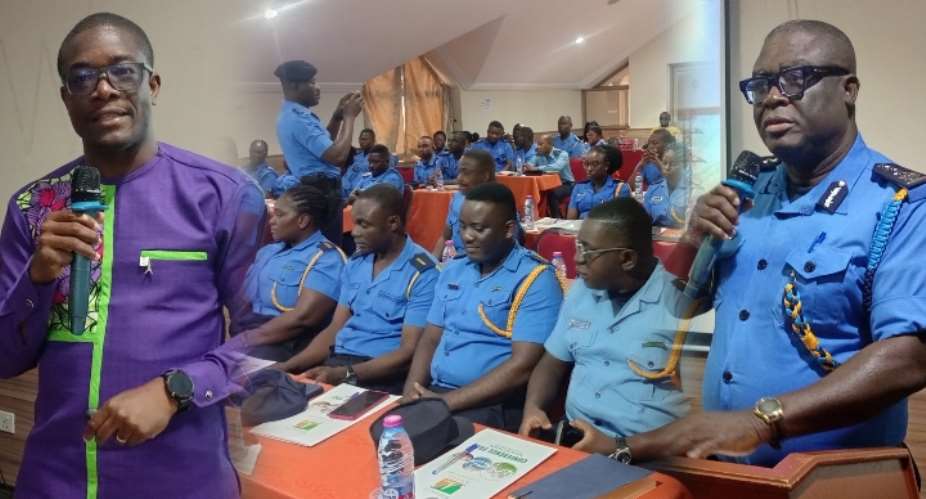
The Energy Commission has intensified technical capacity-building for Customs officials as part of efforts to strengthen the enforcement of Ghana’s energy efficiency regulatory regime and ensure that imported electrical and cooling appliances comply with prescribed minimum energy performance standards.
The technical training, held in Kumasi on Monday, brought together Customs officials for detailed engagement on the Regulatory Framework for Cooling Appliances and Energy Efficiency, including relevant provisions under L.I. 2458, L.I. 2441 aqnd L.I. 1932.
The programme aimed to bridge knowledge and enforcement gaps among agencies responsible for implementing the regulations and to ensure that products entering the Ghanaian market meet applicable energy efficiency and technical requirements.
Regulatory and Enforcement Architecture
Speaking at the training, Hubert Nsoh Zan, Manager for Energy Efficiency Regulation at the Energy Commission, explained that the Commission started engaging Customs officials on the regulations in 2023.
He said the continuous engagement was necessary because effective implementation depended on enforcement agencies having a common technical understanding of the regulatory requirements.
According to him, the regulations were passed in 2022 to establish requirements for energy-efficient products that meet Ghanaian standards.
He explained that Customs, the Ghana Standards Authority (GSA) and the Energy Commission have defined roles as enforcement agencies, making inter-agency coordination essential to achieving regulatory compliance.
“Our mission here is to sustain the enforcement activities where we share experience, discuss with you about the regulations, what even went into considering the regulations,” he said.
Mr. Nsoh Zan said the training therefore provided an opportunity to examine enforcement procedures, regulatory requirements and practical strategies for improving compliance at the points of importation and distribution.
Minimum Energy Performance Standards
A key component of the technical discussions was the application of Minimum Energy Performance Standards (MEPS).
Mr. Nsoh Zan explained that the standards are intended to ensure that imported electrical appliances achieve specified energy performance requirements before being placed on the Ghanaian market.
He noted that Customs plays a critical role in the enforcement chain because imported appliances pass through the ports and borders, making Customs officers an important first line of regulatory control.
The collaboration, he said, is intended to ensure that products that fail to meet the prescribed requirements do not gain unrestricted access to the Ghanaian market.
19 Appliance Categories Under the Regulations
Addressing newsmen on the sidelines of the training, the Manager disclosed that implementation of the new regulations has resulted in an improvement in compliance, with the Commission recording approximately 54 percent compliance across the 19 appliance categories covered by the new regulatory regime.
He expressed optimism that sustained engagement with importers, consumers, Customs, GSA and other stakeholders would further improve compliance.
The technical scope of the training included appliances covered under the regulations, development of energy efficiency standards, regulatory prohibitions, certification requirements and enforcement considerations.
Digital Verification of Energy Efficiency Labels
A significant component of the Commission's compliance strategy is the introduction of the Certified Electrical Appliance App, which is designed to assist consumers and other stakeholders in authenticating certified electrical appliances.
Mr. Nsoh Zan explained that genuine Energy Commission energy efficiency labels contain security features, including a QR code connected to the Commission's energy efficiency database.
The QR-code verification mechanism provides a digital means of checking whether a product and its associated energy efficiency certification are recognised by the Commission.
He therefore urged consumers to verify the QR codes on energy efficiency labels before purchasing electrical appliances.
He also encouraged consumers to download and use the Energy Commission application to authenticate products and avoid purchasing appliances carrying counterfeit or invalid certification labels.
Enforcement Consequences
Mr. Nsoh Zan further cautioned importers and dealers against the distribution of mislabeled, unlabeled or falsely represented products.
He noted that persons found violating the applicable regulations could face legal sanctions, including imprisonment for periods of up to 12 or 24 months, depending on the applicable offence.
He consequently urged importers and dealers to familiarise themselves with the regulatory requirements and ensure that all products they bring into the country comply with the prescribed standards.
Customs: Bridging Policy and Enforcement
The Ashanti Regional Commander of the Customs Division, Evans Teye Agbozo, commended the Energy Commission, UNDP and the Clean Climate and Air Coalition (CCAC) for extending the technical training to Customs officers in Kumasi.
He said Customs remained prepared to strengthen enforcement and contribute to increasing compliance with the energy efficiency regulations.
According to him, the Service was also ready to combat illicit trading involving electrical appliances that fail to satisfy Ghana's regulatory requirements.
In his address, Mr. Agbozo described Customs as a critical link between government policy and practical implementation.
He welcomed the training as an opportunity for Customs officers to gain a clearer technical understanding of the new regulatory framework and its enforcement implications.
He further commended the Energy Commission, UNDP and CCAC for implementing the nationwide capacity-building programme.
Technical Focus of Training
The training also covered the mandate of the Energy Commission, the rationale for energy efficiency regulation, energy efficiency applications across sectors, energy consumption and environmental impacts, Ghana's current energy situation, regulatory requirements for cooling appliances, prohibited practices and the development of energy efficiency standards and regulations.
Participants also took part in a technical quiz designed to assess their understanding of the regulatory requirements, with top-performing participants receiving awards.
The programme was organised by the Energy Commission in collaboration with the United Nations Development Programme (UNDP) and the Clean Climate and Air Coalition (CCAC).
The initiative forms part of efforts to establish a stronger technical and enforcement architecture around energy efficiency in Ghana, with particular emphasis on standards compliance, product certification, import controls, consumer verification and inter-agency enforcement.


 'If God will judge people we call holy, what about us?' — Evangelist asks after ...
 Nigerian evangelist shares list of top Nigerian pastors he saw in hell weeping f...
 How suspected phone thief swallowed five SIM cards during arrest on Kasoa-Bawjia...
 Two arrested over alleged possession and trafficking of suspected narcotics at K...
 Agric Minister urges Finance Minister to reverse Ghana's withdrawal from food re...
 S&P holds Ghana at B-/B as fiscal risks persist
 Mahama exposes 'humiliating' requirements in trashed US Health Compact
 NSA releases PIN codes for private candidates, defaulters and foreign-trained gr...
 Toyota Hiace crashes Toyota Voxy from behind at Tsibu-Bethel Junction
 'It has been the old story of promises upon promises; we won’t return until sala...


