




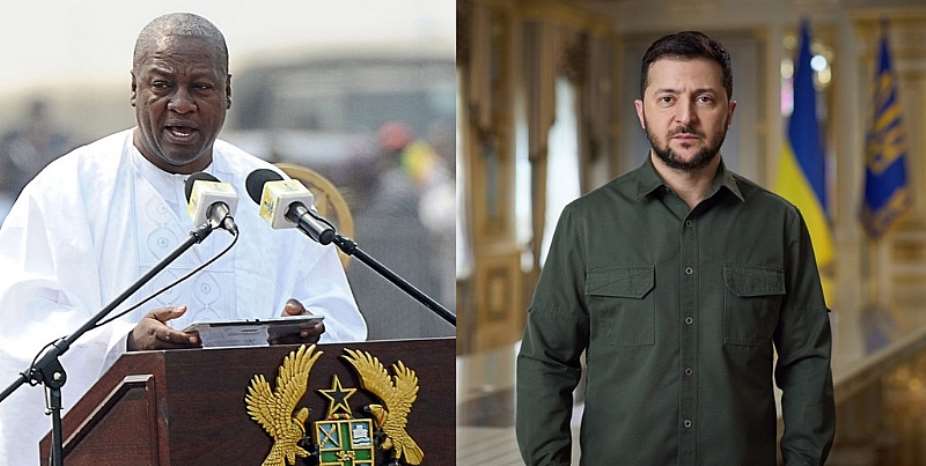
There are moments when a statement made on the floor of the United Nations should stop a nation in its tracks. For me, that moment came when Ukrainian President Volodymyr Zelenskyy stood before the 81st United Nations General Assembly and named Ghana among 47 countries whose citizens, he said, are being used by Russia in its war against Ukraine.
Last year, I followed the United Nations General Assembly proceedings closely. I did so partly because I had argued that Ghana should look beyond its traditional economic relationships and explore Canada more aggressively as a business and investment partner, particularly at a time when Ghana-US trade relations were facing uncertainty over tariffs. I had hoped President John Dramani Mahama would visit Canada. That did not happen, and eventually I stopped pursuing that particular call.
This year has been different. As a university student, with a new programme and assignments arriving almost every day, I have had far less time to follow the UN proceedings.
But social media brought one particular moment back to my attention.
It was not the political arguments. It was not the demonstrations surrounding President Mahama's appearance in New York. It was not even the heated debate over Ghana's political insults and the government's response to what it describes as the excesses of new-age media.
It was Ghana's name coming from the mouth of the Ukrainian president on the UN stage.
Zelenskyy said Russia uses citizens of 47 countries in its war and specifically listed Ghana, Nepal, Tajikistan, India, Yemen, Kenya, Zimbabwe, Cuba, Belarus and Sudan, among others. He appealed directly to representatives of those countries to protect their citizens. He further said that people from those countries were ending up in Russia through what he described as “deception and tricks” and subsequently dying on the battlefield.
That should concern every Ghanaian.
Not because Zelenskyy's allegation should automatically be accepted as established fact—but precisely because an allegation of this magnitude demands an official response, verification and clarification.
Mr. President, if there are Ghanaian citizens being recruited into Russia's war against Ukraine, how many are there?
Who are they?
How did they get there?
Were they knowingly joining the Russian military, or were some deceived into believing they were travelling for civilian employment?
Does the Ghanaian government have information about Ghanaian nationals who may have been captured, killed or wounded?
And most importantly, what is Ghana doing about it?
These are not merely questions for social-media commentators. They are questions of national interest, foreign policy and the protection of Ghanaian citizens abroad.
What troubles me even more is the apparent absence of a major national conversation around the allegation. Much of the online attention surrounding Ghana's UN appearance has focused on political exchanges, personalities, fashion and social-media controversies.
Those subjects may have their place.
But when Ghana's name is publicly mentioned at the United Nations in connection with foreign nationals allegedly being drawn into one of the world's most consequential wars, that story deserves attention too.
I am not suggesting that Ghana has endorsed Russia's war. I am not suggesting that every Ghanaian reportedly fighting for Russia was deceived. And I am certainly not suggesting that President Mahama personally supports such recruitment.
I am asking for something much simpler:
Find out.
If the Ukrainian president's allegation is inaccurate, Ghana should say so clearly.
If Ghanaian citizens have indeed been recruited, Ghana should establish the circumstances.
If deception or fraudulent recruitment is occurring, the government should warn Ghanaians about it and take appropriate action.
And if Ghanaian nationals are prisoners of war, injured or dead, their families deserve answers.
This is where diplomacy should meet the protection of citizens.
President Mahama's government has a responsibility not only to represent Ghana's interests abroad but also to know where Ghanaian citizens are being drawn into dangerous situations and to respond when their lives are at risk.
The international community is watching.
Ghana's name has been spoken. Ghana must answer.
Mr. President, this is bigger than Ghana's domestic political arguments. It is bigger than insults on social media. It is bigger than who said what about whom.
It concerns Ghanaian lives.
If even one Ghanaian has been deceived into a foreign war and is now facing death on a battlefield thousands of kilometres from home, that should matter to all of us.
And if the allegation is wrong, Ghana deserves the truth just as much.
A word to the wise is enough.

 'If God will judge people we call holy, what about us?' — Evangelist asks after ...
 Nigerian evangelist shares list of top Nigerian pastors he saw in hell weeping f...
 How suspected phone thief swallowed five SIM cards during arrest on Kasoa-Bawjia...
 Two arrested over alleged possession and trafficking of suspected narcotics at K...
 Agric Minister urges Finance Minister to reverse Ghana's withdrawal from food re...
 S&P holds Ghana at B-/B as fiscal risks persist
 Mahama exposes 'humiliating' requirements in trashed US Health Compact
 NSA releases PIN codes for private candidates, defaulters and foreign-trained gr...
 Toyota Hiace crashes Toyota Voxy from behind at Tsibu-Bethel Junction
 'It has been the old story of promises upon promises; we won’t return until sala...


