




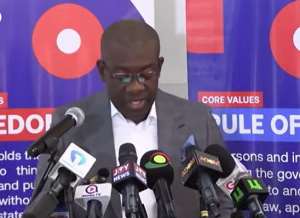
The New Patriotic Party (NPP) has criticised the government’s approach to proposed amendments to the 1992 Constitution, arguing that the recommendations go far beyond routine changes and could fundamentally reshape the country’s constitutional framework.
NPP Policy Committee Chairman and Ofoase/Ayirebi Member of Parliament, Kojo Oppong Nkrumah, made the party’s position known at a press conference on Thursday, September 17.
He said the magnitude of the proposed changes required a wider deliberative process involving political parties, organised labour, professional associations and other relevant groups before any amendments were pursued.
“The New Patriotic Party therefore rejects this approach being pursued by the NDC government in essentially rewriting the 1992 constitution,” he said.
Mr Oppong Nkrumah said the Constitution Review Committee had proposed changes to 147 of the Constitution’s 299 articles, representing about 49% of the existing provisions, in addition to 59 new provisions.
He argued that the number and scope of the proposed changes meant the exercise should not be treated as a conventional amendment process.
“Amendment 147 of 299 articles, together with 59 new provisions, that is 206 reaching into the executive, the legislature, independent constitutional bodies, and local government is not just an adjustment to some provisions of the constitution, they amount to the overhaul of the constitution and in substance the enactment of a new one,” he said.
The former Information Minister also raised concerns about differences between the government’s position and the recommendations submitted by the Constitution Review Committee.
He alleged that the government had adopted alternative positions on about 100 of the 147 recommendations contained in the report of the committee established by the President.
According to him, the government had also brought the consultation process to an end and directed its implementation committee to proceed with drafting proposals, with November 2026 identified as the target for the first constitutional amendment.
Mr Oppong Nkrumah said the NPP was concerned that there was no formal platform through which political parties, Organised Labour, professional bodies and other stakeholder groups could deliberate on the outstanding areas of disagreement.
He cited Ghana’s previous constitutional processes in 1969, 1979 and 1992 as examples of exercises in which expert recommendations were subsequently subjected to broader deliberation before being enacted.
“First, the work of an expert deliberated and settled upon by a broad and representative assembly and only then given the force of law. This was done in 1969, in 1979, and in 1992 and that is what we are calling on the government to respect now,” he said.
The NPP is therefore proposing that the government introduce a Constituent or Consultative Assembly Bill in Parliament to establish a formal body through which the proposed reforms can receive broader consideration.
Mr Oppong Nkrumah said such an arrangement would also create an avenue for stakeholders to deliberate on and resolve the more than 100 areas where the government and the Constitution Review Committee are alleged to have differing positions.

 Senior nurse remanded over alleged link to ‘Ghana Jollof’ TikTok account
 ‘NDC rewriting 1992 Constitution’ – NPP rejects review approach
 $300m World Bank financing package secured to permanently end double-track by 20...
 'No piece of land is worth single human life' – Afenyo-Markin calls for peace af...
 Police declare ‘Ghana Jollof’ wanted for allegedly inciting violence
 How community watchdog group helped Police 'cobra team' arrest seven suspects fo...
 Ghana Jollof probe: “She is safe, unharmed” — Police assure GRNMA over detained ...
 36 suspects arrested over lynching of police officer at Gindabour
 Ghana Card to become e-wallet for electronic transactions soon – NIA Boss
 Constitutional amendment: Five-year presidential, parliamentary terms will weake...


