




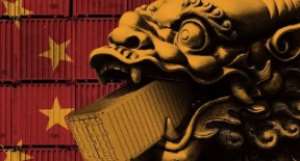
Walk into Makola Market in Accra, Kejetia in Kumasi, or the sprawling stalls that ring Kano and Onitsha, and a quiet but unmistakable shift has taken hold.
The stationery shop, the phone accessories stall, the hardware store, the fabric outlet increasingly, the person behind the counter, or the company behind the brand, is Chinese.
For a growing number of local traders across the sub-region, what began as admiration for cheap, efficient competition has curdled into resentment, and now into open political confrontation.
"Our Market Is Gone"
In Ghana, the numbers being cited by trade associations are startling. The Ghana Union of Traders Association (GUTA) has repeatedly warned that Ghanaians are losing ground in their own retail sector.
Its president, Dr. Joseph Obeng, has said foreign nationals mostly Chinese and Nigerian now control as much as 70 percent of Ghana's retail trade, a figure that has climbed steadily from an estimate of over 40 percent just two years earlier. GUTA's welfare officer, Benjamin Yeboah, has gone further, describing the retail sector legally reserved for Ghanaian citizens as having become "a safe haven for foreigners."
The frustration is no longer confined to statements to the press. In the Ashanti Region, GUTA's local leadership has threatened to physically shut down foreign-owned shops if the Ministry of Trade fails to enforce existing regulations. "In many of the markets, Nigerians and Chinese nationals are dominating the space," the Ashanti Regional Vice Chairman, Nana Nyame, told local media, adding that some individual foreign traders own as many as six shops more than most Ghanaian traders could ever afford while allegedly sidestepping tax obligations.The Association of Ghana Industries has floated a compromise: forcing foreign-owned retail outlets to dedicate at least 40 percent of shelf space to Ghanaian-made goods.
A Law on Paper, Ignored in Practice
At the heart of the grievance is Ghana's Ghana Investment Promotion Centre (GIPC) Act, which reserves petty and retail trading exclusively for Ghanaian citizens. Foreign investors wishing to engage in trading activity are legally required to invest a minimum of $1 million and employ at least 20 Ghanaians.
Traders say the law exists mostly on paper. Dr. Obeng has alleged that many Chinese-owned outlets simply "show evidence of goods worth $1 million" effectively satisfying the letter of the law with imported inventory rather than genuine capital investment while employing the bare minimum of local staff.
There is also a currency dimension to the complaint. Some trader leaders link the depreciation of the cedi to a business model in which goods flow from Chinese manufacturers straight into Chinese-run warehouses in Ghana, with limited corresponding inflows of foreign investment capital. Whether or not that causal claim survives economic scrutiny, it captures a deeper anxiety: that value is being extracted from local markets faster than it is being reinvested in them.
The Other Side of the Ledger
It would be dishonest, however, to reduce this story to grievance alone. China Mall with branches in Accra, Kumasi and Takoradi has become genuinely popular with the very Ghanaian shoppers whose traders complain about it, precisely because of low prices and wide selection.
Analysts tracking the sector describe a Chinese-built distribution system that now runs from factories through warehousing into wholesale channels feeding neighbourhood shops across the country a level of vertical integration that most Ghanaian-owned retail businesses have not matched. Some commentators frame this less as an invasion and more as a competitive lesson: Chinese firms have simply out-organized, and out-financed, the local competition, reportedly securing credit at single-digit interest rates compared with the roughly 40 percent many Ghanaian entrepreneurs face from local lenders.
That gap in the cost of capital may be the single most important and least discussed driver of this whole story. Traders are not only competing against Chinese firms; they are competing against a financing environment that makes it structurally difficult for a Ghanaian entrepreneur to match a Chinese competitor's prices and still survive.
A Regional, Not Just a Ghanaian, Story
Ghana's experience is not unique in the sub-region. Nigerian traders have long voiced similar complaints about Chinese wholesalers moving into markets historically reserved for citizens, and Chinese retail and mining involvement including in artisanal gold operations has periodically triggered friction in Ghana's own crackdown on galamsey, illegal small-scale mining.
Ghana's move to bar foreigners from the local gold trade and centralize oversight under the new Ghana Gold Board reflects a wider political mood: governments across the sub-region are under pressure to reassert control over sectors nationals feel they are losing.
What Comes Next
The tension sits at an uncomfortable intersection of consumer interest, sovereign law, and geopolitical reality. Ghanaian shoppers benefit from the low prices Chinese retailers offer even as Ghanaian traders lose ground to them.
Local associations are demanding enforcement of laws that already exist rather than new legislation a sign that the failure here is regulatory will, not a regulatory gap. And with China remaining one of West Africa's most significant infrastructure financiers and trade partners, governments face a delicate balancing act: protect indigenous traders without triggering a diplomatic and economic rupture with Beijing.
For the trader locked out of his own stall's supply chain, that balancing act is cold comfort. For policymakers in Accra, Abuja, and beyond, it is fast becoming a test of whether trade law in West Africa means anything at all when foreign capital and a more efficient business model decides otherwise.
This analysis draws on public statements from the Ghana Union of Traders Association, the Association of Ghana Industries, and Ghanaian business press reporting through 2026.
Mustapha Bature Sallama
Medical/Science communicator, Private Investigator, Criminal Investigation and Intelligence Analysis,United States Institute of Peace (USIP), [email protected] +233555275880
Sources
Ghana News Agency, "GUTA calls for urgent gov't intervention as Ghanaians lose market to foreign traders," September 8, 2025. https://gna.org.gh/2025/09/guta-calls-for-urgent-govt-intervention-as-ghanaians-lose-market-to-foreign-traders/
Citi Newsroom, "Ashanti Region: GUTA threatens to close foreign shops over retail takeover," February 26, 2026. https://citinewsroom.com/2026/02/ashanti-region-guta-threatens-to-close-foreign-shops-over-retail-takeover/
Citi Newsroom, "GUTA urges gov't to clamp down on foreign dominance in retail trade," December 23, 2025. https://www.citinewsroom.com/2025/12/guta-urges-govt-to-clamp-down-on-foreign-dominance-in-retail-trade/
GhanaWeb, "'Over 40% of our businesses have been taken over by Chinese companies' – GUTA laments," May 27, 2024. https://www.ghanaweb.com/GhanaHomePage/business/Over-40-of-our-businesses-have-been-taken-over-by-Chinese-companies-GUTA-laments-1932782
GhanaWeb, "The Chinese and other foreigners are gradually taking over our retail market – GUTA claims," June 24, 2024. https://www.ghanaweb.com/GhanaHomePage/business/The-Chinese-and-other-foreigners-are-gradually-taking-over-our-retail-market-GUTA-claims-1937025
News Ghana, "Ghanaian Business Owners Raise Alarm over Growing Foreign Dominance in Ghana's Retail Market," December 17, 2025. https://www.newsghana.com.gh/ghanaian-business-owners-raise-alarm-over-growing-foreign-dominance-in-ghanas-retail-market-as-chinese-nigerians-control-over-70-of-ghanas-retail-sector/
ModernGhana, "The Dragon's Footprint: Chinese Business Success in Ghana and Lessons for Ghanaian Entrepreneurs," April 5, 2025. https://www.modernghana.com/news/1391097/the-dragons-footprint-chinese-business-success.html
ModernGhana, "Retail, FMCG Distribution & Consumer Markets in Ghana: The Battle for the Ghanaian Cedi," June 1, 2026. https://www.modernghana.com/news/1498337/retail-fmcg-distribution-consumer-markets-in.html
Africa Reporters Network, "China Mall Ghana: How China Quietly Built Ghana's Most Powerful Retail Distribution System." https://www.africareportersnetwork.com/news/china-did-not-conquer-ghana-through-advertising-it-did-it-through-distribution


 Senior nurse remanded over alleged link to ‘Ghana Jollof’ TikTok account
 ‘NDC rewriting 1992 Constitution’ – NPP rejects review approach
 $300m World Bank financing package secured to permanently end double-track by 20...
 'No piece of land is worth single human life' – Afenyo-Markin calls for peace af...
 Police declare ‘Ghana Jollof’ wanted for allegedly inciting violence
 How community watchdog group helped Police 'cobra team' arrest seven suspects fo...
 Ghana Jollof probe: “She is safe, unharmed” — Police assure GRNMA over detained ...
 36 suspects arrested over lynching of police officer at Gindabour
 Ghana Card to become e-wallet for electronic transactions soon – NIA Boss
 Constitutional amendment: Five-year presidential, parliamentary terms will weake...


