




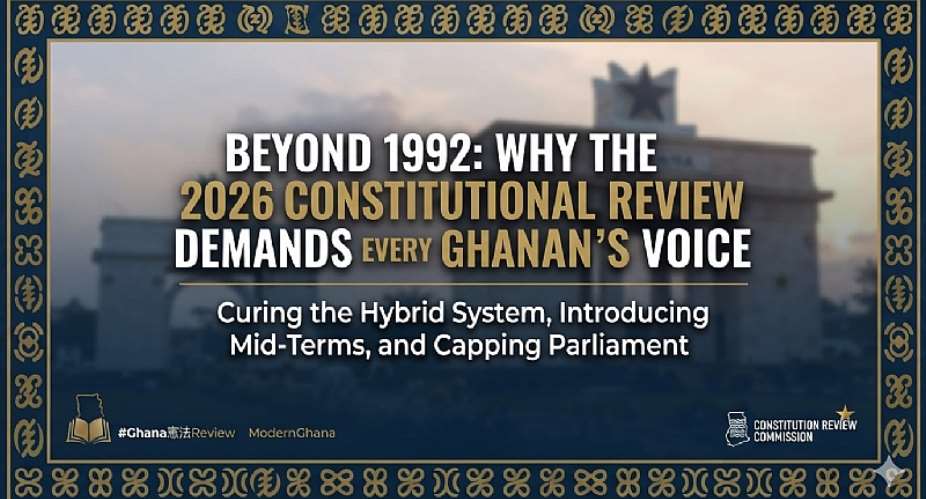
Our nation stands at a monumental democratic crossroads. For thirty-four years, the 1992 Constitution has served as the bedrock of our political stability, guiding Ghana through peaceful transitions of power and earning us the reputation of a democratic beacon in West Africa. Yet, a constitution is a living document, not a monument cast in stone; it must evolve to meet the shifting aspirations of the people it governs. As the ongoing 2026 constitutional review gains momentum, we are witnessing a profound historical shift. Unlike the foundational days of 1992—where political boycotts and structural exclusions left lasting fractures in our national consensus—today’s major political actors, including the New Patriotic Party (NPP), are actively engaging the Constitution Review Committee (CRC). This is a golden opportunity for our republic. This review must not be reduced to an elite partisan wrestling match. It is an urgent, national project that demands the active education, vigilance, and participation of every single Ghanaian citizen.
The Evolution of the 2026 Review Process
To appreciate the stakes of the current amendment process, we must look at how the political landscape has matured since the inception of the Fourth Republic:
- The Lessons of 1992: In 1992, key opposition forces boycotted the Consultative Assembly and subsequent parliamentary elections over concerns of regime dominance. This historic step-back created a deficit in shared "constitutional ownership" that lingered for decades.
- A Shift to Active Participation: The 2026 review breaks cleanly from the past. Rather than walking away, political stakeholders across the spectrum—including the NPP's Constitution and Legal Affairs Policy Committee—have actively submitted rigorous inputs and memoranda directly to the CRC.
- Demanding Total Transparency: There is a growing, cross-party consensus demanding that the CRC's unedited recommendations remain fully transparent. Civil society and political leaders alike are insisting that the final reforms reflect the raw will of the people, rather than selective "cherry-picking" by any incumbent government.
Curing the Hybrid System: Ending the Appointment of MPs as Ministers
One of the most vital debates of the 2026 review centers on Article 78(1) of the 1992 Constitution, which forces the President to appoint the majority of ministers from Parliament. This hybrid system has severely weakened our democracy by creating a conflict of interest, crippling parliamentary oversight, and overburdening MPs. International governance models offer clear pathways to fix this:
- The Strict Separation of Powers (The United States Model): In the United States, Article I, Section 6 of the Constitution strictly prohibits any member of Congress from serving in the executive branch simultaneously. If an elected representative is appointed to a cabinet position, they must immediately resign their legislative seat. This ensures that lawmakers focus entirely on vetting laws and holding the government accountable, without being compromised by the desire for ministerial perks.
- The 'Incompatibility' Clause (The French and Kenyan Models): Under Article 23 of the French Constitution and duplicated in Kenya's 2010 Constitution, a cabinet minister cannot hold a parliamentary seat. In Kenya, this deliberate shift successfully restored independence to the National Assembly. Ministers are treated as technocrats who are summoned by parliamentary committees to answer tough questions, rather than colleagues sitting in the same legislative chamber protecting their political party.
Introducing Mid-Terms and Halting Institutional Bloat
To genuinely modernise our democracy, the 2026 review must introduce progressive structural checks to break the "winner-takes-all" monopoly and curb the soaring costs of governance:
- The Accountability of Mid-Term Elections: Ghana's current concurrent four-year cycle gives an administration a blank check until the next general election. Introducing mid-term legislative elections—modeled after the United States system—would serve as a continuous national referendum. If a ruling government underperforms two years into its term, voters can shift the parliamentary majority to the opposition. This forces the president to build consensus and compromise, effectively curbing executive dominance.
- A Strict Boundary Cap on Parliament: Unlike countries with a fixed number of legislators, Ghana’s Parliament expands indefinitely whenever new constituencies are created, growing from 200 seats in 1993 to 275 seats today. Following global examples like the US House of Representatives (strictly capped at 435 seats since 1911 despite massive population growth) and Kenya (capped at 349 seats), Ghana must introduce a permanent constitutional cap. We must learn to redraw constituency boundaries based on population shifts through data-driven redistricting, rather than creating expensive new legislative seats that drain state resources on V8 vehicles, salaries, and ex-gratia.
- Youth Inclusivity: Lowering the presidential eligibility age requirement from 40 to 35 to better reflect Ghana's youthful demographic and encourage young leadership.
Actionable Suggestions and Recommendations
For this constitutional review to successfully birth a stronger Ghana, the process must be guided by inclusivity, clarity, and institutional integrity:
- Enact a Full Separation of Powers: The 2026 amendment should completely untangle the legislature from the executive by barring MPs from taking up ministerial appointments, thereby restoring Parliament’s true oversight mandate.
- Establish a Permanent Legislative Cap: Lock the size of Parliament at a sustainable maximum (such as the proposed 300-member limit) to protect the national national wallet from infinite institutional expansion.
- Launch Mass Civic Education Campaigns: The National Commission for Civic Education (NCCE) must be aggressively funded and mobilized to translate the complex legal jargon of the CRC proposals into local languages across all 16 regions.
- Publish a Simplified People's Guide: The government and independent think-tanks should co-publish a simplified, side-by-side comparison manual showing the current 1992 provisions against the proposed 2026 amendments.
- De-polarise the National Document: Political parties must consciously separate their internal constitutional overhauls from the national exercise. The national constitution belongs to the sovereign people of Ghana, not to party secretariats.
- Guarantee Inclusive Town Halls: The CRC and civil society organizations must expand regional town halls, ensuring that market women, smallholder farmers, persons with disabilities, and youth groups have equal floor time to voice their expectations.
The 1992 Constitution brought us peace, but the 2026 amendments must bring us progress, efficiency, and deep-seated equity. We cannot afford the luxury of apathy, nor can we allow the ghost of 1992’s political boycotts to haunt our future. When the legal frameworks that govern our daily lives, our local economies, and our generational leadership are being rewritten, sitting on the fence is an abdication of civic duty. This is our moment to shape a constitution that actively works for the ordinary Ghanaian. Let us read, discuss, debate, and demand a transparent review process. Our democracy will only be as strong, as just, and as resilient as the collective voice we inject into it today. Let us build the Ghana we want, together.
✍️ Submitted by:
Retired Senior Citizen
For and on behalf of all Senior Citizens of the Republic of Ghana 🇬🇭
Teshie-Nungua, Accra
📧 [email protected]

 Senior nurse remanded over alleged link to ‘Ghana Jollof’ TikTok account
 ‘NDC rewriting 1992 Constitution’ – NPP rejects review approach
 $300m World Bank financing package secured to permanently end double-track by 20...
 'No piece of land is worth single human life' – Afenyo-Markin calls for peace af...
 Police declare ‘Ghana Jollof’ wanted for allegedly inciting violence
 How community watchdog group helped Police 'cobra team' arrest seven suspects fo...
 Ghana Jollof probe: “She is safe, unharmed” — Police assure GRNMA over detained ...
 36 suspects arrested over lynching of police officer at Gindabour
 Ghana Card to become e-wallet for electronic transactions soon – NIA Boss
 Constitutional amendment: Five-year presidential, parliamentary terms will weake...


