




Yoruba proverb: Òjú ọ̀run tó gbogbo ẹyẹ láti fò láì fara gbára / “The sky is large enough for every bird to fly without colliding with one another.”
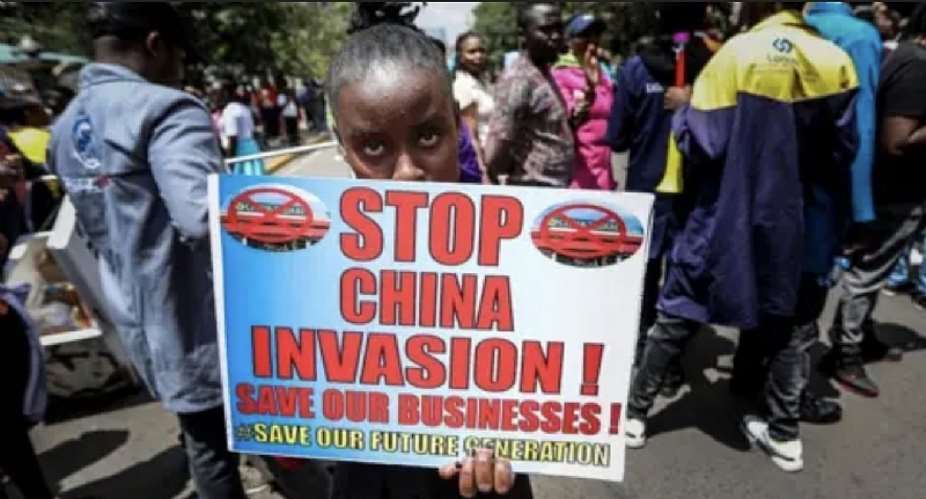
The sight of some Igbo traders in Lagos protesting against Chinese traders is both profoundly comical and deeply disturbing.
The question any well-brought-up and cultured Yoruba would ask these misguided miscreants is: Who sent you, and when did you become the arbiter of who could trade in Lagos?
It’s quite unfortunate and unbelievable that a group of people could live among the Yoruba people and refuse to learn what made the Yorubas the most urbanized national group in Africa.
Like most cultured Africans, the Yoruba subscribed to the Ubuntu philosophy in their own way. Take another look at their proverb above: Òjú ọ̀run tó gbogbo ẹyẹ láti fò láì fara gbára.
The sky is, indeed, wide enough for all birds to fly without touching wings. Every Yoruba child is instilled with this from infancy. It is what created the simple but celebrated live-and-let-live, laissez-faire attitude of the Yorubas to which, unfortunately, uncultured people can’t relate.
The protest is disturbing because one would have thought that Nigerians, of all people, would have developed an allergy to xenophobia.
Nigerians have spent decades complaining loudly, quite justifiably, about being harassed, discriminated against, and chased from businesses and markets in other African countries.
Perhaps more than any other human being on earth, Nigerians vociferated loudly against xenophobia in South Africa, and they have denounced it when it reared its head in Ghana and elsewhere. We have demanded that our governments protect Nigerians living and trading abroad. We have insisted, correctly, that a Nigerian who obeys the laws of another country should not be persecuted merely because he is Nigerian.
Yet here we are, watching some Nigerian traders demanding that Chinese traders be driven out of Nigerian markets. Imagine the irony!
What extraordinary moral amnesia! It was not funny to watch the pathetic protestors accusing the Chinese of the same things Nigerians in other countries were accused of.
Listening to them, one is tempted to ask why they chose to leave their thinking faculties at home. They made no sense.
Our old folks had a proverb for this kind of behavior: the kettle calling the pot black.
They also warned us that anyone who lives in a glass house should think twice before throwing stones.
Apparently, some of our modern-day traders, with little education and no home training, have decided that the wisdom of the ancestors is obsolete.
These brainless idiots with no value and zero appreciation for everything except the clanging of coins have forgotten that Nigerians are notoriously guilty of the sam offense they accused the Chinese of doing: crossing borders in search of commercial opportunities.
Nigerians have, indeed, become remarkably successful practitioners of precisely the kind of transnational commerce some of them now appear to resent when others practice it in their country. Nigerian traders have established and dominated businesses throughout West Africa. You can see this in any of the Grand Marches in the ECOWAS sub-region.
Nigerians travel to China, Dubai, Turkey, Europe, and other parts of the world to buy goods, negotiate with manufacturers and wholesalers, build distribution networks, and return home to sell them for profit.
The Chinese city of Guangzhou has for years been an important commercial destination for African traders, mostly Nigerians.
There is nothing inherently wrong with this. It is commerce, and it’s what every trader does.
Which makes one wonder what goes on in the skull of those protesters in Lagos to make them think that when a Chinese businessman comes to Lagos and engages in lawful commerce, the principle should suddenly become different?
Hypocrisy is a sin.
As we have consistently advocated on this blog, anyone who breaks the law should face the full rigor of the law. If a Chinese company is breaking Nigerian law, it should be prosecuted. If a foreign trader operates without the required license, the law should be enforced. If somebody is evading taxes, the appropriate authorities should investigate and punish the offense. If particular categories of retail trade are legally reserved for Nigerians, it’s up to the Nigerian government to enforce its laws and restrictions consistently. There is nothing unreasonable about Nigerian traders demanding that their government enforce its own laws.
But that is a very different proposition from the crude idea that Chinese traders should be chased out simply because they are Chinese. We denounced it in South Africa and Ghana, and we condemn the misguided protesters' actions in Lagos.
Our position is clear and consistent: State officials enforcing rules and regulations are not xenophobic. By our definition, demanding fair competition is not xenophobia.
But treating an entire nationality as an undesirable presence in your country is another matter altogether.
And this is where the Nigerian protest becomes almost painfully ironic. Those illiterate and uncultured protesters in Lagos should be told that they cannot spend Monday condemning xenophobia against Nigerians abroad, and Tuesday embrace a crude version of the same principle at home.
We cannot demand that the world respect Nigerian traders abroad while arguing that foreigners should have no place in Nigerian commerce. We cannot insist that Nigerian entrepreneurs have a right to seek opportunities in China while declaring that Chinese entrepreneurs have no right to seek opportunities in Nigeria.
If we believe in any principle, we must believe in it universally.
That is why we consider the misguided protests in Lagos crass opportunism.
Rather than expose their lack of education and culture to the world, the protesters should also spend a little time educating themselves about the country whose traders they are so eager to expel.
China is not some insignificant trading post whose only relationship with Nigeria is the presence of a few merchants in Lagos. The two countries have developed substantial bilateral relations over several decades, encompassing trade, infrastructure, investment, education, technology and diplomatic cooperation.
Whatever one’s opinion of individual Chinese businesses, it would be churlish and childish to pretend that the relationship between the two countries can be reduced to an argument over retail stalls in the Lagos Trade Fair Complex.
More importantly, China has recently opened an extraordinary commercial opportunity for African exporters.
Beginning on May 1, 2026, China introduced zero-tariff treatment across 100 percent of tariff lines for the 53 African countries with which it maintains diplomatic relations, including Nigeria.
The stated objective is to expand African access to the Chinese market and encourage greater trade between China and Africa.
Those loud-mouthed illiterate protesters did not consider the absurdity of their situation.
At the very moment China is lowering tariff barriers for African products, some Nigerians are focusing their energy on driving Chinese traders away from Lagos.
A country of more than a billion people is effectively saying to African exporters, “Bring your products to our market,” while some of our people are saying, “Get out of our market.”
This is not an economic strategy. It is criminal intellectual laziness.
An educated, sensible Nigerian trader should be asking how to take advantage of the Chinese market. What agricultural products can Nigeria export? How can Nigerian manufacturers penetrate Chinese supply chains? What processed food products can be sold in China? How can Nigerian businesses use Chinese technology, machinery and capital to increase production? How can Nigerian entrepreneurs build companies that can compete with Chinese businesses instead of merely demanding that those businesses disappear?
That is the conversation we should be having in Nigeria and in Africa.
Unfortunately, such a conversation requires something that seems increasingly scarce in both Nigeria and across the continent: serious economic thinking.
As usual, we brandish emotion in situations that demand rigorous intellectual application.
Unfortunately, we Africans find it is much easier to blame foreigners than to confront the failures of our governments. It is easier to accuse the Chinese trader of destroying one’s livelihood than to ask why Nigeria has failed to build a competitive manufacturing sector. It is easier to organize a protest against foreigners than to demand reliable electricity, functional ports, affordable credit, decent roads, efficient customs administration and a coherent industrial policy.
For decades, Nigerian governments have presided over an economy where manufacturing remains constrained by infrastructure deficits, high production costs, policy instability, and a befuddling array of bureaucratic obstacles.
Let’s not mention corruption for the time being.
Yet when imported goods arrive, and Nigerians buy them because they are cheaper or more accessible, the foreigner becomes the villain.
If Chinese manufacturers can produce certain goods more cheaply than Nigerian manufacturers, the answer cannot forever be to chase the Chinese away. At some point, Nigerians must ask the harder question: why can they produce it more cheaply than us?
That question may lead us into uncomfortable territory. It may force us to discuss electricity, corruption, infrastructure, the cost of finance, taxation, logistics, ports, and government incompetence. It may even force us to admit that Nigerian entrepreneurs sometimes succeed despite the Nigerian state rather than because of it.
Perhaps that is why the foreigner is such a convenient scapegoat.
The truth is that Nigerians and Africans need a far more sophisticated understanding of geopolitics and international commerce.
The world is undergoing profound economic and geopolitical realignment. China is expanding its trade relationships with Africa. India is increasing its commercial engagement with the continent. Russia is deepening relationships with several African countries. Europe and the United States continue to compete for markets, resources, strategic partnerships, and influence.
Meanwhile, too many Africans remain trapped in the primitive politics of “foreigner versus local”.
We should ask how Africa can exploit competition among the major powers to advance African interests. We should negotiate hard for technology transfer, local manufacturing, employment, infrastructure, and access to foreign markets.
We should be demanding that foreign investment produce greater value within African economies. We should be developing industries capable of exporting finished products rather than perpetually shipping raw materials abroad and importing finished goods at several times the price.
That is economic nationalism that’s worthy of the name, instead of stupidly chasing Chinese traders from a Lagos market.
China, like every major power, pursues its national interests; Nigeria must learn how to do the same.
The answer to our chronic underdevelopment is not sentimentality about China, nor blind hostility towards the country. It is intelligent application of well-crafted diplomacy. It is negotiation, regulation, and reciprocity. It is in developing Nigeria's productive capacity so Nigerian businesses can compete.
And Nigerians should remember something else before they become too enthusiastic about throwing stones at the Chinese. Nigerian traders are scattered across the world. They operate in countries whose governments have every right to enforce their own laws. If Nigerians expect those governments to distinguish between legitimate regulation and xenophobic persecution, then Nigerians must demonstrate that same distinction at home.
This is why the Lagos protest should provoke something more profound than another round of shouting. It should provoke self-examination. The question is not simply whether Chinese traders are complying with Nigerian laws. The question is what kind of society Nigerians want to build.
Nigerians and Africans must sit down and ask themselves very serious questions: Do we want a country governed by law, where nationality does not determine whether somebody may engage in legitimate commerce, or do we want a country where mobs decide who belongs in the marketplace?
Do we want Nigerian/African businesses to become competitive manufacturers and exporters, or do we want to protect traders from competition indefinitely?
Do we want to exploit China’s enormous market for Nigerian goods, particularly now that China has opened zero-tariff access to African products, or do we prefer to stand at home shouting at Chinese merchants?
The choice is ours.
As we have advised several times on this blog, Africans, Nigerians especially, must wake up from this perpetual intellectual slumber. We must develop an interest in geopolitics and geoeconomics. We must understand how international trade works and how relations between nations operate.
We must stop behaving as though the world owes us prosperity while we refuse to examine the failures of our own political and economic systems.
Rather than picking on the Chinese, Nigerians and Africans certainly have no shortage of targets if they genuinely want something to protest about.
How about protesting against corruption, protesting against government waste, protesting against electricity failures, protesting against the extortion that suffocates small businesses; protesting against the infrastructure deficits that make Nigerian production unnecessarily expensive; protesting against policies that encourage import dependence; protesting against the political class that has had decades to transform Nigeria/Africa’s enormous human and material resources into prosperity and has repeatedly failed to do so.
Those protesting in Lagos should be told that actions have consequences. The world is not so simple that we can demand one standard for Nigerians abroad and another for foreigners in Nigeria.
The protestors should be told that Karma has a particularly wicked sense of humor.
The Nigerian trader who cheers when a Chinese competitor is chased away from Lagos should remember that Nigerian traders may one day find themselves on the receiving end of precisely the same argument somewhere else. And when that happens, the same people who are now shouting “Chinese must go” will suddenly rediscover the vocabulary of human rights, fairness, international law and freedom of commerce.
That is why the protesters should simmer down and think. That is why every Nigerian and every African who wishes the continent well should join in shouting the idiotic protesters down.
Nigeria’s fundamental problem is the failure to build an economy in which its own citizens can compete successfully.
Until we confront that reality, we will continue chasing shadows while the real thieves walk away with the treasury.
And perhaps, before throwing another stone, somebody should remind the angry men in Lagos of the wisdom with which our elders settled many an argument long before the arrival of economists and geopolitical strategists: If you live in a glass house, do not throw stones.
Ọ̀dọ̀fin Fẹ́mi Akọ́mọláfẹ́ (1st Dan, Ọ̀dọ̀fin I of Kasoa)

 Senior nurse remanded over alleged link to ‘Ghana Jollof’ TikTok account
 ‘NDC rewriting 1992 Constitution’ – NPP rejects review approach
 $300m World Bank financing package secured to permanently end double-track by 20...
 'No piece of land is worth single human life' – Afenyo-Markin calls for peace af...
 Police declare ‘Ghana Jollof’ wanted for allegedly inciting violence
 How community watchdog group helped Police 'cobra team' arrest seven suspects fo...
 Ghana Jollof probe: “She is safe, unharmed” — Police assure GRNMA over detained ...
 36 suspects arrested over lynching of police officer at Gindabour
 Ghana Card to become e-wallet for electronic transactions soon – NIA Boss
 Constitutional amendment: Five-year presidential, parliamentary terms will weake...


