




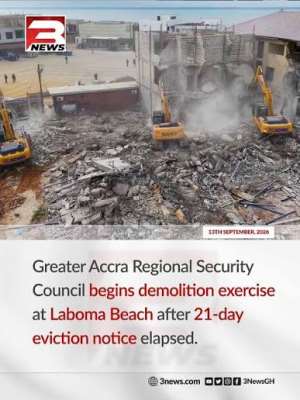
Whenever heavy rains hit Accra, a familiar and painful pattern unfolds. Streets overflow, businesses wash away, homes submerge, and the state responds with heavy machinery.
The recent enforcement actions at the Laboma beach enclave near the Kpeshi Lagoon are the latest example of this routine. On one hand, government officials, municipal authorities, and security forces present these demolitions as necessary, decisive steps to free up blocked waterways and rescue low-lying communities from annual disaster. On the other hand, affected property owners and observers point to valid municipal permits they paid for, watching millions of cedis turn into rubble overnight while rightly questioning the legality, institutional motives, and economic fallout of such actions.
Behind the headlines of bulldozers, displaced businesses, and television crews lies a far more fundamental question: Is this demolition strategy rooted in an engineered redesign of Accra’s flooding gateways, or is it merely an arbitrary exercise based on institutional instinct, political pressure, and reactive optics?
In my recent analysis of the capital's historic flooding ("The Chronic Deluge of Accra: Reconciling Historical Failure, Infrastructure Deficit, and Civic Responsibility"), I emphasized that urban flooding is fundamentally a physical problem governed by water dynamics and spatial reality. Over recent decades, Accra has stripped away nearly 60% of its natural green cover while concrete construction has surged, increasing peak stormwater runoff by 3.5 times. When rain hits paved surfaces that can no longer absorb water, that runoff will naturally take the path of least resistance.
Clearing structures built directly along natural waterways or lagoon margins can be a legitimate component of restoring water channels. But demolition as a standalone act is not a solution—it is a blunt instrument.
If state authorities simply flatten buildings without first executing proper hydrological planning, we are merely performing administrative theater. If you knock down a building in a waterway but fail to redesign the broader drainage system, you accomplish very little. The water will simply flow into the newly cleared space, pick up silt and debris, and flood the very next neighborhood down the line.
To make demolition meaningful and effective, state enforcement must satisfy clear, practical engineering criteria:
- Hydraulic Re-Engineering of Gateways: Are the cleared paths actually calibrated to the real volume of water flowing through the basin during a major storm? Merely clearing an arbitrary strip of land does not guarantee flood relief if the downstream outlet into the Gulf of Guinea or the intake channels from upstream tributaries remain constricted or improperly graded.
- Integrated Channel and Outlet Design: Simply removing a building leaves behind raw, exposed terrain. Without paved channels, wide-bore underground pipes, urban retention ponds, or managed green wetlands, the cleared ground will quickly silt up, collect unmanaged waste, and choke right back up during the next deluge, shifting the bottleneck a few hundred meters down the road.
- Addressing the Root Permitting Crisis: As indicated, many owners build because municipal assemblies issue them official permits or turn a blind eye for years. Pulling down properties after granting permits creates massive legal liabilities for the state in judgment debts, while doing nothing to stop local assemblies from issuing conflicting permits elsewhere in the same catchment basin tomorrow.
We cannot continue to rely on heavy machinery every June as a substitute for real infrastructure planning, deploying bulldozers every time the rains hit only to watch the same neighborhoods drown the following season. Clearing blocked waterways must be part of a larger, scientifically tested drainage master plan.
A workable flood mitigation strategy requires a centralized, practical approach:
- Deploy Hydraulic Modeling: Use catchment-wide hydrological data to determine the exact channel sizes and locations needed for water transport before sending in demolition crews.
- Build "Sponge Infrastructure": Construct dedicated retention basins, permeable surfaces, and properly sized drainage networks along major basins like the Odaw and Kpeshi catchments.
- Enforce Institutional Accountability: Merge and align the fragmented mandates across the Land Use and Spatial Planning Authority (LUSPA), the Hydrological Authority, and local MMDAs so that spatial planning, municipal permitting, and civil engineering work together rather than at cross-purposes.
Accra’s flood crisis stems from decades of poor spatial planning, weak drainage networks, and civic indiscipline like refuse dumping in gutters. But while the state has every right to demand discipline from citizens, citizens have every right to demand technical competence, structural foresight, and an end to quick fixes from the state.
Demolition without an engineered plan is just destruction. Only grounded, professional engineering will finally keep Accra dry.
ABOUT THE AUTHOR
Yao Ababio, PhD, MBA is a process engineering leader, systems executive, and civic commentator dedicated to sustainable development and institutional reform. Combining an extensive background in global technical infrastructure with a focus on public policy, Dr. Ababio applies data-driven analytical frameworks to structural and urban development challenges in Ghana. His public commentaries advocate for institutional accountability, engineering rigor, and long-term infrastructure planning.
Contact: [email protected]


 'Some NPP members did not vote in 2024 election because I left NPP' – Alan Kyere...
 How €225 million cocaine from Ghana traced to fugitive Dutch drug kingpin based ...
 'Galamsey remains an existential threat' – Gyampo demands more action
 'I’m like Akpeteshie, I don’t need adverts to win' – Hawa Koomson storms home tu...
 'Excessive bail conditions must be reviewed' – GBA President
 Ketu South: Four-year water crisis deepens hardship in Agbozume
 Show evidence of higher operating costs to justify fare hike – NPA CEO to transp...
 Four Ghanaians arraigned over alleged €225 million cocaine shipment to France
 Agbogbloshie: Police kill suspected robber, recover AK-47, 186 rounds of ammunit...
 DVLA opens 29 new offices in 18 months; 62 offices nationwide - CEO


