




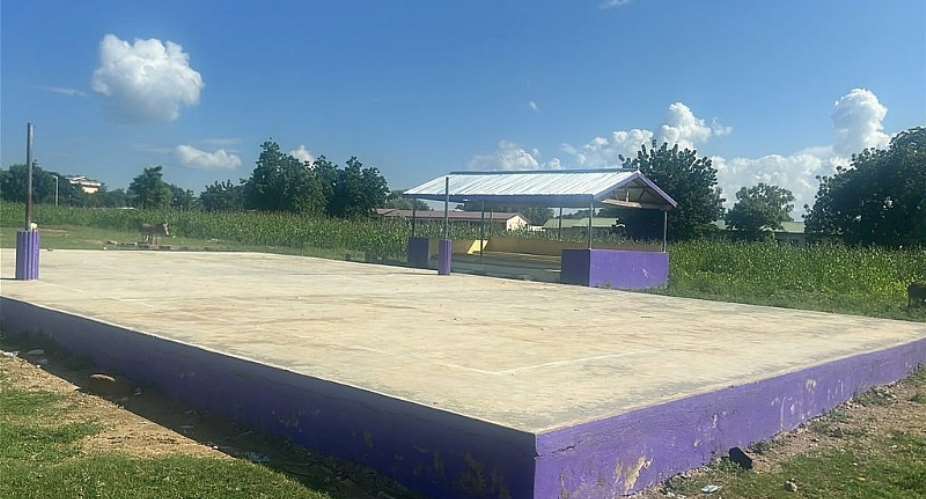
A GH¢213,490 volleyball court constructed by the Bongo District Assembly under the World Bank-funded Gulf of Guinea Northern Regions Social Cohesion (SOCO) Project has remained largely unused for more than two years, after young people in the community rejected the facility.
The project, completed in 2024, was intended to provide recreational opportunities for young people and promote social cohesion in the Bongo District of the Upper East Region.
But instead of becoming a hub for sporting activities, the facility has become a source of controversy, with residents questioning why the Assembly chose to invest heavily in a sport they say has little or no following in the community.
Some young people who spoke to the media said they were not consulted before the project was undertaken and believe the money could have been better spent rehabilitating the community's existing football park, which they say attracts young people every day.
23-year-old Godwin Akurubire said the choice of volleyball was difficult to understand given the popularity of football among young people in Bongo.
“There are no volleyball players in Bongo,” he said. “Even if the Assembly was bent on spending the money on sporting activity, it should have been our football park. What all the youth here like is football.”
For 20-year-old Rodney Aduko, the unused facility represents a project that does not reflect the priorities of the community.
“Every day, we come there to play football and yet they say they did this thing for the community. This thing, I do not see its use for us as youth. Here in Bongo, I have never seen any person who plays or has interest in playing volleyball,” he said.
The Assembly Member for the Bongo-Atampiisi Electoral Area, where the court is located, Mba Asampana, was even more critical, describing the facility as a “deathtrap and a waste of state resources.”
“Looking at how high it is, who would risk himself to play there?” he asked.
Mr Asampana also alleged that assembly members were not consulted before the decision was taken to construct the facility, raising further questions about community participation in the selection and implementation of the project.
Documents obtained from the Bongo District Assembly show that the GHS213,490 project was expected to include a urinal in addition to the volleyball court.
Assembly officials, however, said the amount allocated for the project was insufficient to construct the urinal.
The Bongo District Planning Officer, Kugoriba Thomas, defended the project, saying it was conceived to provide young people with inclusive recreational activities and help steer them away from social problems.
However, the concerns do not end with the facility's lack of use.
Questions have also been raised about the design and safety of the court, particularly its elevated platform and the narrow space around the playing area.
Abdul-Rahman Danladi, head coach of Ghana's senior women's national indoor volleyball team, expressed concern about the design after examining the facility.
“The court is very high. And if it’s high like that, they should have at least expanded it because it is very narrow,” he said.
Mr Danladi warned that players chasing balls beyond the cemented playing area could fall from the elevated platform and sustain serious injuries.
“The best way is to expand it or, better still, construct a lower platform around it so it would not cause any danger to the players,” he advised.
He also suggested placing gravel around the facility as an additional measure to reduce the risk of injuries.
The project was undertaken as part of the SOCO programme, which supports infrastructure and social cohesion initiatives in Ghana's northern regions.
But more than two years after its completion, the Bongo volleyball court remains a stark example of the challenge of implementing public projects without adequately aligning them with the needs, interests and priorities of their intended beneficiaries.
Rita Atanga, a former Bongo District Chief Executive who was involved in the decision to construct the facility, declined to comment when contacted.
The questions now confronting the project go beyond why the court was built. They include whether adequate consultation was undertaken, whether the design was appropriate for its location, whether the project represented value for money and, ultimately, who the facility was actually built for.


 Founder’s Day September 21 declared holiday
 Council of State was not qualified to determine prima facie case against Torkorn...
 'Grounds for removal of Chief Justice and justice of superior court shallow, eph...
 Ghanaian banks write Off GH¢1.23bn in bad loans in first half of 2026
 Family of Gbewaa Training College lecturer killed by curfew soldiers vows legal ...
 Don't be a Bar that flips on principles but a Bar that is consistent — AG tells ...
 Fully completed GH¢213,490 SOCO volleyball court abandoned after Bongo youth rej...
 Stan Dogbe orders Greater Accra Regional Coordinating Council to restore Kpeshie...
 Police probe mysterious death of popular primary school teacher at Ampabame No. ...
 NACOC arrests three members of ‘Bolle Jos’ Network over French cocaine seizure


