




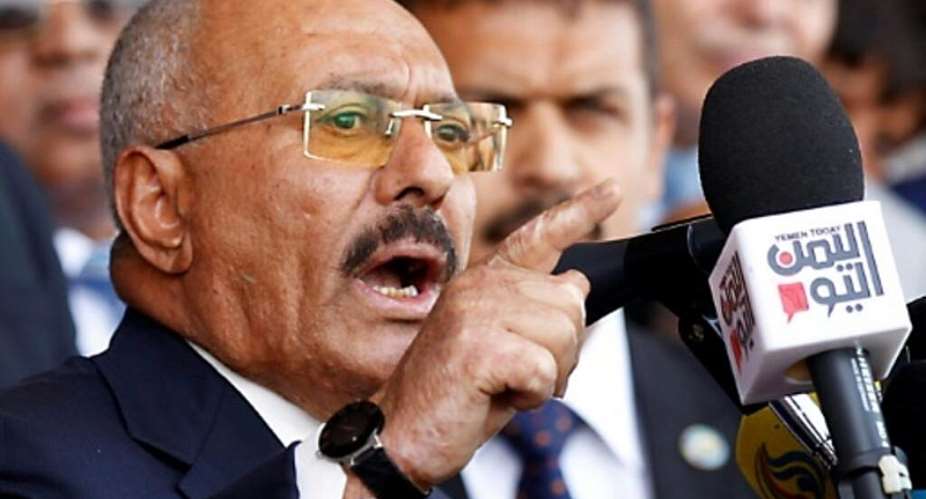
Ahmed and Khaled Saleh are charged with money laundering, embezzlement of public funds and corruption as part of an organised criminal group. They deny the allegations.
Their father, Ali Abdullah Saleh, was forced out of power in 2012 and killed by Iran-backed Houthi rebels five years later.
During his 33-year rule from 1978 to 2012, he is suspected of having plundered Yemen's resources and allowing those close to him to benefit from the proceeds.
His eldest son Ahmed, now 54, and his third son Khaled, 39, are among those accused.
France's Financial Prosecutor's Office (PNF) opened an investigation into suspicious fund transfers in March 2019, following a request for legal assistance from Swiss authorities.
Swiss investigators were examining transfers into accounts held by Ahmed Saleh, with funds moving from Yemen to Geneva via Paris. French prosecutors accuse Ahmed Saleh, centre, of playing "a central role within the regime established by his father".
Luxury Paris properties
The probe centres on the purchase of three properties in the up-market west of Paris, close to the Arc de Triomphe and Champs-Élysées.
Several flats in one of the buildings were bought for €7m in 2005 and another for €6.5m in 2010.
The third transaction involved a 2.5m-euro stake in the purchase of two private mansions in 2011.
Several of the properties have been seized by the courts.
Investigators from France's anti-corruption and financial-crime police unit (OCLCIFF) identified several Paris bank accounts belonging to Ahmed Saleh.
More than €26m was transferred from Yemen into one of the accounts between 2009 and 2011. The money is suspected of having helped finance the properties.
The PNF said the fraudulent origin of the funds had been established because they were "inextricably linked to the kleptocratic regime established by Ali Abdullah Saleh".
Toll from Yemen clashes passes 300 as civilians flee homes
Corrupt practices
The case is based largely on investigations and reports by a United Nations Security Council panel of experts on Yemen.
In its first report, published in February 2015, the panel said that during his 33-year rule, the former president was "alleged to have amassed assets between $32 billion and $60 billion, most of which are believed to have been transferred abroad under false names or the names of others holding the assets on his behalf [...] to at least 20 different countries".
The UN experts alleged that Saleh, together with relatives and political allies, took control of Yemen's resources partly through his corrupt practices – including the redistribution of previously nationalised land and kickbacks from arms, gas and oil contracts.
A senior Yemeni government official told the experts in 2015 that "oil companies operating in the country paid a 20 percent commission to Ali Abdullah Saleh".
Large sums were also allegedly diverted from public services through so-called ghost services, with money allocated to the army, education and health but producing no concrete results.
Project costs were also allegedly inflated to create commissions, particularly in public works, with 16 percent going to the regime.
French billionaire investigated in money laundering probe
Alleged laundering network
In reports published from 2016 to 2018, the UN experts examined suspected money-laundering networks, including through the purchase of property in France by two companies.
The panel said it had evidence that Ahmed Saleh was the main shareholder in the companies.
It also pointed to the "decisive role" allegedly played by Khaled Saleh after the UN froze the assets of Ali Abdullah Saleh in 2014 and Ahmed Saleh in 2015.
The Security Council lifted sanctions against Ahmed Saleh and his late father in the summer of 2024.
The PNF said Ahmed Saleh, a former commander of the Republican Guard, had played "a central role within the regime established by his father". He had initially been expected to succeed his father, prosecutors said, placing him "necessarily at the heart of this oligarchy operating as a family business".
Prosecutors said he had personally been involved in acts of corruption and had also played "a central role in the money-laundering network established in France".
Ahmed Saleh was appointed ambassador to the United Arab Emirates after the 2012 uprising against his father.
His younger brother Khaled, also a former member of the Republican Guard who later went into business, is described by prosecutors as initially acting as a financier on behalf of, or under the orders of, his brother and father.
His role became "more central after his father and brother were placed on the UN sanctions list", prosecutors said.
Dubai's thriving global financial hub faces wartime stress test
'Gifts' from foreign heads of state
Both men rejected the UN experts' work on the origins of the family's wealth during the investigation.
Ahmed Saleh described their findings as "provocative and false statements" based on "the discourse of the political opposition".
He said the roughly €26m transferred to France came from "gifts" from foreign heads of state, but said he could not prove this because the evidence had been destroyed during the war.
The defendants' lawyers said that while the brothers did not dispute owning the properties targeted in the case, they categorically denied that the money had a fraudulent origin.
"The prosecution in this complex case is weak," lawyers Pierre-Olivier Sur and Clara Gérard Rodriguez told RFI.
"First, because the allegedly illegal nature of the funds received by our clients' father is based only on vague and general allegations reported in open sources, with no material evidence to support them."
They said the use of the money to buy property in France had been carried out "legally, and in complete transparency".
The lawyers said they had wanted the brothers, who live in the United Arab Emirates, to answer the court's questions in person.
But the current security situation in the Middle East and numerous flight cancellations had prevented them from meeting their clients and would also prevent the brothers from attending the hearing, they said.
Two other defendants are also on trial – a Yemeni businessman close to the Saleh family, accused of helping manage their assets, and the manager of an asset-holding company set up by the businessman.
The trial is due to run until 14 September.
The article is based on theoriginal in French by RFI's Laura Martel

 'Some NPP members did not vote in 2024 election because I left NPP' – Alan Kyere...
 How €225 million cocaine from Ghana traced to fugitive Dutch drug kingpin based ...
 'Galamsey remains an existential threat' – Gyampo demands more action
 'I’m like Akpeteshie, I don’t need adverts to win' – Hawa Koomson storms home tu...
 'Excessive bail conditions must be reviewed' – GBA President
 Ketu South: Four-year water crisis deepens hardship in Agbozume
 Show evidence of higher operating costs to justify fare hike – NPA CEO to transp...
 Four Ghanaians arraigned over alleged €225 million cocaine shipment to France
 Agbogbloshie: Police kill suspected robber, recover AK-47, 186 rounds of ammunit...
 DVLA opens 29 new offices in 18 months; 62 offices nationwide - CEO


