




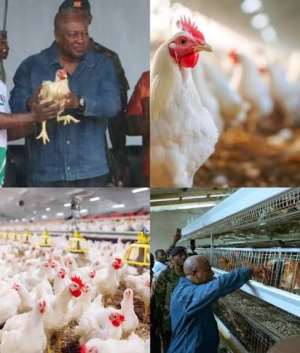
Ghana is reportedly committing $270 million to developing an integrated poultry industry covering feed production, hatcheries, farming, processing, cold storage and distribution.
It sounds impressive. But behind the headline figure lies a more important question: Will this investment rescue Ghanaian poultry farmers, or simply create another big industry around them?
Ghana reportedly consumes about 340,000 tonnes of chicken annually, while importing approximately 270,000 tonnes. If these figures are accurate, roughly four out of every five tonnes of chicken consumed in Ghana come from abroad.
That is not merely a food-security problem. It is an economic problem.
Every shipment of imported chicken requires foreign exchange. At the same time, Ghanaian poultry farmers struggle with expensive feed, high interest rates, disease risks, inadequate processing facilities and fierce competition from imported frozen chicken.
So where will the ordinary poultry farmer fit into this $270 million investment?
Will existing farmers become contract growers and suppliers to the new processing facilities? Will they receive affordable day-old chicks, veterinary support and financing? Will processors guarantee markets for their birds?
And perhaps the biggest question: Will poultry feed become cheaper?
Feed remains one of the largest costs of poultry production. Building modern processing plants will mean little to the farmer if maize, soybean meal and other feed ingredients remain so expensive that locally produced chicken cannot compete.
Government must therefore go beyond announcing the size of the investment and tell Ghanaians exactly what success will look like.
How many existing poultry farmers will participate? How many new jobs will be created? How much chicken will Ghana produce locally within three to five years? How much foreign exchange will be saved? What percentage of the country's poultry demand will eventually be supplied locally?
These are measurable questions requiring measurable answers.
There is also an uncomfortable issue that cannot be ignored.
If Ghana's poultry industry succeeds, somebody's import business will suffer.
For decades, poultry imports have supported a substantial commercial network of importers, wholesalers, cold stores and distributors. If Ghanaian chicken begins replacing imported frozen chicken, some businesses will inevitably lose market share.
Will policymakers remain committed to domestic production when those commercial interests begin feeling the pressure?
Ghana cannot invest hundreds of millions of dollars in rebuilding its poultry industry while simultaneously allowing imports to undermine the very farmers the investment is supposed to support.
But consumers must also be protected. The solution is not simply banning imports and forcing Ghanaians to buy expensive local chicken. The objective must be to make Ghanaian poultry genuinely competitive through affordable feed, efficient production, improved breeds, modern processing, accessible financing and reliable markets.
Done properly, the benefits could extend far beyond poultry farmers.
Maize and soybean farmers would gain new markets. Hatcheries, feed mills, veterinary services, transport companies, packaging businesses, cold-chain operators and retailers would benefit. Thousands of jobs could be created while valuable foreign exchange remains within Ghana's economy.
But small and medium-scale poultry farmers must not become spectators.
The true measure of this $270 million investment will not be the number of factories commissioned or speeches delivered.
It will be whether Ghanaian farmers are producing more birds, earning sustainable incomes and supplying more of the chicken on Ghanaian tables.
If Ghana gets poultry right, somebody's import business will certainly suffer. But Ghana's farmers, workers, economy and foreign-exchange reserves could be the winners.


 OSP invites Patricia Appiagyei over alleged GHS70,000 vetting payment
 Avoid conduct that creates perception of judicial bias — CDD-Ghana urges Chief J...
 It may be time to end vetting if it has become an avenue for extortion – Kwaku A...
 'You have one week to shut down new Winneba Police Station or face our wrath' — ...
 NACOC arrests alleged drug dealer, wife in Weija operation
 Northern Minister orders probe into School Feeding irregularities
 Afenyo-Markin, A-Plus to lead peace mission to Gomoa and Effutu communities on S...
 NPP Chairmanship race: I have not made disparaging comments about John Boadu – B...
 Rally firmly behind Bawumia for 2028 victory – Afenyo-Markin charges NPP communi...
 FAKE: Deputy Minority Leader returns GHS70,000 received from vetting of Minister...

