




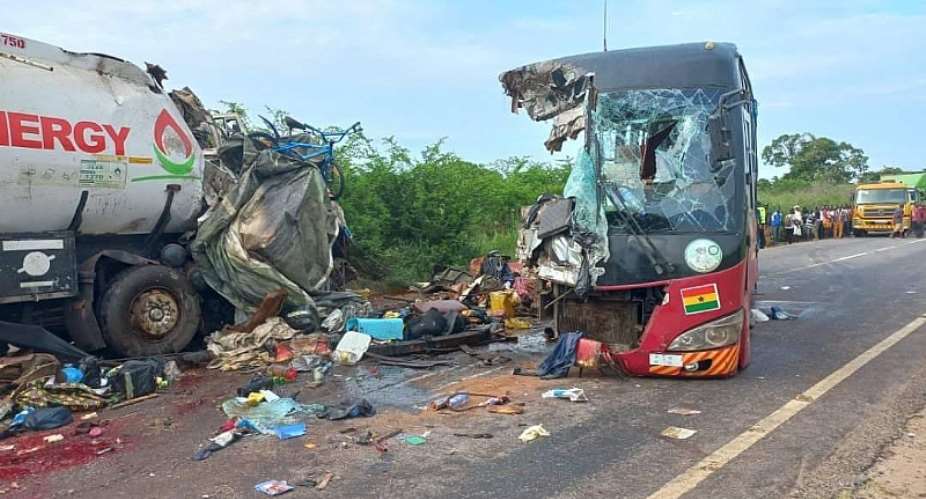
Road accidents cost Ghana an estimated US$4.55 billion annually, equivalent to about 2.1 per cent of the country’s Gross Domestic Product (GDP), the World Bank has disclosed.
The Bank also said only about 27 per cent of Ghana’s 94,200-kilometre road network is paved, with more than half of the paved roads in fair-to-poor condition.
The country’s rail network has similarly experienced a significant decline, from 947 kilometres of operational rail lines in 1960 to about 160 kilometres by 2020. Over the same period, population access to rail services fell from nearly 30 per cent to less than one per cent.
The World Bank disclosed these figures in its 10th Ghana Economic Update, launched in Accra on Wednesday under the theme, “Reset for Growth: Sustaining macroeconomic recovery and unlocking transport for transformation.”
According to the Bank, Ghana’s transport infrastructure challenges have been worsened by fragmented institutional responsibilities, which have made effective coordination in the planning and implementation of programmes difficult.
“The economic cost is staggering, road safety incidents alone cost an estimated 2.1 per cent of Gross Domestic Product (GDP) annually – roughly US$4.55 billion – more than the entire national education budget,” Dr Robert Taliercio O’Brien, World Bank Division Director for Ghana, Liberia and Sierra Leone, said.
The Bank, however, noted that it was supporting government efforts to address some of the infrastructure challenges.
In May 2026, the World Bank provided US$500 million through the Ghana Market Access and Connectivity Project to support the rehabilitation of about 1,050 kilometres of feeder roads under performance-based maintenance contracts.
Dr O’Brien said improving Ghana’s transport infrastructure was critical to the country’s economic transformation, describing it as a growth, competitiveness and jobs issue.
He outlined six priority areas for transforming the transport sector, including operationalising the Road Maintenance Trust, developing a unified national transport sector strategy and revitalising value on the western and eastern rail corridors.
Other proposed reforms include treating road safety as a public health emergency to reduce fatalities, incorporating climate-resilient design standards into new infrastructure projects and introducing a digital single window to streamline permits, inspections and logistics.
Dr O’Brien described the government’s Big Push programme as a “significant ambition” and said the World Bank remained committed to working with Ghana to address the country’s transport infrastructure challenges.
“The returns will only materialise if reforms in maintenance financing, institutional coordination, and governance are implemented alongside the capital investment,” he said.
Finance Minister Dr Cassiel Ato Forson, whose speech was read by the Ministry’s Coordinating Director, Samuel Arkhurst, said government recognised the infrastructure deficit and was investing to close the gap.
He said the economic gains recorded in recent years provided a foundation for the country to focus on creating jobs and attracting investment to communities that had experienced development challenges for extended periods.
“This is precisely the thinking behind our Big Push Infrastructure Programme, the largest coordinated investment in strategic transport infrastructure that Ghana has undertaken in recent years,” Dr Forson said.
He disclosed that by the end of June 2026, projects under the programme were underway in all 16 regions, with 13 projects at least halfway completed and six more than three-quarters completed.
Dr Forson said the 176-kilometre, six-lane Accra-Kumasi Expressway had 122 kilometres of its right-of-way cleared, with feasibility and engineering designs expected to be completed by the end of August. Procurement for construction was scheduled for September.
He also highlighted progress on the Adawso-Ekye Amanfrom Bridge over the Afram River and the Dambai Bridge along the Eastern Corridor, describing them as projects aimed at addressing longstanding connectivity challenges affecting communities.
The Finance Minister said the World Bank-funded US$500 million feeder roads rehabilitation programme, covering 13 regions, was expected to reduce travel times by 40 per cent, lower transportation costs and post-harvest losses, and create 25,000 jobs, including 7,500 opportunities for women.
“When a farmer in the Afram Plains or along the Northern Corridor can get her produce to market without losing a third of it to a damaged road, that is not just an infrastructure achievement. It is a food security story, an income story, and a story about who gets to share in growth,” he added.
Dr Forson expressed appreciation to the World Bank for its support towards improving Ghana’s transport infrastructure.

 WAEC must open itself to greater scrutiny and accountability – GNAPS
 Parliament unanimously approves Ayariga, Zenator as ministers
 Parliament approves three Supreme Court nominees despite Minority boycott
 James Agalga assumes office as new Majority Leader
 'I promise you well-researched dossier for all my debates; offer different lens ...
 Road accidents costs Ghana approximately US$4.55 billion annually — World Bank
 Only 27% of Ghana’s roads paved – World Bank
 Forgive Ayitey Powers — Bukom Banku begs Yaw Ampofo Ankrah
 [VIDEO] Tricycle rider refuses to comply with plainclothes police man after arre...
 Controlled spillage from Bagré Dam begins Friday — Water Resource Commission


Comments
It is shameful, is it not, that we have all besuited, bespectacled Ph.D holders in our various institution, especially Ghana Statistical Service, yet it takes foreign entities to tell us things like this. What is the matter with us koraa????