




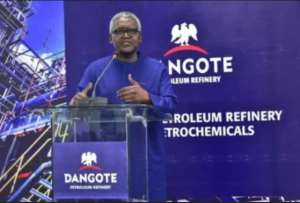
The scale of corporate ambition in African equity capital markets has reached a historic inflection point. The formal submission of an initial public offering (IPO) application by the Dangote Petroleum Refinery to Nigeria’s Securities and Exchange Commission (SEC) signals what is poised to become the largest stock market listing in the continent's history. Targeting an aggregate raise of approximately $5 billion on a valuation benchmark sitting around $40 billion, the proposed offering transforms theoretical regional self-sufficiency into an investable, public asset.
Crucially, this public market milestone is anchored by a strategic $1 billion underwriting programme structured by Marob Strategies and Lilium Capital Group. This facility comprises a completed and fully funded $600 million private placement through Lilium’s Pan-African Refinery Investment SPV, alongside a $400 million underwriting commitment dedicated to supporting the upcoming public offer. By securing institutional backing ahead of the filing across Africa and international markets, the sponsors have effectively established institutional pricing credibility. This pre-IPO capital structure clears out early execution risk and sets an aggressive valuation baseline, laying the groundwork for a primary issuance designed to reshape domestic institutional portfolio allocations across the continent.
The Market Capitalization Footprint
A primary equity issuance targeting $5 billion introduces a monumental gravitational pull to the domestic exchange. With the Nigerian Exchange (NGX) total market capitalization sitting around the 150 trillion Naira threshold, a single listing of this magnitude instantly commands a massive weight, accounting for roughly 30% to 35% of total exchange value. Absorbing an asset of this scale alters baseline index tracking overnight, meaning institutional benchmark funds will be forced to recalibrate their sector allocations and concentration limits almost immediately.
Historically, emerging and frontier exchanges face severe liquidity bottlenecks, often constrained by a lack of mega-cap supply capable of absorbing institutional-scale capital. The Dangote Refinery offering fundamentally rewrites this dynamic. By creating a multi-billion-dollar liquid security, the listing provides a deep, high-capacity vehicle that can accommodate heavy ticket sizes from both local and international institutional desks without inducing extreme price volatility.
Asset Valuation and Corporate Strategy
When evaluating a massive single-train refining asset operating at 650,000 barrels per day, analysts must move beyond standard price-to-earnings metrics toward throughput multiples and robust cash-flow visibility. Specifically, those assessing the targeted $40 billion to $50 billion valuation benchmark look closely at nameplate capacity utilization which has pushed near peak operational thresholds to gauge replacement cost value and long-term earnings power.
Furthermore, a critical component of the asset's financial architecture is its projected $6.4 billion in annual revenue driven by petrochemical and petroleum product exports. This hard-currency generation directly supports a novel dividend structure designed to pay out in US dollars despite shares being purchased in local currency. Consequently, analysts must weigh these robust dollar inflows against the refinery's $3.65 billion debt load, evaluating how free cash flow will be split between servicing capital expenditure commitments, paying down leverage, and funding investor returns.
Rather than functioning as a standard private equity exit where early backers completely cash out, the primary proceeds are framed as vital growth capital. The offering serves to optimize the company's capital structure, institutionalize its governance framework, and provide a liquid currency to back ongoing operational expansions across regional energy markets.
Continental Integration and Macroeconomic Significance
Beyond the balance sheet, this transaction serves as a foundational pillar for the broader structural trade goals of the African Continental Free Trade Area (AfCFTA). For decades, the continent has suffered from a profound structural paradox: exporting raw crude oil only to import over 70% of its refined petroleum products back at higher, inflation-prone costs. By bringing a facility of this magnitude into the public capital markets, the listing aligns directly with regional mandates to foster intra-African trade, industrialization, and value addition.
Consequently, the macroeconomic transition is profound. The refinery effectively reshapes regional energy trade flows, converting Africa from a net energy-importing dependent into an industrialized, self-sustaining hub. When investors examine this upcoming public offering, they are not merely pricing a manufacturing asset; they are evaluating an anticipated structural shift in the continent’s balance of trade, currency stability, and economic sovereignty.

 'Some NPP members did not vote in 2024 election because I left NPP' – Alan Kyere...
 How €225 million cocaine from Ghana traced to fugitive Dutch drug kingpin based ...
 'Galamsey remains an existential threat' – Gyampo demands more action
 'I’m like Akpeteshie, I don’t need adverts to win' – Hawa Koomson storms home tu...
 'Excessive bail conditions must be reviewed' – GBA President
 Ketu South: Four-year water crisis deepens hardship in Agbozume
 Show evidence of higher operating costs to justify fare hike – NPA CEO to transp...
 Four Ghanaians arraigned over alleged €225 million cocaine shipment to France
 Agbogbloshie: Police kill suspected robber, recover AK-47, 186 rounds of ammunit...
 DVLA opens 29 new offices in 18 months; 62 offices nationwide - CEO


