




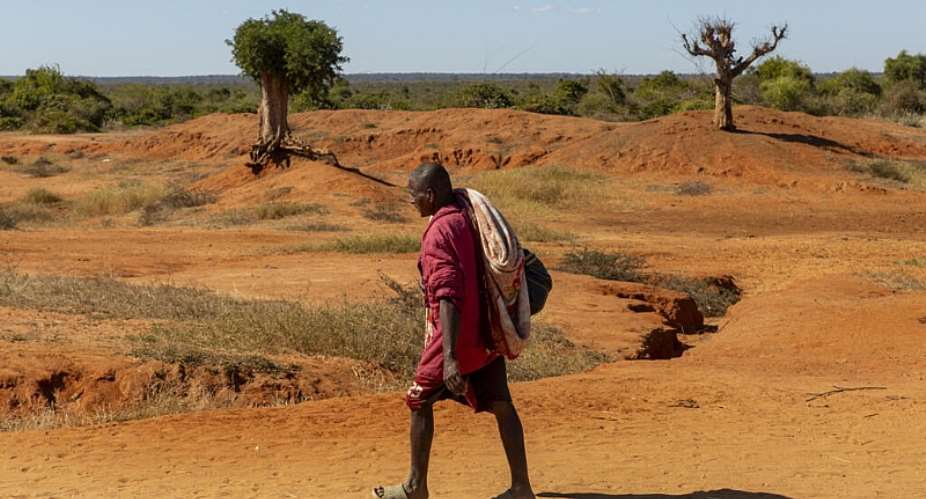
The 17th session of the Conference of the Parties (Cop17) of the United Nations Convention to Combat Desertification (UNCCD) runs in Ulaanbaatar, Mongolia, from 17 to 28 August, under the theme "Restoring Land. Restoring Hope."
Less well known than the UN's climate and biodiversity conferences, the bi-annual talks on desertification have taken on far greater importance in the wake of recent heatwaves and wildfires in the northern hemisphere, Europe and Asia.
North America, Africa, and Asia all experienced their hottest July on record, according to Nasa.
At the summit in Mongolia, 196 countries plus the European Union will discuss the "operationalisation" of the Riyadh Global Drought Resilience Partnership, set up during Cop16 in 2024 under the leadership of Saudi Arabia.
Under the partnership, countries and institutions pledged $12 billion (€10.3 billion) over seven years to help 74 vulnerable countries deal with drought and the accompanying problem of land degradation.
3.2 billion people impacted
The amount is small compared to the needs – about $2.6 trillion by 2030, according to UNCCD estimates, to repair degraded land, halt desertification, protect against drought and restore soils.
Worldwide, desertification and land degradation affect 40 percent of the Earth's land area and 100 million hectares of healthy land become unproductive each year.
Climate change, deforestation, poor farming practices and monocultures are putting pressure on the land and yields are falling where soils are exhausted, directly threatening the lives of 3.2 billion people and causing estimated economic losses of $880 billion (€758 billion) a year.
In high-income countries, land degradation is often masked by intensive use of fertilisers, which can further damage soils over time. In low-income countries, particularly in sub-Saharan Africa, lower yields and limited access to fertilisers leave populations extremely vulnerable.
Why China's decades-long ambition to green the desert could run dry
Restoring degraded land
While the UNCCD estimates that restoring degraded soils costs $1 billion a day, there is nonetheless a return on investment.
"There's a huge need for funding but there's an economic return on these investments," said Sandra Rulliere, deputy head of the agriculture, rural development and biodiversity division at the French Development Agency (AFD) .
"Every dollar invested in restoring degraded land brings a return of between seven and 30 dollars. So these are investments that pay off – for societies and for the planet," she told RFI.
The researcher underlined that investing in the health of the land means investing in food security and in the ability to adapt to climate change, since soils store carbon.
"After all, healthy land is land that is better able to withstand climatic hazards. When you have soil that has managed to capture and retain water – because it's healthy, it contains organic matter – it means that this water can be released back to the plants, and so the soil has a greater capacity to sustain and nourish them."
One of the aims of Cop17 will therefore be to persuade governments, agricultural banks and the private sector to invest in restoring land and stop subsidising intensive farming practices that destroy soils.
Why reviving old crops is key to saving Africa's degraded soils
Pastoralism in focus
Pastoralism is also expected to be a major focus of Cop17 in Mongolia – where 77 percent of the land has been degraded through desertification.
Under Mongolia's initiative, the UN's General Assembly has declared 2026 theInternational Year of Rangelands and Pastoralists.
The move is a belated recognition of the benefits of pastoralism for protecting soils and fragile ecosystems, as well as supporting economic development and social cohesion in arid and semi-arid areas.


 'Your visit is perfect' — Defeated Kokofu pledges support to newly elected Ashan...
 Upper East Regional Minister pushes for revival of abandoned Bolgatanga Sports S...
 Two killed, seven injured in Sienta-MMT bus crash at Assin Fosu
 Dome-Kwabenya-Kitase residents hit streets over 20-year abandoned road project
 14 arrested over alleged cultivation and distribution of ‘wee’ in Nabdam
 FDA cautions against use of chemicals to ripen plantain
 August 17: Cedi appreciates, sells at GHS12.30 on forex market, GHS10.96 on BoG ...
 Ghana's missing billions: What 16 years of Auditor-General reports show
 Fire breaks out at Gushegu Nursing and Midwifery Training College dormitory
 'Go ahead and imprison me because of my friendship with Bawumia, I will come bac...

