




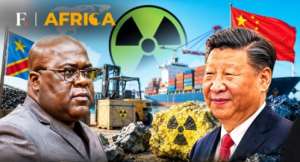
An investigation published on July 30, 2026 by the Dutch outlet Lighthouse Reports and Britain's Financial Times, backed by a peer-reviewed study in Nature Communications, has revealed that between 2,000 and 5,000 tons of uranium may have left the Democratic Republic of Congo for China over the past two decades hidden inside routine, entirely legal cobalt exports. The findings raise serious questions about nuclear materials accounting, environmental safety around Congolese mines, and the opacity of one of the world's most strategically important supply chains.
How the uranium travels with the cobalt
The DRC is the world's dominant cobalt producer, supplying more than two-thirds of global output and feeding directly into the batteries powering the global energy transition. The mineral belt of Katanga and Lualaba, where most of this cobalt is mined, also contains naturally occurring uranium. Because cobalt and uranium behave similarly in the acid baths used in hydrometallurgical processing, the two elements are extracted and concentrated together. Without a dedicated separation circuit, uranium ends up concentrated in the cobalt hydroxide that is shipped abroad overwhelmingly to Chinese refineries, which today receive roughly 80 to 95 percent of Congolese cobalt.
Researchers Sébastien Philippe and Ryan Manzuk modelled uranium concentrations across Katanga's ore deposits and mine-output data to arrive at their estimate. Even the lower bound of the range, 2,000 tones, would theoretically be enough once extracted and enriched to fuel a one-gigawatt nuclear reactor for at least a decade, or, according to calculations cited in the investigation, to produce several hundred nuclear weapons if enriched to weapons-grade. The researchers were careful to note that their work does not establish whether any uranium was actually recovered once it reached China, or how it might have been used.
A warning ignored for fifteen years
The investigation traces back to a confidential 2009 memo from the International Atomic Energy Agency, which already noted that uranium was present in significant quantities in most cobalt ores from Katanga and was effectively being exported as a byproduct of cobalt. No systematic separation measures were introduced in the years that followed. Less than 10 percent of the uranium estimated to have left the DRC has ever been declared to international authorities a gap researchers describe as a substantial failure in nuclear materials accounting and environmental oversight within a critical supply chain.
Tenke Fungurume at the centre of the dispute
The investigation's most pointed allegations concern Tenke Fungurume, one of the DRC's largest cobalt mines, majority-owned by China's CMOC Group (formerly China Molybdenum) since it acquired Freeport-McMoRan's controlling stake in 2016. Leaked internal documents cited by the Financial Times and Lighthouse Reports allegedly show uranium levels in Tenke's cobalt repeatedly exceeding Congolese legal limits between 2016 and 2020, with elevated concentrations reportedly persisting in some batches as late as June 2021.
CMOC has firmly rejected the findings, stating that none of the cobalt hydroxide it has marketed has ever exceeded applicable uranium limits, and that it has never faced a customs hold, a customer rejection, or a complaint over uranium content. The company argues compliance should be judged on the characteristics of the final dried product rather than intermediate production-stage results. The Union sacrée des minières chinoises au Congo (USMCC), an association representing Chinese mining firms in the DRC, issued a statement on August 5 backing CMOC's position, calling the allegations unfounded and insisting there is no economic or technical basis for anyone to recover or exploit uranium from Congolese cobalt.
Other operators, including Glencore and the Eurasian Resources Group, have in the past suspended or adjusted production after uncovering similar contamination issues an indication that the phenomenon, while newly quantified at this scale, is not unknown to industry insiders. Beijing did not respond to the Financial Times' requests for comment.
Congolese authorities acknowledge the risk
DRC officials have not dismissed the concerns. Steve Muanza, head of the country's nuclear energy agency, told the Financial Times it is "technically possible," and even "likely," that Chinese companies are extracting uranium from cobalt ore exported from the DRC. His agency has requested funding to install radiation monitors on trucks leaving the country along National Highway One toward Zambia an acknowledgment of how porous and difficult to police the DRC's borders remain amid ongoing insecurity in the east.
The findings carry particular historical weight given their geography. The uranium-rich Katanga copper belt is also home to the now-closed Shinkolobwe mine, the source of the uranium used in the American atomic bombs dropped in 1945. Kinshasa has maintained an official moratorium on uranium exports since Shinkolobwe's closure in 2004 a moratorium this investigation suggests has been effectively circumvented for years, not through clandestine smuggling networks, but through the entirely legal channel of cobalt exports.
Why this matters beyond the DRC
For Western nonproliferation analysts, the core concern is that undeclared uranium flows of this scale complicate assessments of China's actual fissile material stockpile and enrichment capacity, even though enrichment to weapons-grade remains a formidable technological bottleneck on its own. For the DRC, the story adds another layer to a familiar pattern across Africa's critical minerals sector: resource wealth extracted under legal cover, environmental and safety oversight lagging years behind known risks, and accountability structures that depend heavily on the goodwill of the companies being investigated.
For communities living near Katanga's mines, the immediate concern is more basic radiation exposure risks that Congolese authorities themselves admit they lack the monitoring capacity to properly assess.
As Europe and other cobalt-dependent economies weigh how to reduce reliance on Chinese-controlled Congolese supply chains, this investigation is likely to sharpen calls for direct engagement with Kinshasa, independent monitoring of mineral exports, and a long-overdue reckoning with a regulatory gap that international authorities were warned about seventeen years before it became public knowledge.
Mustapha Bature Sallama.
Medical/ Science Communicator,
Private Investigator, Criminal investigation and Intelligence Analysis.
International Conflict Management and Peace Building.USIP
[email protected]
+233-555-275-880
References
Lighthouse Reports & Financial Times (2026). "Congo's Hidden Uranium Exports." Published July 30, 2026. Available at: https://www.lighthousereports.com/investigation/congos-hidden-uranium-exports/
bne IntelliNews (2026). "DRC cobalt exports to China may have contained up to 5,000 tonnes of uranium, study finds." Available at: https://www.intellinews.com/drc-cobalt-exports-to-china-may-have-contained-up-to-5-000-tonnes-of-uranium-study-finds-458657/
Actualite.cd (2026).
"RDC : une mine de cobalt du groupe chinois CMOC a dépassé les seuils légaux d'uranium pendant des années." July 30, 2026. Available at: https://actualite.cd/2026/07/30/rdc-une-mine-de-cobalt-du-groupe-chinois-cmoc-depasse-les-seuils-legaux-duranium-pendant
Actualite.cd (2026).
"RDC : CMOC rejette les accusations de dépassement des seuils d'uranium à Tenke Fungurume." August 1, 2026. Available at: https://actualite.cd/2026/08/01/rdc-cmoc-rejette-les-accusations-de-depassement-des-seuils-duranium-tenke-fungurume
Congo-Press (2026).
"Mines de cobalt en RDC : entre 2 000 et 5 000 tonnes d'uranium exportées vers la Chine." Available at: https://www.congo-press.com/economie/mines-de-cobalt-en-rdc-entre-2-000-et-5-000-tonnes-duranium-exportees-vers-la-chine/
"Cobalt congolais : les sociétés minières chinoises réfutent les accusations de contamination à l'uranium." August 5, 2026. Available at: https://www.mediacongo.net/article-actualite-166246_cobalt_congolais_les_societes_minieres_chinoises_refutent_les_accusations_de_contamination_a_l_uranium.html

 'If God will judge people we call holy, what about us?' — Evangelist asks after ...
 Nigerian evangelist shares list of top Nigerian pastors he saw in hell weeping f...
 How suspected phone thief swallowed five SIM cards during arrest on Kasoa-Bawjia...
 Two arrested over alleged possession and trafficking of suspected narcotics at K...
 Agric Minister urges Finance Minister to reverse Ghana's withdrawal from food re...
 S&P holds Ghana at B-/B as fiscal risks persist
 Mahama exposes 'humiliating' requirements in trashed US Health Compact
 NSA releases PIN codes for private candidates, defaulters and foreign-trained gr...
 Toyota Hiace crashes Toyota Voxy from behind at Tsibu-Bethel Junction
 'It has been the old story of promises upon promises; we won’t return until sala...


