




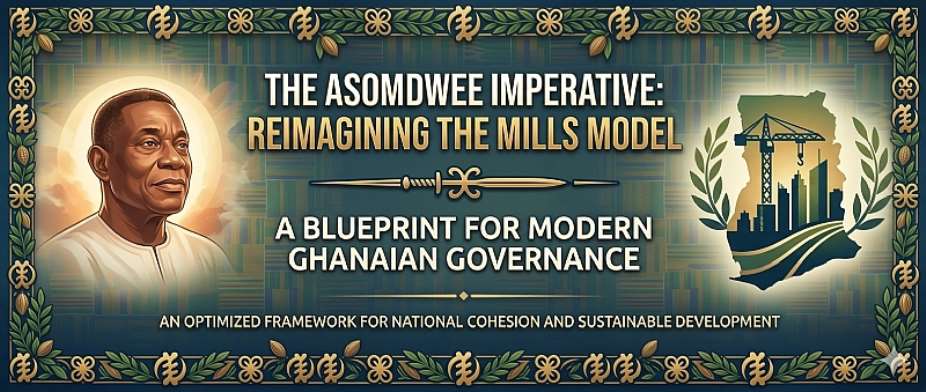
Ghana’s status as a beacon of stable democracy in Africa faces recurring tests every political cycle. As partisan hostility threatens our national cohesion, the urgent need for a transformative paradigm shift in our political landscape becomes clear. Fourteen years after the sudden passing of former President Professor John Evans Atta Mills, his enduring legacy provides a template for national healing. Known fondly as the Asomdwee Hene (King of Peace), his style of leadership was not a sign of weakness, but a masterclass in strategic self-control.
Think of it this way: political power in Ghana often feels like a pendulum swinging between ideological extremes, leaving national development caught in the crossfire. By taking a closer look at his executive decisions, we can find a functional framework to build a more collaborative political future. This opinion piece explores how adopting the "Asomdwee Model" can help reduce structural political friction, dismantle win-at-all-costs political mentalities, and guide Ghana toward sustainable national development.
Understanding the Asomdwee Model: Theory and Historical Action
The leadership philosophy of the late Professor John Evans Atta Mills was anchored on distinct civic principles, backed by specific actions during his presidency:
- Decoupling Power from Bitterness: Prioritizing state stability over settling political scores or seeking personal vendettas.
- Historical Action: Upon taking office in January 2009, despite intense pressure from party foot soldiers to launch aggressive retributive campaigns against members of the previous New Patriotic Party (NPP) administration, Mills resisted political witch-hunting. Instead, he publicly acknowledged his predecessors, Presidents Jerry John Rawlings and John Agyekum Kufuor, as crucial reference points for statecraft during his inaugural address.
- The Architecture of Inclusivity: Ensuring that national resources, development projects, and public appointments transcend political affiliations.
- Historical Action: Mills famously declared in his presidential directives that he would be a "President for all Ghanaians, whether they voted for me or not." He demonstrated this by refusing to abandon uncompleted infrastructure projects initiated by the Kufuor administration—a common practice in partisan transitions—and continued funding key projects like the N1 Highway (George Walker Bush Highway) to completion.
- Institutional De-escalation: Intentionally using state communication channels to calm political tensions rather than incite them.
- Historical Action: During the highly charged 2010 Akwatia and Chereponi parliamentary by-elections, when localized clashes broke out, President Mills consciously chose not to deploy aggressive state security apparatuses or issue inflammatory statements. He consistently relied on formal judicial systems and administrative investigations, modeling his signature approach of dynamic patience to absorb political friction.
- Principled Humility: Treating political opponents with respect and validating constructive criticism as a vital tool for good governance.
- Historical Action: A scholar by training, Mills fundamentally changed executive protocol to optimize public funds and minimize state display. In his first State of the Nation address in 2009, he implemented strict austerity measures, downsizing his presidential convoy and scaling back lavish state banquets to protect ordinary citizens' daily interests.
Core Challenges Threatening Ghana's Democratic Stability
Ghana's political landscape risks backsliding if the following systematic trends are left unaddressed:
- The Winner-Take-All Mindset: A system where the ruling party monopolizes state resources, leaving the opposition completely disenfranchised.
- Monetized and Hostile Campaigning: Political campaigns driven by heavy spending and aggressive rhetoric rather than focus on issues and policy tracking.
- Weakened Independent Institutions: The perceived weaponization of regulatory bodies, which erodes public trust in democratic systems.
Actionable Policy Recommendations and Suggestions
To transform Ghana's political framework, the executive, legislature, and civil society must implement targeted reforms:
- Legalize Long-Term National Development Plans: Pass legislation requiring successive governments to continue baseline infrastructure and development projects, preventing partisan abandonment.
- Enforce Independent Institutional Autonomy: Shield critical bodies like the Electoral Commission (EC) and the judiciary from partisan interference through transparent selection processes.
- Code of Conduct for Political Communication: Establish strict accountability frameworks within political parties to penalize actors who use hate speech or incite violence.
- Incorporate Peace-Building in School Curricula: Implement civic education programs that teach dispute resolution, political tolerance, and democratic history at the basic education level.
The memory of Professor John Evans Atta Mills, preserved through initiatives like the John Evans Atta Mills Memorial Heritage, must serve as a blueprint for national progress rather than just a moment for annual mourning. True peace is not simply the absence of conflict; it is the presence of justice, equity, and institutional integrity. Ghana can no longer afford a system of toxic partisanship that stalls development every four to eight years.
Embracing the Asomdwee Model means building a resilient nation where every citizen can thrive, regardless of their political allegiance. Let us choose to protect the soul of our nation by honoring the ultimate legacy of our historic peacekeeper.
✍️ Retired Senior Citizen
For and on behalf of all Senior Citizens of the Republic of Ghana 🇬🇭
Teshie-Nungua
[email protected]

 Tiktok activist ‘mama one’ granted Gh¢50,000 bail over alleged offensive remarks...
 "Arrest contractors of Achimota–Ofankor road over potholes" – Kofi Gharbin urges...
 'I am ready to lead Ashanti region NPP with less talk and more action' — COKA
 'NDC said they did not need too many loans, but are now borrowing heavily' — Osa...
 Chairman Wontumi’s 20-year sentence is a clear case of selective justice — Adoma...
 Ghana’s public debt stock hits GH¢720.8bn, equivalent to 45.1% of GDP — BoG
 Ghana to replace periodic education surveys with real-time data system
 Bank of Ghana keeps policy rate unchanged at 14%
 Wontumi's 20-year sentence raises concerns about proportionality and fairness — ...
 Describing me as the worst-performing MP is demotivating and dangerous — Stephen...

