




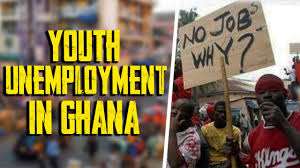
Behind every unemployment statistic is a person, a family, and a different experience of the economy.
Using three years of data from the Ghana Statistical Service and the Ghana Labour Market Information System, this report looks beyond the headline figures to understand what the labour market has really been like for Ghanaians. It explores the changing patterns of employment, the groups facing the greatest challenges, and the opportunities that continue to emerge. By connecting the numbers to everyday realities, the report offers a clearer picture of what work, job searching, and economic participation mean in Ghana today.
Key Findings
A three-year rollercoaster. National unemployment rose from 13.3% in early 2022 (roughly 1 in 8 people) to a peak of 14.9% in the first quarter of 2023 (nearly 1 in 7 people). Before reaching this peak, the rate had declined to 11.3% in the fourth quarter of 2022, the lowest level recorded during the period. After peaking in early 2023, unemployment gradually eased to 13.1% by the end of 2024, bringing it almost back to its starting level.
Where you live decides your odds. In 2024, Greater Accra's unemployment rate was 21.5%, meaning roughly 1 in 5 job seekers could not find work. That is more than three times Bono's rate of 6.6% (about 1 in 15). Greater Accra, Central, Western, and Ashanti, all major commercial hubs, were the four hardest-hit regions.
Women carry the heavier burden. Between Q1 2022 and Q3 2023, about 1 in 6 women looking for work could not find it, against roughly 1 in 9 men. The gap did not shrink during the 2023 spike. It grew wider.
Young Ghanaians are re-engaging. The share of youth not in employment, education, or training (NEET) fell from about 1 in 8 in Q1 2022 to roughly 1 in 11 or 12 by late 2023, a meaningful improvement in a short span.
Low regional unemployment is not the full story. Regions like Bono, Oti, and Bono East report the country's lowest unemployment, but this likely reflects reliance on informal and subsistence farming rather than plenty of formal jobs.
Why This Matters
These numbers describe real households: a mother in Accra sending out applications for months, a young graduate in Kumasi deciding whether to move for work, a farmer in Bono who is counted as “employed” but earns barely enough to get by. Unemployment in Ghana is not one single story. It is shaped sharply by where you live, and just as sharply by whether you are a man or a woman.
Left unaddressed, these gaps tend to grow. Persistent regional differences push young people toward Accra in search of work that is not guaranteed to exist, straining housing and services in the capital while leaving opportunity behind elsewhere. A gender gap that widens exactly when the economy weakens shows women absorbing more than their fair share of every downturn. It is also worth remembering that the official rate only counts people who are actively job hunting. It does not count Ghanaians working informally, doing casual jobs, or underemployed in roles that pay too little to live on, and that hidden group needs attention too. Closing these gaps means building policy around the people actually being left behind, not just the national average.
Detailed Analysis
1. Unemployment Rate (2022 Q1 - 2024 Q4)
Ghana's unemployment rate did not move in a straight line between 2022 and 2024. It moved in three distinct phases. It held fairly steady through most of 2022, sitting between 13.3% and 13.9%, dipped to 11.3% by the fourth quarter, then jumped sharply to 14.9% in the first quarter of 2023, meaning almost 1 in 7 job seekers came up empty. From there it stayed high through the rest of 2023 before drifting gradually downward across 2024, closing the year at 13.1%.
The sharp swing between late 2022 and early 2023 is the single biggest movement in the entire series, and it is worth treating with some caution. GSS notes that the underlying panel is unbalanced, with some respondents dropping out and new ones added between quarters. Some of that jump may reflect real economic pressure, and some of it may reflect who happened to be in the sample at the time. Either way, the broader pattern of a 2023 peak followed by a steady 2024 recovery held for four straight quarters.
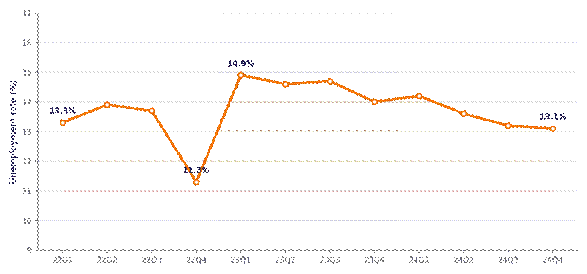
Figure 1. National unemployment rate by quarter, 2022 Q1–2024 Q4. Shaded band marks the 2023 peak period.
2. Unemployment by Region
The 2024 regional breakdown makes one thing clear. Unemployment in Ghana is not a nationwide condition, it is a regional one. Greater Accra sits far above every other region at 21.5%, or about 1 in 5 job seekers, trailed by Central at 15.5% and a near tied Western and Ashanti at 15.1% each. Together, these four regions form a distinct high-unemployment tier, all well above the national average of roughly 13.5% in 2024.
Everywhere else looks different. Eleven of the sixteen regions post rates below 11%, and the four lowest, including Western North, Oti, Bono East, and Bono, sit under 8%. That is a striking contrast. The regions with the biggest, most varied economies have the highest joblessness, while smaller, more rural regions report the lowest. That pattern is counterintuitive only until you consider what kind of work is actually available in each place, which the next two findings unpack.
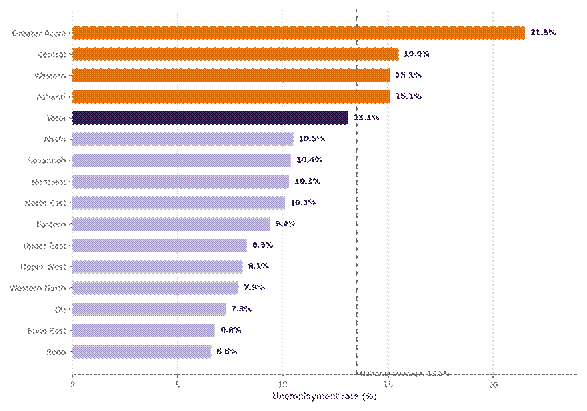
Figure 2. Unemployment rate by region, 2024. Orange bars mark the four regions above 15%. Dashed line shows the national average.
3. The Gender Gap That Will Not Close
Look at every quarter where we have data split by gender, from Q1 2022 to Q3 2023, and one pattern never breaks: women's unemployment rate is higher than men's, every single time. On average, about 1 in 6 women looking for work could not find it, against roughly 1 in 9 men. That gap held up even as the overall numbers moved up and down. In the worst quarter, Q1 2023, roughly 1 in 5 to 6 women were unemployed, right as the national rate hit its own peak.
The timing matters here. The gap did not stay the same size through the downturn, it grew. When the job market tightened in late 2022 and early 2023, women lost ground faster than men did, and the recovery that followed did not fully close that distance back to where it stood before 2023. This points to women being more concentrated in roles or sectors that are hit first and hardest whenever the economy slows.
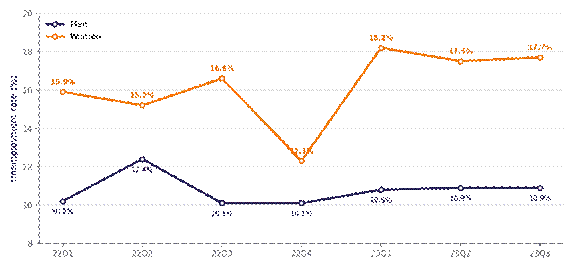
Figure 3. Unemployment rate by gender, quarter by quarter, Q1 2022 to Q3 2023.
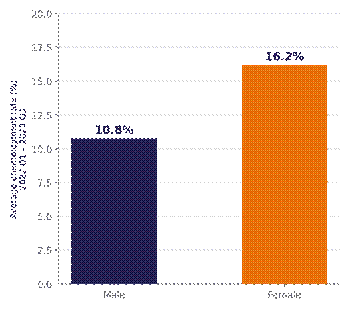
Figure 4. Average unemployment rate by gender across the same period.
4. Young Ghanaians: A Genuine Bright Spot
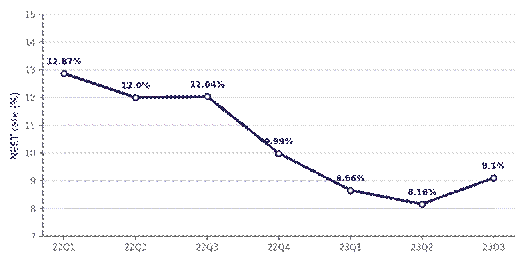
Figure 5. Youth NEET rate by quarter, Q1 2022 to Q3 2023.
Amid all the national ups and downs, youth NEET figures tell a more encouraging story. NEET stands for young people who are Not in Employment, Education, or Training, meaning they are not working, not studying, and not learning a trade. That share fell from about 1 in 8 in Q1 2022 to roughly 1 in 12 by Q2 2023, a drop of slightly more than a third in under eighteen months. It ticked back up slightly to about 1 in 11 in Q3 2023, but stayed well below where it started.
This deserves its own spotlight, separate from the adult unemployment numbers, because it suggests that whatever pressures were pushing overall unemployment upward in 2023, they were not falling as heavily on young people's ability to find work, training, or a place in school. It is the one clearly positive trend in this data set, and it deserves to be protected and built on, not lost in the noise of the national headline figure.
5. Low Regional Unemployment Is Not Always Good News
It is tempting to read Bono's 6.6% or Oti's 7.3% as success stories. But unemployment, as GSS defines it, only counts people who are actively looking for work and cannot find any. It says nothing about the quality, security, or income of the jobs people already have. Ghana's lowest-unemployment regions are also its most agricultural, where subsistence farming and informal family labour can keep the unemployment rate low without necessarily providing steady income or decent work.
This does not mean the regional gap is fake. Greater Accra genuinely has a harder time absorbing job seekers than Bono does. But it does mean that closing the gap on paper, by focusing only on the unemployment rate, could miss the point entirely. A fuller picture would pair these figures with data on underemployment and informal-sector earnings, which GSS does not include in this release.
| A note on the informal economy: a large share of working Ghanaians earn a living outside of formal jobs, as market traders, drivers, artisans, or farmhands. The unemployment rate does not count them as unemployed, since they are technically working, but it also does not tell us whether that work pays enough to live on. Any honest reading of these numbers has to keep this hidden group in mind, especially in regions where the official rate looks reassuringly low. |
Recommendations
| # | Recommendation | Responsible Stakeholder |
| 1 | Direct job-creation and private-investment incentives toward Greater Accra, Central, Western, and Ashanti, where unemployment is concentrated and structurally highest. | Ministry of Employment & Labour Relations; GIPC |
| 2 | Launch gender-targeted employment support, such as childcare subsidies, re-entry training, and hiring incentives in growth sectors, to close the gap that widens every time the economy slows. | Ministry of Gender, Children & Social Protection; private sector employers |
| 3 | Sustain and expand TVET and apprenticeship placements that appear to be driving the NEET decline, rather than scaling back once headline unemployment falls. | Ministry of Education; Youth Employment Agency |
| 4 | Commission a follow-up study on informal-sector income and underemployment in low-unemployment regions to determine whether “low unemployment” there reflects real opportunity. | Ghana Statistical Service |
| 5 | Publish regional and gender breakdowns on the same quarterly cycle as the national rate, so trends, not just single-year snapshots, can be tracked for both. | Ghana Statistical Service; GLMIS |
Methodology Snapshot
This analysis draws on two sources: the Ghana Statistical Service's Quarterly Labour Force reports and the Ghana Labour Market Information System (GLMIS). The national unemployment figures cover people aged 15 and older, tracked from Q1 2022 to Q4 2024, though the group of people surveyed shifts slightly each quarter. The regional breakdown reflects 2024 only. Gender and NEET breakdowns are available from Q1 2022 through Q3 2023. Unemployment is calculated as the number of unemployed people divided by everyone aged 15 and older who is working or looking for work, multiplied by 100. This report describes and compares the trends in the data. It does not attempt to prove what caused them.
Limitations
• The survey group changes a little each quarter, since some people drop out and new people are added, which may affect how well one quarter compares to the next.
• Gender and NEET data end in Q3 2023, so neither can be checked against the 2024 recovery seen in the national rate.
• No single data set combines region, gender, and age together, so the single most vulnerable group cannot be pinpointed precisely.
• The unemployment rate does not include underemployment or informal work, both important for understanding regions that look low-unemployment on paper.
• Data is limited for an in-depth analysis of unemployment rate in Ghana.
Sources / References
• Ghana Statistical Service (GSS).
• Ghana Labour Market Information System (GLMIS).

 ‘Father-for-all please pardon Chairman Wontumi to increase your glory' - Former ...
 [Full Text] Minority Caucus in Parliament react to High Court conviction of Wont...
 Tiktoker ‘bawumia ba’ re-arrested over alleged offensive conduct
 Minority criticises court for piercing Akonta Mining's corporate veil and holdin...
 Wontumi's conviction was based on assumptions with no evidence — NPP alleges
 Galamsey prosecutions should not end with Wontumi's sentence — Prof Agyemang-Dua...
 Attorney General was very efficient in Wontumi's Samreboi case — Martin Kpebu
 Ghana has lost a statesman among traditional rulers — Mahama mourns Yaa Naa
 Mahama Rallies ECOWAS: “Differences Must Not Divide West Africa”
 “I’ll Put My Life on the Line!” — Appiah‑Kubi Questions Basis of Wontumi’s Galam...

