




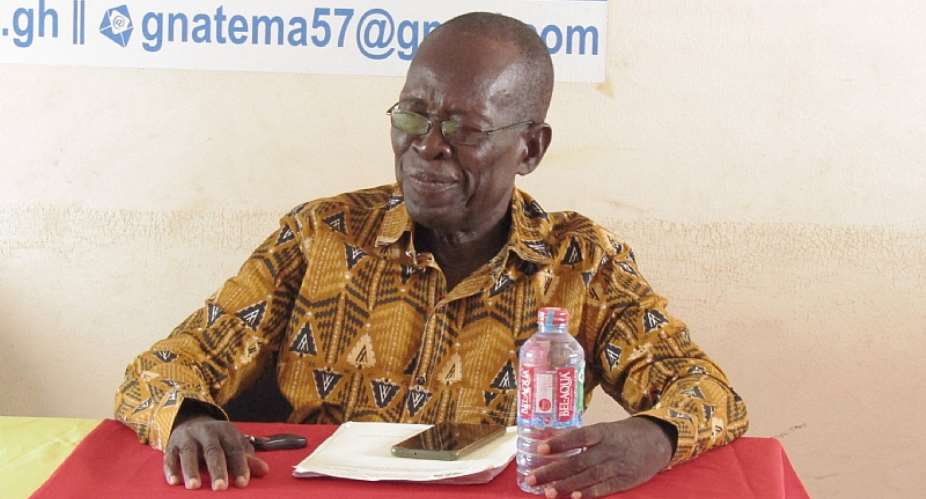
Mr Abraham Koomson, the Secretary General of the Ghana Federation of Labour (GFL), on Monday called on the government to urgently strengthen the financial and logistical capacity of Metropolitan, Municipal and District Assemblies (MMDAs) to deliver effective and sustained sanitation services across the country.
Mr Koomson said the recently concluded two-day National Cleanup Exercise, while commendable in intent, exposed deep structural gaps in how sanitation interventions are planned and resourced at the local level.
“Obviously, the exercise wasn’t as effective as envisaged because of inadequate preparations. The assemblies lacked adequate funds to undertake the exercise,” he stated.
The nationwide exercise was led by President John Dramani Mahama across flood-affected regions, following the devastating floods of June 29 that claimed lives and caused widespread destruction.
Held under the theme “Our Actions, Our Future: Cleaning Ghana after the Floods", the campaign mobilised citizens, the Ghana Armed Forces, the Ghana Police Service, MMDAs, and waste management companies to clear debris, desilt choked drains, and improve environmental sanitation as part of efforts to reduce future flood risk.
Mr Koomson, however, noted that poor planning undermined the impact. He pointed to heaps of filth, debris and refuse that remained on several streets as evidence of weak logistical coordination.
“Trucks should have been sent everywhere to collect and dispose of waste from homes, streets, and gutters.” Unfortunately, the factories and industries that used to provide financial support for such community sanitation exercises are no longer operational or have become defunct,” he said.
The GFL Secretary General stressed that without proper preparation and adequate resourcing, the cleanup campaign risks becoming a symbolic event rather than a sustainable solution to Ghana’s sanitation challenges.
“Since the cleaning is going to continue, there must be proper preparation, and the assemblies must be adequately resourced to carry out their mandate,” he emphasised.
Mr Koomson added that reviving private sector partnerships and ensuring predictable budgetary support for MMDAs will be critical if Ghana is to translate national cleanup campaigns into lasting health outcomes and resilient communities.
His comments come at a time when sanitation is being prioritised as a critical determinant of public health under Sustainable Development Goal 3: Good Health and Well-being. Poor waste management and open defecation remain key drivers of waterborne diseases, flooding, and lost productivity, particularly in urban and peri-urban communities.
To address this, the Media Coalition Against Open Defecation (M-CODe), with support from World Vision Ghana, has launched a nationwide accountability activation from Monday 20th to Saturday 25th July to track how Metropolitan, Municipal, and District Chief Executives (MMDCEs) are delivering on the government's new directive making sanitation a Key Performance Indicator.
Under the theme "Institutionalising Sanitation Performance", the exercise marks the first phase of M-CODE’s revitalisation agenda and positions the media as the accountability bridge between government, traditional authorities, local assemblies, and citizens in the push to achieve a clean environment and end open defecation.
The first of the project will involve M-CODe Regional Branches in the Upper East, Northern, Western, Greater Accra, Upper West, and Ashanti; the second phase will be rolled out later in the other regions.
The President of Ghana has formally declared sanitation a Key Performance Indicator (KPI) for Metropolitan, Municipal and District Chief Executives. (MMDCEs) It shifts sanitation from advocacy talking points to a measurable governance requirement.
The National Convenor of M-CODe, Mr Francis Ameyibor, said the goal is not to witch-hunt but to create transparency. “When citizens and traditional leaders track performance together, MMDCES are more likely to deliver."
He further encouraged traditional councils across the country to establish a Sanitation Monitoring Committee that will meet monthly with the municipal assembly to review progress and map up strategies to deal with sanitation issues.
The intervention seeks to position the media as the accountability bridge between government, traditional authority, local assembly, and citizens across the country, with a sharp focus on ending open defecation (OD), Mr Ameyibor explained.
Mr Ameyibor explained that now that sanitation is a KPI, the focus shifts from just talking about it to making sure it happens, and the media's job, as outlined by M-CODE, is to make sure that budgets are actually used, that laws are enforced, and that local leaders are actively doing their jobs.
The M-CODe National Convenor, therefore, appealed to state and non-state actors, development partners, media outlets, traditional and religious leaders, environmental service providers, and the general public to support M-CODe with funds and logistics to ensure the success of the project in the best interest of everyone living in Ghana.
Mr Yaw Attah Arhin, WASH Technical Specialist at World Vision Ghana, also emphasises that "sanitation as a KPI is a bold step". This media-led accountability week ensures that commitments translate into measurable results for the most vulnerable communities."
Mr Attah Arhin stressed that the week is designed to deliver three immediate outcomes: increased public awareness that sanitation is now a measurable MMDCE performance metric, not a discretionary activity.
 ‘Father-for-all please pardon Chairman Wontumi to increase your glory' - Former ...
 [Full Text] Minority Caucus in Parliament react to High Court conviction of Wont...
 Tiktoker ‘bawumia ba’ re-arrested over alleged offensive conduct
 Minority criticises court for piercing Akonta Mining's corporate veil and holdin...
 Wontumi's conviction was based on assumptions with no evidence — NPP alleges
 Galamsey prosecutions should not end with Wontumi's sentence — Prof Agyemang-Dua...
 Attorney General was very efficient in Wontumi's Samreboi case — Martin Kpebu
 Ghana has lost a statesman among traditional rulers — Mahama mourns Yaa Naa
 Mahama Rallies ECOWAS: “Differences Must Not Divide West Africa”
 “I’ll Put My Life on the Line!” — Appiah‑Kubi Questions Basis of Wontumi’s Galam...

