




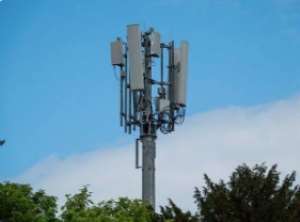
A debate that refuses to die
For close to two decades, Ghanaians living beside telecom masts have complained of headaches, sleeplessness, and a nagging fear that the steel towers rising over their rooftops are silently damaging their health. The debate over radio frequency radiation from telecom towers has played out in Parliament, in the media, and in ordinary households, alongside grievances about noise, vibration, and fumes from generators at base stations, towers interfering with aircraft approaches, and masts collapsing onto people and property.
Some families, unable to get straight answers from operators or regulators, have simply packed up and moved. Yet the scale of this quiet exodus has never been properly documented, making it one of Ghana's least understood public health puzzles.
Why the masts multiplied
The problem traces back to how quickly Ghana's telecom infrastructure grew. The rapid spread of masts across the country, particularly into residential neighbourhoods, followed the licensing of multiple multinational mobile network operators in a country with limited land. Even with thousands of towers already standing, experts have argued that the number remains inadequate to guarantee reliable service, which keeps pressure on operators to erect more towers, often close to homes, schools, and clinics, rather than fewer, taller, shared structures.
What the science actually says
scientific bodies have consistently drawn a distinction between the panic and the evidence. Emissions from telecom equipment fall into the non-ionizing category of electromagnetic radiation, meaning they lack the energy to alter human cells or genetic material the way X-rays or gamma rays can. Ghanaian telecom operators are expected to operate within limits set by the International Commission on Non-Ionizing Radiation Protection, and the Commission has concluded that available data are insufficient to establish a link between such exposure and long-term risks like cancer.
A senior scientist at the Ghana Atomic Energy Commission's Radiation Protection Institute has similarly stated that mast and mobile phone emissions do not carry enough energy to strip electrons from atoms, and that global bodies including the World Health Organization and International Telecommunications Union have endorsed the same exposure limits.
Still, "no confirmed adverse effect" is not the same as "proven safe," and that gap is precisely where public anxiety continues to grow.
The real, documented danger: non-compliance
If there is a genuine, measurable problem in Ghana's mast landscape, it is not radiation exposure within approved limits, it is regulatory non-compliance. A study of mast siting in the Kumasi Metropolis found that while operators generally met height standards, there was widespread non-compliance with the required twenty-meter safety buffer zone around masts, and the co-location requirement meant to limit the proliferation of towers was routinely violate. The same research linked this failure to weak inspection, land value pressures, and inconsistent penalties for operators who ignore the rules.
Abandoned and rusting masts add a separate hazard entirely. Officials at the Ghana Atomic Energy Commission have warned that decommissioned masts can be brought down by rainstorms and pose a physical death trap to nearby residents, even though such structures no longer emit meaningful radio frequency signals. In other words, some of the fear directed at "radiation" may actually be a rational response to poorly maintained, badly sited, and unmonitored infrastructure, a governance failure dressed up as a health scare.
Why families are still moving
For residents who cannot verify emission readings themselves, distance becomes the only reassurance available. Regulators have advised the public to keep away from directly beneath mast antennas and to limit time spent near base stations, since exposure is a function of both proximity and duration. For a family without the resources to relocate a mast erected feet from their compound wall, relocating themselves can feel like the only realistic option, even when the underlying risk is disputed by scientists.
Closing the trust gap
Ghana does not currently lack rules; the Communications Regulation and the Communications Authority guidelines already set out sitting standards, and the Environmental Protection Agency and National Communications Authority share oversight. What is missing is consistent enforcement, transparent public reporting of emission tests near residential clusters, and a credible channel through which anxious families can request independent verification rather than relying on operator assurances. Until that trust gap closes, the quiet movement of Ghanaian families away from mast-heavy neighborhoods will likely continue, driven less by confirmed radiation harm than by the absence of visible, enforced accountability.
Mustapha Bature Sallama.
Medical/ Science Communicator,
Private Investigator, Criminal investigation and Intelligence Analysis.
International Conflict Management and Peace Building.USIP
[email protected]
+233-555-275-880
References:
https://www.modernghana.com/news/225753/radiation-from-telecom-masts-and-our-health.html
https://iipgh.org/cancerous-nature-of-telecom-masts-on-the-environment-a-myth-or-reality/
https://gaec.gov.gh/abandoned-masts-are-death-traps/
https://nca.org.gh/wp-content/uploads/2024/11/Consumer-Watch-21-01-20.pdf


 World Cup 2026: Spain crowned champions after extra-time thriller against Argent...
 Nana B Sets Sights on Top NPP Leadership Slot, Calls for Unity Ahead of 2028
 Tribunals Bill Fears Misplaced — New System Has Built‑In Safeguards, Says Gaming...
 Suame MP Tears Into Tribunals Bill: Gov’t Hasn’t Shown What’s Broken — So What A...
 ECOWAS backs Ghana’s AU petition against xenophobia – Ablakwa
 Gov’t Moves to Scrap Double‑Track: Haruna Iddrisu to Detail Massive GH₵3bn SHS B...
 Missing 8-month-old baby found safe in Kpando
 Captain Smart cuts sod for first DVLA office in Gomoa enclave
 Committee tasked to review Adamus Resources Limited licence revocation petition ...
 'The Tribunals Bill appears to preempt constitutional review recommendations' — ...


Comments
We just need to pay attention to the science. Without living near any masts, we are all bombarded with TV microwave signals all the time. And oh, the sun constantly sprays us with neutrinos, those subatomic particles that are able to pass through our bodies.