




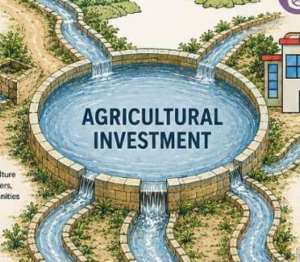
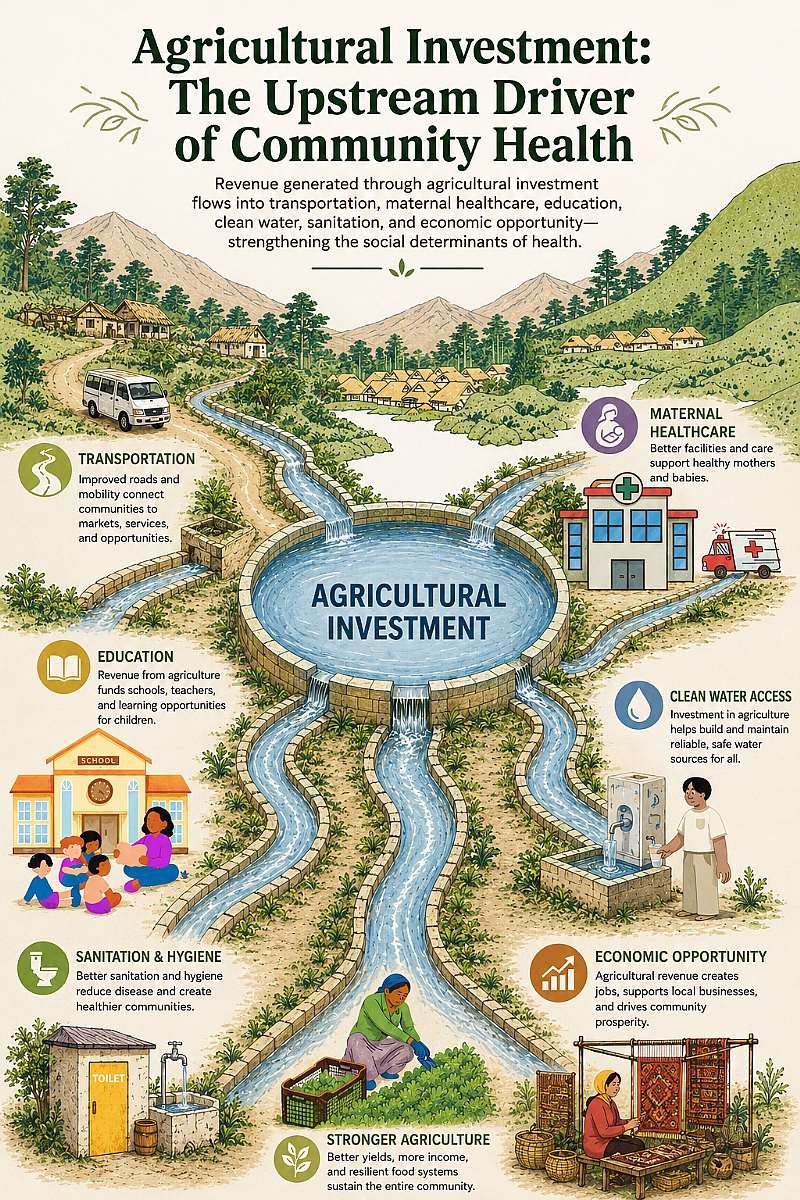
Throughout my time at the High Atlas Foundation (HAF), I kept noticing what I've come to think of as the invisible infrastructure woven through rural Morocco. Public health rarely announced itself directly, but it showed up in cooperative meetings, on farm visits, in the distance between these communities and essential services. Health wasn't always the topic, but it was almost always part of the story. We tend to treat agriculture and public health as separate entities, yet they're far more intertwined than we acknowledge.
In Anamer-n-Oucheg, women told me their biggest problems were rashes from poor sanitation and dust irritation. At first telling of it, several described the rashes as bruises – not a language slip, but a sign of how little health literacy has ever been built into that village, since no one had a reason to teach the difference. This was a small mistranslation that said more than it meant to. Wastewater from houses ran down through crops, and children playing nearby stepped in it and got sick, again and again, in a loop that had yet to be named. There was nowhere at school for girls to manage their periods. The closest clinic could give their babies vaccines and fit them for birth control, but anything more sent them two hours down the road. None of this was for lack of people who could help. The village contains a women’s cooperative, like many villages in Morocco, that’s self-sustaining, organized, and doing real work to hold the community together.
HAF has already recognized this connection through its clean drinking water initiatives, expanding access to safe water and sanitation in rural communities. My time here in Morocco left me wondering what could happen if that same philosophy extended even further, connecting water, agriculture, procurement and health education through the communities already doing the work.
It became clear to me how seldom public health education intersects with agricultural and financial planning more broadly. Sanitation and clean water get treated as one NGO’s mandate, income and crops as another’s, and health literacy as a separate project entirely. Yet a rash mistaken for a bruise and wastewater running through cropland were not separate problems but symptoms of the same system. Women already sustaining their communities through cooperatives could become trusted messengers for health education too, if the two were designed together rather than in isolation
Take childbirth: A 2021 study of two villages in the Anti-Atlas Mountains found that women felt safest giving birth at home with midwives (kablas), who are traditional birth attendants with no formal training, who learn by watching and doing. Kablas came up constantly in the researchers’ interviews, and not once as a complaint. One woman, comparing her home birth to her hospital birth, said the hospital staff “don’t have the patience to ask you to keep pushing, and be patient.” Meanwhile, the regional hospital, two hundred kilometers away and reachable only by transportation most families can’t reliably afford, was described as well-staffed, well-supplied and respectful. The formal system works in spaces it’s been invested in. Where it hasn’t, women turn to the informal system that has quietly worked all along, undercredentialed but trusted.
The same shape shows up in agriculture, and here the disconnect is structural, rather than incidental. The institutions needed to bridge this gap already exist. Morocco's National Initiative for Human Development (INDH) has long tested community-based approaches before scaling them through government ministries, and Morocco's more than 27,000 cooperatives— two-thirds of them agricultural— are an existing network capable of delivering far more than production. Morocco has already demonstrated this model: through partnerships between ministries, nonprofits, and local organizations, rural preschool enrollment rose from roughly a third of eligible children to more than 90 percent. The same structure could connect agricultural cooperatives with schools and health institutions.
This shape has a name in Dr. Ben-Meir's decentralization literature: delegation, where decision-making and day-to-day responsibility shift to communities and their organizations while the government keeps a hand in setting standards and providing funds. It's different from privatization, which hands services to private enterprise outright — a route Morocco's own regionalization program has notably not taken. A procurement rule connecting cooperatives to schools and hospitals would simply be that same logic aimed at a much smaller target.
Yet, Morocco’s school canteen system, the one feeding children in the same villages these cooperatives farm, runs on a centralized tendering process favoring large intermediary companies and high-volume farms. Researchers have found this means Morocco often imports lower-value ingredients for its own schools while small, diversified local farms get passed over entirely. The capacity to feed these children locally exists. It’s that no procurement rule routes the money there.
But there is movement on this. A pilot project is already working to shift school food sourcing toward local, agroecological farms. There’s an international model where Brazil’s home-grown school feeding law requires a minimum share of procurement to come from family farmers, with prices set fairly in advance and no competitive bidding required for that portion. It’s the kind of mechanism that could be plugged into Morocco’s existing cooperative structure without new government spending, just a redirection of purchasing that’s already happening.
However, the case for centralized procurement is difficult when central planners often have more information and are better positioned to weigh long-term national interests than a patchwork of local contracts. The risk on the other side is just as well documented – decentralizing authority without decentralizing real financing leaves local institutions starved for resources and unable to function, and power meant to reach communities can shift from one elite group to another instead. That risk isn’t abstract here: cooperatives are not immune to the same hierarchies that sideline women elsewhere. Nearly a third of members are women, but a much smaller share actually run these organizations. Home-grown feeding models elsewhere have also struggled with inconsistent supply and the coordination of matching hundreds of small farms to hundreds of schools. None of that is a reason not to try it. It’s a reason to build the rule with the same rigor as the system it’s replacing, not less.
The point is not to argue that kablas should deliver every birth, or that a woman with a dangerous complication shouldn’t reach a hospital with an operating theater. The point is that development doesn’t always mean bringing something into a new place. Sometimes it means noticing what’s already sustaining people and finally paying for it. The Rowad Tanmia Cooperative in Anamer isn’t waiting to be discovered. It’s waiting to be connected; to the school down the road, to the clinic two hours away, to a funding stream that already exists but currently passes by.
Carter Covington is a Global Public Health student at the University of Virginia and a Participatory Development Intern with the High Atlas Foundation in Marrakech, Morocco.
 'I would have loved to have experienced Asiedu Nketiah remain NDC National Chair...
 NDC not a principled political party over Supreme Court nominations — Afenyo-Mar...
 Miracles Aboagye’s arrest: EOCO is ‘unprofessional, are liars’ - Nana B
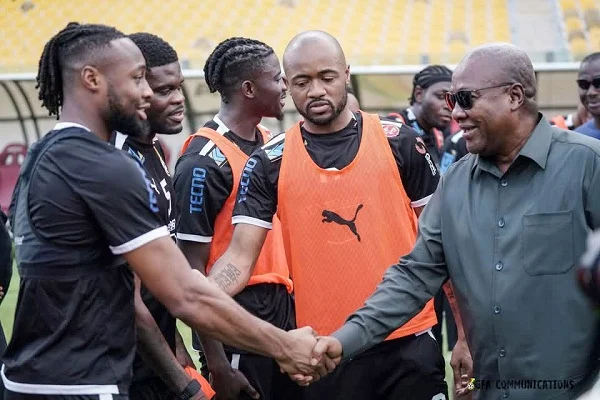 Black Stars can win AFCON, World Cup if team and coach is maintained – Mahama
 GNAT, NAGRAT and PRETAG threaten strike over unresolved conditions of service
 GHS55m probe: Miracles is not a threat; NPP using national communicator ambition...
 Two Ghanaians petition ICC to probe Xenophobic attacks, killings in South Africa
 Mahama nominates Tony Forson, two Appeal Court Justices to Supreme Court
 Creating new tribunal system to compete with existing courts will create chaos i...
 Tribunal system another new bureaucracy; digilize existing courts — Afenyo-Marki...

