




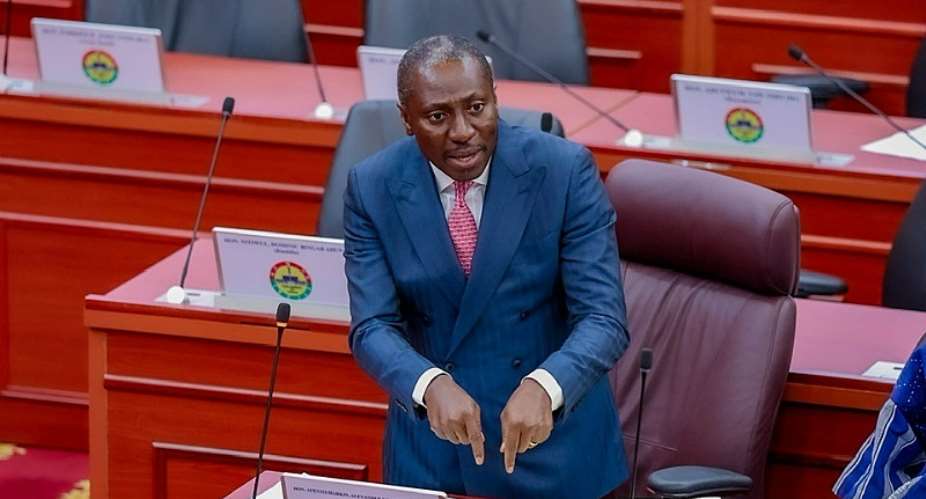
Minority Leader Alexander Afenyo-Markin has called for the removal of a key provision in the proposed Tribunals Bill, 2026, arguing that the establishment of district and regional tribunals would create a parallel justice system and weaken Ghana's existing judicial framework.
The Bill, which is currently before Parliament, seeks to revive public tribunals as part of efforts to enhance the administration of justice and expand access to the courts. It also aims to operationalise Article 126 of the 1992 Constitution, which provides for tribunals within the country's judicial system but has remained largely inactive.
If passed, the legislation would establish district and regional tribunals to function alongside the conventional courts under constitutional safeguards, oversight mechanisms and due process protections.
Contributing to debate on the Bill in Parliament on Thursday, July 16, 2026, Mr. Afenyo-Markin urged lawmakers to delete Clause 4 in its entirety, insisting there was no need to create additional judicial institutions when the existing court system was capable of delivering justice.
"Mr. Speaker, I move that the entire Clause 4 be deleted," he told the House, adding that his reasons for opposing the provision were straightforward.
The Minority Leader argued that although Articles 125 and 126 of the Constitution recognise the possibility of establishing tribunals, they do not make it mandatory for Parliament to do so.
He maintained that lawmakers should instead focus on strengthening the current judicial system rather than introducing new institutions that could complicate the delivery of justice.
"What kind of chaos are we introducing?" he asked. "You have a district court, you have a circuit court, you have a high court, you have a court of appeal, you have a judiciary architecture that is not broken."
Mr. Afenyo-Markin said dissatisfaction with some judicial decisions should not be used as justification for creating what he described as a competing justice system.
"The disagreement we may have with certain pronouncements of certain judges does not mean that we create some parallel structures that we call a justice system," he said.
He also questioned the proposed jurisdiction of the tribunals, asking whether they would handle civil or criminal matters and how they would fit into the country's established judicial hierarchy.
"How on earth do we create a new system to compete with a known system just because somewhere in the Constitution certain pronouncements are made?" he asked.
According to the Minority Leader, Parliament should exercise the discretion granted under the Constitution by declining to establish the proposed tribunals.
"The Constitution says Parliament may determine. I am saying that this Parliament must know that the justice architecture we have is not a broken architecture," he stated.
Rather than creating new judicial bodies, Mr. Afenyo-Markin called for increased investment in the judiciary through the digitalisation of court processes, improved infrastructure and adequate logistical support for judges and court staff to speed up justice delivery.
He warned that introducing a parallel tribunal system could erode public confidence in the judiciary and create unnecessary complications within the justice delivery framework.
"I contend that creating this new tribunal system by this proposal will bring chaos to the justice delivery system we have in our country," he said.
The government, however, maintains that the Tribunals Bill is intended to strengthen the administration of justice by activating the constitutional tribunal system and expanding access to justice through district and regional tribunals operating alongside the existing courts. It argues that the proposed framework incorporates adequate oversight and safeguards to protect due process and human rights.
Despite those assurances, the Minority insists that Ghana's justice system would be better served by strengthening the existing courts rather than establishing a new tribunal structure.

 Open aviation fuel supply to more players to reduce airfares – Akim Swedru MP to...
 Pay my salary arrears, terminal benefits by September 11 or face court – Former ...
 Trump says he'll give Americans $5,000 each if Republicans win midterm elections
 'Govt moves to confiscate, auction containers left at Ghana’s ports for over six...
 'We are not serious Christians; bunch of selfish, greedy people' – Duncan-Willia...
 30,000 classrooms without teachers is a crisis waiting to happen – Adutwum
 How honest station loading boy handed over missing £3,000, GH¢1,000 to Police
 Upgrade one SHS in each MMDAs to first class category A school to tackle placeme...
 How frustrated parents sleep at GNAT Hall as CSSPS placement challenges enter th...
 Two men accused of land guard activities weep in court for forgiveness



Comments
Are you really the one to instruct the government on what to do, especially when it holds the majority in Parliament? Anyone familiar with Afenyo-Markin's cunning tactics knows he has no genuine interest in establishing a new tribunal system that would hold the NPP's looters and corruption‑ridden officials accountable.