




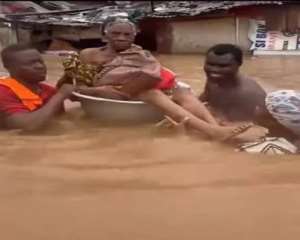
On June 3, 2015, Ghana experienced torrential rains that caused flooding and fires, which claimed over 150 lives, displaced many, and left several others with disabilities. Eleven years later, heavy downpours have led to another major flooding incident with similar dire consequences.
Data from the World Bank Group indicate that floods account for more than half (54.7%; 29) of natural disasters in Ghana, affecting over 5 million people, causing over 500 deaths, and costing over $70,000 in flood-related losses. Flooding ranks second among the top 10 natural disasters in Ghana, lagging right behind bacterial and viral epidemics. Flooding is now an annual national emergency that must be treated with urgency.
In such emergency preparedness conversations, one group that is often overlooked and eventually left behind is older adults.
According to the Ghana Statistical Service, older adults aged 60 years and above represent 6.5% of the total population, a share projected to increase to 12% by 2050. Most older adults experience high acuity, including multimorbidity, multiple disabilities, and psychosocial limitations.
Older adults constitute a growing but vulnerable population with increasingly unmet needs in Ghana. This raises questions about whether Ghana can achieve emergency preparedness-related SDG Goals, including SDG 10 (reduced inequalities), SDG 13 (climate action), and SDG 15 (Life on land), given the growing unmet needs of the older adult population.
In the Sendai Framework for Disaster Risk Reduction (2015-2030), the National Disaster Management Organization (NADMO) of Ghana, mandated by Act 517 of 1996 and amended by Act 927 of 2016, declared its commitment to disaster risk reduction by supporting disaster management efforts through resource coordination and fostering community resilience across various structural levels.
Despite the declared commitments to the Sendai Framework for Disaster Risk Reduction, several structural and data gaps persist: (1) no age-specific mandate, (2) no clear national aging policy with an emergency preparedness component, (3) no systematically collected age-disaggregated disaster data, (4) no community-level evacuation protocols or post-disaster support for older adults, and (5) inclusivity gaps within the Sendai Framework for Disaster Risk Reduction that prioritize older adults.
These apparent gaps make it challenging to account for vulnerable older adults who may be impacted by floods in Ghana. In addition, there is a paucity of research that informs policy-to-practice interventions to directly address the unmet needs of older adults during emergencies.
Unfortunately, Ghana’s climate patterns do not wait for policy deliberations, underscoring the urgency of disaster and emergency preparedness and response measures. We therefore propose the following recommendations to ensure no older adult is left behind.
- The Government of Ghana and NADMO must build age-specific emergency protocols that go beyond broader policy mandates. Specifically, welfare services should be integrated into national disaster risk reduction policies and be age-inclusive while ensuring that data collection efforts intentionally identify vulnerable older adults.
- Local assemblies, community leaders, civil societies, health care systems, and NGOs should work collaboratively to establish community-level registers to identify and monitor older adults in high-risk flood-prone areas. They should include older adults in their early-warning communication channels within the community.
- Through advocacy, older adults should be included in designing and implementing humanitarian and person-centered response frameworks while also empowering healthcare systems to prioritize care continuity for older adults after being displaced by floods. Intergenerational family networks should translate respect and solidarity for older adults into actionable measures during such emergencies and not just in ordinary times.
As we await the next rains amid uncertainty, the real question is whether older adults in Ghana will remain invisible within emergency preparedness and response systems or whether meaningful measures will be taken to address their unmet needs. We hope the response will be to implement the proposed interventions to ensure that our elders are recognized, valued, and protected, because ignoring the intentional inclusion of older adults during emergencies is not merely a policy failure but a betrayal of ourselves.
Notes: The proposed interventions were informed by the first author’s work on emergency planning . We would also like to acknowledge Martha Darkwa Seffah for her contributions to the preparation and publication of this article.
Alfred Boakye is a doctoral candidate in Gerontology at the University of Maryland, Baltimore (UMB) and can be reached at [email protected]
Clinton Gyimah is a doctoral student at the University of Pittsburgh School of Social and he can be reached at [email protected]

 Stop speculation, premature conclusions; allow investigation to determine Baffou...
 Judge halts Ex-NAFCO CEO's trial until ruling on seized phones
 Manhyia South MP who resisted arrest reports to EOCO a day after arrest warrant ...
 "Show us evidence" —Upper West teacher unions demand proof of payment before end...
 Adenta: Bolt driver jailed 25 years for cutlass attack and robbery of beautician...
 EOCO drags Manhyia South MP to former law firm, residence for search
 BNI investigates Yaw Ampofo Ankrah over alleged World Cup visa facilitation sche...
 EOCO arrests three over drone flights at headquarters during arrest, probe of Ma...
 Prof Emmanuel Osei Sarpong appointed Acting NSA Director-General
 NSA Boss Yaw Ampofo Ankrah suspended over US$623,000 World Cup visa allegations


