




Femi’s Principle: When praise is deserved, give it without grudging, but never sheath the sword of truth.
One of the great afflictions of our public life in Africa is that we have converted politics into religion.
Once a man wears the colors of a political party, his admirers imagine him incapable of error, while his opponents become incapable of acknowledging virtue.
Such intellectual dishonesty is the enemy of nation-building; it remains one of the biggest problems we face in our beautiful continent.
I have never subscribed to that infantile creed. Years ago, when Samuel Okudzeto Ablakwa served as Deputy Minister of Education, I criticized what I considered a disappointing performance.
We shouldn’t regard public office as a sanctuary against scrutiny; it is a trust.
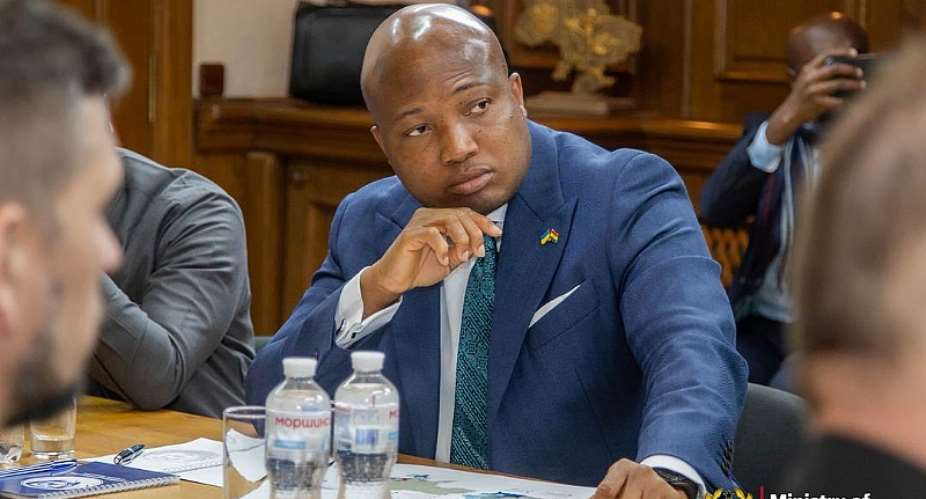
Today, intellectual honesty compels me to say something different: as Ghana’s Minister for Foreign Affairs, Ablakwa has grown remarkably into his office.
He deserves our massive kudos. He thus became the first recipient of the Pan African Digest’s recognition.
For perhaps the first time in many years, Ghana’s foreign ministry appears animated by purpose rather than ceremonial pageantry. The country’s diplomacy has become a vigorous defense of Ghanaian interests and a determined projection of Ghana’s image abroad.
That deserves acknowledgment.
When xenophobic violence erupted in South Africa, Mr. Ablakea’s ministry did not hide behind bureaucratic platitudes.
As the March March Xenophobes paraded South African cities with lynching intentions, Ghana moved with unprecedented swiftness to evacuate stranded citizens.
Ghanaians facing molestation in Cambodia were astounded by the speed with which their government organized their repatriation.
It did not stop there; it sought employment opportunities for returnees, and boldly announced legal and diplomatic efforts to pursue compensation for those who lost businesses and property.
This is precisely what a foreign ministry should do. Citizens must have confidence that their passport is not merely a travel document; it is a covenant between citizen and state.
Wherever a citizen faces difficulties, his country must stand behind him.
Minister Ablakwa also deserves credit for insisting that African governments confront xenophobia. He told us that our continent cannot chant “African integration” while fellow Africans hunt Africans in the streets.
As we have argued in this blog, Pan-Africanism cannot coexist with organized hostility toward Africans crossing artificial colonial frontiers.
Equally commendable has been the Minister’s energetic advocacy for reparatory justice, although I have my reservations on the matter.
Ghana has become one of the loudest voices clamoring that the enduring consequences of slavery and colonialism be confronted, reinforcing the moral authority first established by Ghana’s Founding President, Osagyefo Dr. Kwame Nkrumah.
To the glory of Ghana, Minister Ablakwa pursues diplomacy with conviction, not diplomacy by cocktail reception.
Yet admiration must never become idolatry. Here lies the contradiction that refuses to leave the mind: why is Ghana enthusiastically negotiating labor mobility agreements with wealthy European countries eager to recruit our educated youth, while showing far less urgency in demanding that productive industries relocate to Ghana itself?
Europe’s demographic winter is no mystery. Its population is aging, and its industries need engineers, nurses, doctors, technicians, programmers, and skilled artisans.
Africa has become the convenient reservoir from which depleted Western societies replenish their human capital.
This arrangement is marketed as a “win-win.” It is anything but.
No nation in history has developed by exporting the very brains upon which development depends. Britain did not industrialize by sending its engineers to France. Germany did not become an economic giant by exporting its scientists. Japan and South Korea did not rise by shipping their brightest graduates abroad.
These countries built factories, created laboratories, established research institutes, and retained their talent in their homelands.
Why should Africa adopt the exact opposite formula?
This is the question I respectfully place before Minister Ablakwa.
Instead of negotiating principally for labor exports, why not negotiate relentlessly with China?
China has relocated thousands of factories across Asia, transforming Vietnam, Cambodia, and Ethiopia in the process.
Why should Ghana not become another destination?
Why should the foreign ministry not aggressively pursue agreements under which Chinese manufacturers relocate textile plants, pharmaceutical factories, electronics assembly facilities, railway engineering works and machinery production to Ghana?
Bring the factories. Our young people will supply the intelligence. Our universities will supply the graduates.
Our economy will retain the value. That is infinitely superior to exporting another generation of doctors, nurses, engineers and software developers whose education has been substantially funded by Ghanaian taxpayers.
The simple law of economics dictates that a nation that exports cocoa and imports chocolate will remain forever poor. The corollary is: a nation that exports brains while importing technology condemns itself to perpetual dependency.
This is not an argument against migration. Human mobility is as old as civilization itself.
But there is an enormous difference between migration as individual choice and state policy that normalizes the systematic export of a country’s most valuable strategic resource, its educated citizens.
Human capital is a nation’s greatest capital. Once lost, it is painfully expensive to replace.
So yes, Minister Ablakwa deserves praise. He has brought vigor to Ghanaian diplomacy, defended endangered Ghanaians abroad, projected Ghana with confidence, and spoken courageously on Pan-African unity and reparatory justice. But the measure of African diplomacy in the twenty-first century cannot simply be how many visas our citizens obtain to foreign labor markets. Its true measure must be how many factories, laboratories, industrial parks and centers of innovation we persuade the world to establish on African soil.
For nations are not built by exporting their finest minds. They are built by giving those minds compelling reasons to remain at home and transform their own homeland.
That is the diplomacy worthy of Nkrumah, whom Minister Ablakwa appears to be a worthy heir. In his book Sex is a Nigger, famous Nigerian writer Naiwu Osahon wrote about his frustration when, as a student in Sweden, people asked him which province of Ghana he was from.
So powerful was the image of Ghana under the Ossgyefo.
Blessedly, Minister Ablakwa is restoring this image. And like Naiwu Osahon, not a few Nigerians are seething with envy
To Mr. Samuel Okudzeto Ablakwa: Cheers🙏
©️ Ọdọ́fin Fẹ̀mi Akọ̀mọ̀làfẹ̀ (1st Dan, Ọdọ́fin I of Kasoa)
(Farmer, Writer, Published Author, Essayist, Satirist, Social Commentator, Geopolitical Analyst.)


 'I would have loved to have experienced Asiedu Nketiah remain NDC National Chair...
 NDC not a principled political party over Supreme Court nominations — Afenyo-Mar...
 Miracles Aboagye’s arrest: EOCO is ‘unprofessional, are liars’ - Nana B
 Black Stars can win AFCON, World Cup if team and coach is maintained – Mahama
 GNAT, NAGRAT and PRETAG threaten strike over unresolved conditions of service
 GHS55m probe: Miracles is not a threat; NPP using national communicator ambition...
 Two Ghanaians petition ICC to probe Xenophobic attacks, killings in South Africa
 Mahama nominates Tony Forson, two Appeal Court Justices to Supreme Court
 Creating new tribunal system to compete with existing courts will create chaos i...
 Tribunal system another new bureaucracy; digilize existing courts — Afenyo-Marki...

