




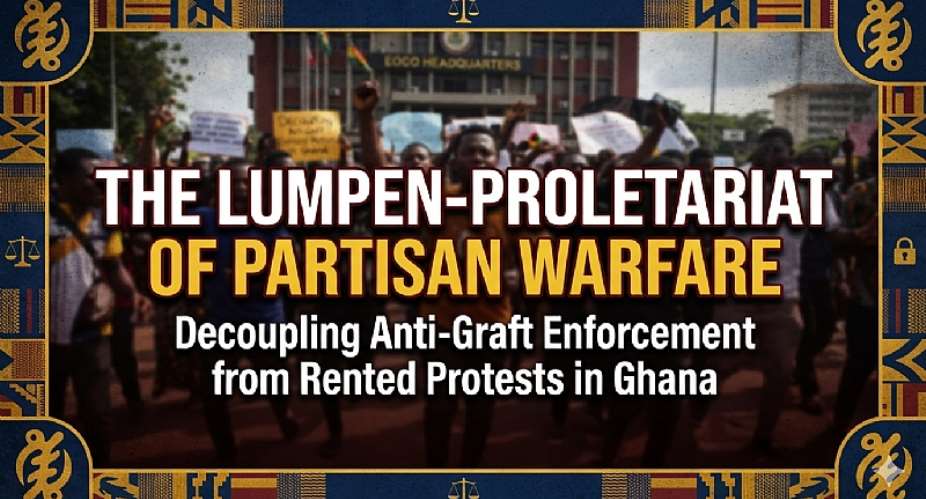
Ghana’s democratic experiment is under siege—not from external enemies, but from within. The greatest threat to accountability today is not simply corruption in high office, but the deliberate weaponisation of vulnerable youth as partisan shields against justice. When state institutions attempt to enforce anti-graft laws, they are frequently met not with sober legal defenses but with mobilised, rowdy crowds intent on obstructing accountability. This toxic cycle undermines the very foundations of the Fourth Republic and degrades the rule of law.
The Systemic Corruption Cycle
The weaponisation of public dissent functions as a self-sustaining loop that paralyses state oversight:
- Diversion of Public Resources: Millions of cedis are siphoned from state coffers through high-profile financial scandals.
- Youth Vulnerability: Deepening economic dependency leaves young citizens desperate for daily survival.
- Cheap Patronage: Low-cost alcohol brands become accessible tools for crowd manipulation and energy deployment.
- Rented Crowds: Demonstrators are mobilised to form human shields for accused elites outside investigative bodies.
- Institutional Atrophy: Enforcement bodies lose operational momentum, leading to the gradual decay of accountability.
Case Study: The EOCO Headquarters Protests
A stark manifestation of this crisis occurred during the high-profile Economic and Organised Crime Office (EOCO) investigation into allegations of a multi-million cedi fraud.
- The Incident: Following the arrest of prominent political figure Dennis Miracles Aboagye, crowds of partisan supporters quickly converged on the EOCO headquarters to protest the detention.
- The V8 Distribution: Video evidence and eyewitness reports captured scenes where lawyer Kwesi Botchway Jnr and other political actors operated around vehicles loaded with refreshments. This included the distribution of sachets and bottles of cheap alcoholic beverages, such as "K-20" and "Striker," directly to the gathered demonstrators.
- The Socio-Political Effect: Vulnerable youth, stripped of stable economic leverage, were heavily incentivised to form an aggressive physical perimeter around the anti-graft institution.
- The Symbolism: The incident serves as a troubling precedent where luxury vehicles became mobile vending stalls, legal practitioners acted as crowd mobilisers, and Ghana’s premier investigative body was besieged by hostile chants rather than formal legal petitions.
The Architecture of Manufactured Dissent
The systemic resistance to accountability relies on a specific structural design:
- Subversion of the Bar: Legal professionals compromise their role as officers of the court by actively orchestrating and validating rowdy street mobs.
- The "Miracles" Precedent: Legitimate legal defenses are replaced by manufactured public outrage to pressure state institutions.
- Selective Accountability Resistance: Anti-graft transparency is aggressively demanded only when political opponents are targeted, but fought when it hits close to home.
- Economy of Intoxication: Cheap, highly potent liquor is weaponised to dull critical thinking and fuel confrontational behavior among protestors.
- Weaponised Partisan Bifurcation: Every independent financial investigation is immediately framed through a hyper-partisan lens as a political witch-hunt.
- Structural Abuse of Youth: Chronic youth unemployment is systematically exploited to supply cheap labour for elite protection schemes.
Recommendations for Reform
To safeguard the integrity of Ghana's anti-graft institutions, direct structural interventions are required:
- Codify Misconduct Standards: The General Legal Council (GLC) must institute swift disciplinary actions against lawyers who incite or coordinate rowdy mobs outside active investigative offices.
- Statutory Perimeter Protections: Amend security protocols to enforce strict "Zero-Tolerance Protest Zones" directly surrounding the perimeters of EOCO, the OSP, and the courts.
- Depoliticise Enforcement: Reform the appointment structures of EOCO and OSP leadership to ensure independent, merit-based, and non-partisan tenures.
- Radical Transparency: Mandate the quarterly, online publication of all ongoing investigations and asset recoveries under the Right to Information (RTI) Act to maintain public trust.
- Criminalise Rented Unrest: Update the Public Order Act to strictly penalise and fine political parties or individuals found to be financing, feeding, or intoxicating crowds to disrupt law enforcement.
Reclaiming the Democratic Commons
The image of Ghanaian youth being handed "Striker" and "K-20" from the back of a luxury V8 outside the gates of EOCO is a sobering indictment of our contemporary political culture. It reveals how the vital civic energy needed to build hospitals, fund schools, and create sustainable jobs is being deliberately weaponised to defend the very elites accused of stealing those opportunities away.
True patriotism demands an unyielding loyalty to the state, the rule of law, and the absolute defense of public funds—not blind allegiance to political figures. Ghana’s youth must collectively reject the role of cheap political currency. The trunks of manufactured outrage must be closed, transparent accountability must be allowed to proceed, and the nation’s future must never again be bargained away for a bottle of cheap liquor.
✍️ Retired Senior Citizen
For and on behalf of all Senior Citizens of the Republic of Ghana 🇬🇭
Teshie-Nungua
[email protected]


 Alleged robber mistakenly shot by colleague arraigned before court
 A/R: 59 SHSs transition to single-track system as GES gradually phase out double...
 Ghana’s youngest parliamentary aspirant to wrestle with ‘elders’ for Manhyia Sou...
 'Is this how to decide bail conditions?' — NPP's Akosua Manu blasts EOCO over Mi...
 'Probe beneficiaries who consumed Nkoko Nkitinkiti birds, it also amounts to loo...
 Trump administration orders ICE to halt traffic stops after Maine shooting, US m...
 'We can't enstool chief during our mourning period' – Ahantaman Kingmakers
 Cabinet concludes deliberations on constitution review committee report
 Chief Justice Baffoe-Bonnie urged to stay away from Yilo Krobo chieftaincy dispu...
 Ghana needs national sanitation policy; two-day clean-up won't end flooding cris...

