




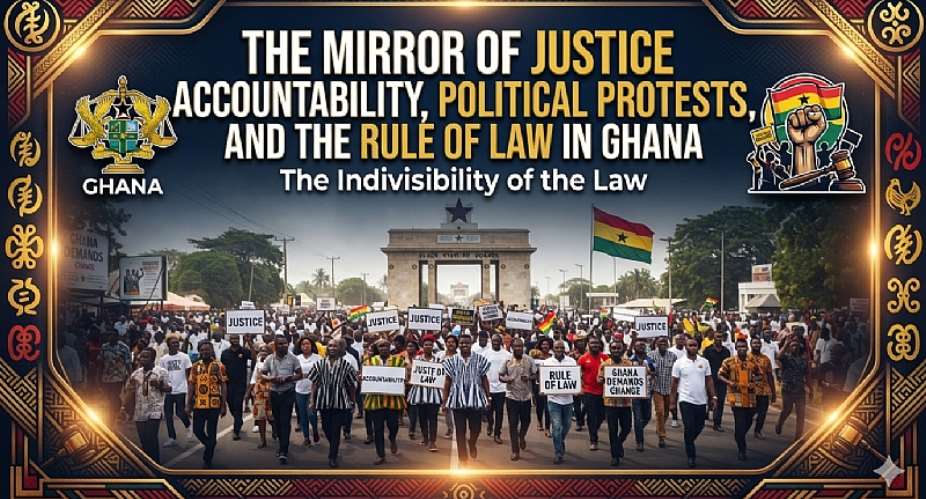
The Indivisibility of the Law
A functional democracy cannot survive on a dual system of justice where accountability is demanded only from political opponents while allies enjoy absolute immunity. Recent political developments in Ghana—most notably the arrest of New Patriotic Party (NPP) National Communications Officer aspirant Dennis Miracles Aboagye by the Economic and Organised Crime Office (EOCO)—have exposed deep-seated double standards in how we view the rule of law. When civic actors or everyday citizens face state crackdowns, legal technicalities are weaponized against them. Yet, when political heavyweights are subjected to the same legal scrutiny, partisan machinery rises in defense, threatening state institutions. We must hold up a mirror to our society: if injustice anywhere is a threat to justice everywhere, then the application of the law must remain blind to political colors. The law is the law.
The Litany of Allegations: Connecting the Dots
Public office is a public trust, and anyone vying to lead or speak for a major political party must be beyond reproach. A critical look at the administrative track record of Dennis Miracles Aboagye reveals an unsettling pattern that warrants thorough, impartial investigation rather than partisan shielding:
- 2020 MCE Removal: His appointment as Municipal Chief Executive (MCE) for Akuapem North was revoked by his own government following serious administrative concerns regarding Common Fund and Internally Generated Fund (IGF) allocations.
- 2024 Campaign Fund Discrepancies: In early 2025, NPP National Treasurer Dr. Charles Dwamena openly questioned the transparency of political campaign allocations handled by Aboagye during the 2024 elections, citing a complete lack of financial accountability.
- 2023 IMCCoD Staff Dismissals: During his tenure as the Executive Secretary of the Inter-Ministerial Coordinating Committee on Decentralisation (IMCCoD), the abrupt termination of veteran staff members, including Dr. Dominic Gameli Hoedoafia, raised widespread ethical and financial questions.
- 2026 EOCO Arrest: He was intercepted at Kotoka International Airport and detained by EOCO over suspected procurement irregularities, money laundering, and the theft of public funds totaling GH¢55 million.
While he has since been granted a steep GH¢50 million bail, his supporters immediately resorted to street protests to disrupt state operations.
Holding Up the Mirror: Confronting the Double Standards
The volatile reaction of party loyalists massing outside the EOCO Headquarters raises fundamental questions about civil liberties, police mandate, and institutional consistency in Ghana:
- The Mandated Notice: Did the party supporters provide the legally required notice under the Public Order Act before executing their sudden march on a state security installation? [10]
- Selective Enforcement: If everyday citizens blocked public roads with motorbikes during a protest, the police would swiftly arrest bystanders and demonstrators alike, holding them across various cells. Why should political affiliation grant a waiver?
- Human Rights Violations: When ordinary Ghanaians are detained, they routinely face unlawful 72-hour detentions, lack of legal counsel, denial of emergency medical aid (such as asthma pumps), and hostile bail oppositions by the Attorney General.
- The Partisan Paradox: It is hypocritical to cheer when these harsh police measures are used against civic dissidents, only to cry "political persecution" when a party executive faces the exact same system.
Policy Suggestions and Recommendations
To rescue Ghana’s democratic institutions from partisan decay, systemic reforms must be enforced immediately:
- Insulate Anti-Graft Agencies: Institutions like EOCO and the Office of the Special Prosecutor must be legally and financially decoupled from executive influence to allow independent probes into all public officers.
- De-polarize Law Enforcement: The Ghana Police Service must apply the Public Order Act uniformly, treating partisan demonstrators with the exact same legal protocols applied to civil society groups.
- Strict Asset Recovery: The state must aggressively pursue the verification of sureties and properties for high-profile bail conditions to guarantee the absolute recovery of public assets.
- Enforce Internal Party Accountability: Political parties must self-regulate by banning individuals with active, multi-million cedi corruption investigations from vying for national executive positions.
Smashing the mirror will not change an ugly reflection. Ghana cannot build a prosperous future on a foundation of selective justice and institutional intimidation. If we only appreciate human rights and due process when our own political allies are affected, we do not care about justice; we only care about power. Dennis Miracles Aboagye, like any citizen, deserves a fair and transparent trial. However, his political status must neither fast-track his clearance nor immunize him from state accountability. Let the state investigate, let the courts adjudicate, and let the law take its course uniformly across all boundaries.
✍️ Retired Senior Citizen
For and on behalf of all Senior Citizens of the Republic of Ghana 🇬🇭
Teshie-Nungua
[email protected]


 Alleged robber mistakenly shot by colleague arraigned before court
 A/R: 59 SHSs transition to single-track system as GES gradually phase out double...
 Ghana’s youngest parliamentary aspirant to wrestle with ‘elders’ for Manhyia Sou...
 'Is this how to decide bail conditions?' — NPP's Akosua Manu blasts EOCO over Mi...
 'Probe beneficiaries who consumed Nkoko Nkitinkiti birds, it also amounts to loo...
 Trump administration orders ICE to halt traffic stops after Maine shooting, US m...
 'We can't enstool chief during our mourning period' – Ahantaman Kingmakers
 Cabinet concludes deliberations on constitution review committee report
 Chief Justice Baffoe-Bonnie urged to stay away from Yilo Krobo chieftaincy dispu...
 Ghana needs national sanitation policy; two-day clean-up won't end flooding cris...

