




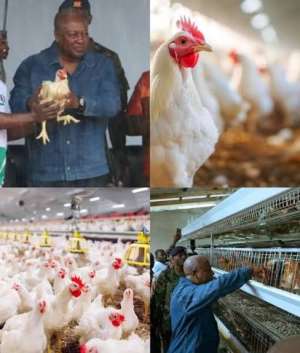
The Government's Nkoko Nkitinkiti Programme is one of the most promising agricultural interventions introduced . Its objectives are clear and timely: reduce Ghana's dependence on imported poultry, create employment, improve household incomes and nutrition, and strengthen food security. These are goals that every Ghanaian should support.
However, every good policy succeeds or fails because of its implementation. As the programme unfolds, there is growing evidence that some adjustments are necessary if it is to deliver lasting national benefits.
Recently, according to media reports, the Minister for Food and Agriculture, Hon. Eric Opoku, informed Parliament's Assurance Committee that some beneficiaries had even sent him videos showing themselves eating the birds they had received under the programme. Whether these were isolated incidents or not, the comments highlight an important reality: not every beneficiary is converting the support into a sustainable poultry enterprise.
The purpose of the Nkoko Nkitinkiti Programme is not simply to put chicken on the dinner table for a few days. It is to help families establish viable poultry businesses that generate income, create employment, and contribute to Ghana's economic development.
This raises an important policy question: Is distributing fifty-day-old chicks to thousands of individuals who are most likely to be party members the most effective way of achieving these objectives?
I believe there is a better and more sustainable approach.
Instead of concentrating almost entirely on distributing chicks to individuals, Government should establish at least one modern commercial poultry farm in every district. These district poultry farms should become permanent national assets that support production, training, research, and entrepreneurship.
Such farms would create hundreds of direct and indirect jobs. Veterinary officers, farm managers, animal health technicians, accountants, security personnel, transport operators, feed suppliers, hatchery operators, processors, marketers, and many others would all benefit from the value chain.
More importantly, district poultry farms would become practical training centres for young people. Instead of simply receiving birds, aspiring poultry farmers could first receive structured training in poultry farming, vaccination, feeding, disease control, financial management, and marketing before being supported to establish their own farms.
This model would significantly improve the survival rate of the birds and increase the likelihood that beneficiaries build successful businesses rather than abandon poultry farming after the first production cycle.
District poultry farms could also serve as hatcheries that continually supply healthy day-old chicks to farmers within the district. Rather than importing chicks or depending on irregular government distributions, local production could become continuous and self-sustaining.
In addition, these farms could support school feeding programmes, hospitals, hotels, restaurants, supermarkets, and local markets with a steady supply of fresh chicken and eggs. This would stimulate local economic activity while reducing Ghana's dependence on imported poultry products.
The Government's own vision for Nkoko Nkitinkiti is to transform subsistence poultry keeping into sustainable livelihoods. Establishing district poultry farms would accelerate that vision by creating permanent productive infrastructure instead of relying predominantly on one-time distributions.
There is also a need to strengthen beneficiary selection and post-distribution monitoring. Public confidence in the programme will increase if beneficiaries are selected transparently, based on clear criteria, and supported through regular monitoring by district agricultural officers. Those who demonstrate commitment and good management should receive additional support to expand their farms, while lessons learned from unsuccessful cases should be used to improve future implementation.
The objective should not be to criticise the programme but to strengthen it. Every flagship government initiative deserves constructive feedback because public resources must produce maximum public value.
The Nkoko Nkitinkiti Programme has the potential to transform Ghana's poultry industry. But for that transformation to occur, Government must invest not only in distributing chicks but also in building the infrastructure, skills, institutions, and local production systems that will sustain the industry for decades.
If every district had a well-managed commercial poultry farm serving as a production, training, and marketing hub, Ghana would be taking a giant step towards poultry self-sufficiency. Thousands of young people would find meaningful employment, local businesses would flourish, and the nation would save millions of dollars currently spent on imported chicken.
The true measure of the Nkoko Nkitinkiti Programme should not be the number of chicks distributed. It should be the number of successful poultry businesses created, the number of jobs generated, and the extent to which Ghana becomes capable of feeding itself with poultry produced by its own farmers.That is the lasting legacy this programme should strive to achieve.

 NDC Enforces Strict Verification and Voting Rules as Constituency Elections Begi...
 Protests against cost of living expected in Italy under heavy security
 Lula, Bolsonaro clash on living costs, corruption in final Brazil election debat...
 Ebola vaccine trial begins in DR Congo
 Trump says US may launch ‘another little Epic Fury’ attack on Iran
 ‘Too arrogant, too sure of itself’ France confronts its legacy in Africa
 Nigeria's unwritten power-sharing rule looms over presidential race
 Several killed, dozens wounded in Jordan church shooting
 ‘I killed lots of terrorists, but it didn’t make me feel better’: The trauma hau...
 Casualties feared as multi-storey building collapses in Nairobi


