




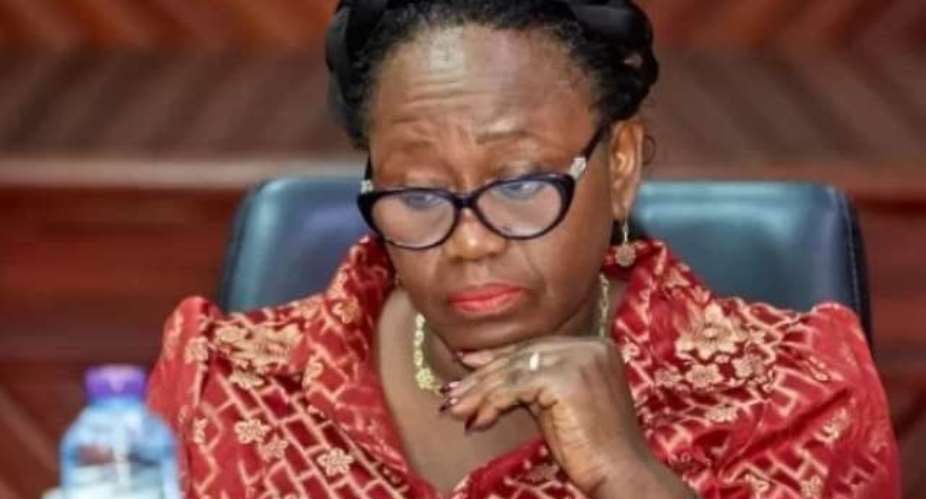
Of all the issues related to the controversial removal from office of Justice Gertrude Esaaba Sackey Torkornoo, Ghana’s third woman Chief Justice (CJ), I think the most concerning, if not the main, is this: that in her quest for justice, aiming to clear her name of wrongdoing, she has lost all her earned exit entitlements, too.
Again, the ‘between a rock and a hard place’ predicament the 15th CJ found herself in, following the three petitions against her alleging misconduct and seeking her ouster, has left her without a position-related exit package or pension!
As an informed source confirmed to me a few days ago: “nothing so far paid or intended to be paid.”
This troubling situation is why I believe Ghana needs a State ‘Dwanetoahene’, borrowing the concept from Akan culture and chieftaincy tradition; an office similar to the western ‘Ombudsman’ position.
I don’t know if other tribes have a similar post, but according to my admittedly basic knowledge of Akan culture, a Dwanetoahene is one of the honorary chieftaincy titles in many Akan areas, appointed by the Paramount Chief (some with a woman too appointed as ‘Dwanetoahemaa’).
Furthermore, from reference sources:
“In the Ghanaian and Akan traditional systems, the Dwanetoahene is a specialized sub-chief or high-ranking counselor whose primary title translates to … "the one to run to for rescue" (emphasis added). This chief serves as a traditional mediator, peacemaker, and the direct intermediary between the people and the paramount chief….”
“An ombudsman is an independent official appointed to investigate and resolve complaints made by individuals against public authorities, corporations, or institutions …a neutral mediator between citizens or employees and the organization.”
“In Ghana, the Ombudsman function is carried out by the Commission on Human Rights and Administrative Justice (CHRAJ). It investigates complaints against government officials and public institutions to ensure fairness and transparency.”
But what about when an individual has a problem with the Government or the President?
Strange that there seems to be no such appointee or office to take care of a possible situation when there is need for critical intervention between an aggrieved individual and the State apparatus, or the President, without the cost of a court action.
Under such a proposed office, a ‘State Dwanetoahene’, it should be possible for any interested party, or concerned member of the public, to request the intervention of that office to ensure that the rights of the affected are served; that there is a just outcome for both sides of a grievance.
I have in mind a type of Ombudsman, but different from the role set out for the CHRAJ in our national Constitution, now under review. Is has to be an independent office or authority that can mediate when there is a disagreement, grievance or problem between, for example, an individual, state official or appointee and the sitting President.
My view is that Ghana would be well served by such an office, which could step in when there is a problem such as the Justice Torkornoo situation, or any other official of the state, who has not been accused, or found guilty of embezzlement, perfidy, corruption, or treason, but is being denied their deserved entitlements after removal from office.
For the record, evidently, Justice Torkornoo didn’t come lightly to her decision to challenge the contentious three petitions alleging misconduct that led to her dismissal by President Mahama on September 1, 2025; after the Council of State had reportedly found a ‘prima facie’ case, seemingly plausible allegations, against her.
However, she described the allegations as “wild claims in a collection of petitions (not) even remotely true or (which meet) the standard required for removing any Judge” (emphasis added). Thus, she was put in a situation of being ‘between a rock and a hard place’, or ‘between the devil and the deep blue sea’. Understandably, she felt the urgent, non-negotiable need to try to clear her name, despite the known risks. As she explained in her statement to the media on June 25, 2025:
“ I do not seek to cling to a title or position. However, as a lawyer of 38 years standing, a Judge of 21 years standing, and Chief Justice of Ghana who has served in the rule of law all of my working life, I consider it my onerous duty and obligation to speak up concerning the administration of justice in this country.
“The situation I have been confronted with has shown me a model of injustice that I would never have thought possible if I had not been exposed to it. This is why despite great personal discomfort, I have decided to marshal every effort, in law and leadership, to answer to this situation.
“Furthermore, resigning or retiring while article 146 proceedings are being conducted to remove a Judge is not an option any Judge or public official is even allowed to have. There is a decided case on the subject by the Supreme Court. The suit number is J6/02/2019.
“Again, no one has the authority to walk away from proceedings started by the State. Judgment can be entered against you because you failed to defend yourself. And a Judge who resigns or retires would still lose all entitlements because they failed to defend the claims and resigned or retired while the proceedings were going on.
“Therefore, if false claims are made against a Judge or any Commissioner or other public office holder subject to article 146 proceedings, just to achieve a political agenda, the solution cannot be to resign or voluntarily retire out of frustration, pressure or fear. One would only find themselves being subjected to two cruelties – a judgment based on false claims, and loss of everything that one has worked for.
“It may well be that efforts are being made to make me feel frustrated and resign so that the architects of the scheme can go back into the media to say that the wild and unfounded allegations in the petitions were not defended because they were true or that I had no credible defence to them.
“As Chief Justice of a nation, who has been given the onerous duty and obligation to lead administration of justice, I should not turn tail and run when I know the implications of not defending false and unwarranted charges. If I resign under these circumstances, I will be saying that this flawed, unknown and opaque process is acceptable. It is not,” Justice Torkornoo reiterated.
I believe that the Report of the Constitution Review Committee (CRC) set up by President John Mahama in January, 2025, is currently being studied by the Government, but perhaps my ‘State Dwanetoahene’ proposal, too, can be considered if not now, in the future.
Again, as she indicated in her press statement, she knew that her quest might end in loss of her entitlements accrued in 38 plus years in law service.
Loss of entitlements may be what the law stipulates, but is this fair? Is it just that a person who has worked for nearly four decades, but is controversially forced out of office, also forfeits all their professional exit entitlements, losing position-related pension?
How can it be right that a Judge and former CJ goes home empty handed, empty pocket, and nobody is talking publicly about that, not even the legal fraternity; the non-governmental organisations; rights advocates, or the Christian and Muslim leaders so vocal on other national issues?
And if the current plight of Justice Torkornoo is not cause for continuing national discussion, towards correction, why is it not?
Interestingly, recently, President Mahama gave an address based on practical Christianity at the Faith Conference of the Men’s Ministry of the Assemblies of God, at Gomoa. It was a compelling, comprehensive speech, identifying him as a person of faith, who espouses Christian values. And I believe I heard “compassion”, a hint of Christian charity towards others, in his well-received presentation.
So, regarding Justice Torkornoo, where is the fellow feeling? Particularly, why is the Christian community, too, silent on this matter? Yet, Ghana prides itself as a very religious country.
Obviously, Ghana hasn’t got a State Dwanetoahene, but surely in this case religious leaders can take that role? Can’t Justice Torkornoo benefit from some compassion?
How can it be acceptable that a person seeking to clear their name of clearly “unfounded allegations”, ends up forfeiting all their rightfully earned entitlements, too?
But I’m convinced that President Mahama has the power and the AUTHORITY to correct the manifest injustice to Justice Torkornoo, who continues to pursue justice despite the disappointments suffered in courts.
Meanwhile, as ever, I applaud the courage, resilience and tenacity of Justice Torkornoo in her continuing fight for justice.


 Chairman Wontumi’s lawyer says plea-bargaining talks with state ended over unfav...
 University Administrators demands 114% market premium before calling off strike
 We need your support in fight against illegal mining - Mahama appeals to chiefs
 Haruna Iddrisu orders suspension of Obuasi SHTS headmaster over alleged sexual m...
 World Cup visas: Hold TRIBE Culture Fest liable for defrauding applicants – Kofi...
 Police arrest farmer seen in viral video assaulting wife in Agona Nkwanta
 NDC appoints Julius Kwame Anthony as Deputy Communications Director
 French counter-terrorism body to investigate 14-year-old behind school shooting
 Suame MP John Darko granted bail after appearing before EOCO over GH¢27m SIC Sav...
 Ghana among stronger-performing economies in sub-Saharan Africa — IMF


