




Every year, as the dark skies of Northern Ghana are set ablaze by thousands of grass torches, we witness Bugum Chugu (the Fire Festival) --- a spectacular cultural milestone for the Dagomba, Mamprusi, and Nanumba peoples. But behind the smoke, the drumming, and the chanting of war songs (ziem) lies a deeper, incredibly complex history of cultural fusion, spiritual survival, and what can only be described as the brilliant "spiritual marketing" of early Islamic missionaries.
With the dust now settled on this year’s celebrations, we have entered the new traditional and Islamic year. True to custom, the day after the flames died down, our Imams consulted their scripts to reveal which prophet will "rule the world" for the next 12 months.
This year, the ledger points directly to Prophet Moses (Musa, Alayhi Salam). Before we dissect the heavy, politically charged predictions of a "Moses Year," we must first look back at how this festival truly began, and how early scholars cleverly integrated themselves into our traditional governance.
The Authentic Cultural Root: The Lost Prince
To truly educate ourselves on Bugum Chugu, we must separate historical reality from later theological adaptations. There are two competing narratives of its origin:
- The Lost Prince: Dating back to the 15th century (pre-unification of the kingdom by Naa Gbewaa), oral history tells us of a young prince who wandered into the bush, grew tired, and fell asleep under a tree.
- The Search: As night fell, the panicked king ordered his warriors and the community to light grass torches (bugum) and search the dark wilderness.
- The Discovery: They found the boy safely asleep. Believing an evil spirit or the tree itself had "stolen" the child, the community threw their burning torches at the tree to shame and banish the evil.
- The Ritual: The King decreed this search be re-enacted annually. Today, the throwing of the torches at a designated tree at the edge of town remains the climax of the festival.
- “The Islamic Interpretation” --- Noah’s Ark: When Islam gained dominance in Dagbon between the 17th and 18th centuries, early Muslim scholars faced a dilemma: how to handle a deeply loved, highly spirited traditional festival that they couldn't easily ban. Their solution was brilliant. They reinterpreted the fire as the torches lit by Prophet Nuhu (Noah) and his followers to navigate after the Ark landed on Mount Ararat, and to search for his lost, rebellious son. This was a classic case of cultural syncretism --- wrapping an ancient Gur tradition in an Islamic cloak to make it palatable to a transitioning population.
The Clever “Schemes” of the Early Mualims
Your history books might paint the spread of Islam in the Sahel as purely theological, but it was also deeply economic. The early Wangara and Hausa missionaries, whom we initially called Mualims (teachers), now corrupted to Mallams, needed to carve out a comfortable, secure livelihood in a foreign land. They did not have vast farmlands or armies; instead, they traded in spiritual capital.
They established a highly effective "spiritual bureaucracy" through several key strategies:
- Monopolizing the Future (Sabili Larigibu): By positioning themselves as the only gatekeepers who could read Arabic scripts, they created an annual dependency. The ritual of declaring "which Prophet rules the year" meant the King and his sub-chiefs could not make major state, agricultural, or military decisions without paying for a consultation.
- The Power of the Slate (Waliga): Mallams commercialized divine protection. If a farmer wanted a bountiful harvest or a father wanted to protect his newborn, the Mallam would write Quranic verses on a wooden slate (allo), wash the ink off with clean water, and sell this holy water (waliga) to be drunk or sprinkled on crops. It was a genius bridge that replaced traditional herbal shrines with "literate" Islamic magic.
- Auspicious Timing: From naming ceremonies to the exact day to plant crops, the Mallams consulted astrological charts (Khatim) --- for a fee. They successfully made themselves the indispensable operational managers of the state’s daily life.
The Strategy of “Integrated Islam”
This survival mechanism of early clerics is not a conspiracy theory; it is a thoroughly documented socio-historical phenomenon.
In his seminal anthropological work The Tribes of the Ashanti Hinterland (1932), R.S. Rattray observed how deeply entrenched traditional African beliefs were, noting that foreign religions could only survive by adapting to, rather than fighting, local customs.
The late historian Ivor Wilks, in his pioneering studies on the expansion of Islam in Dagbon (such as A Note on the Early Spread of Islam in Dagomba), illustrated that early Muslim minorities did not arrive as militant conquerors. Because they lacked political or military muscle, they acted as peaceful "clerical networks." Wilks documented how these scholars strategically integrated themselves into the Dagomba state apparatus by offering specialized literacy and spiritual services to the Yaa-Naa and his chiefs.
This is what the renowned sociologist of religion Nehemia Levtzion termed "Integrated Islam" in his landmark book, Muslims and Chiefs in West Africa. Levtzion argued that West African clerics deliberately chose not to demand rigid, purist Islamic reforms from local rulers. Instead, they built a highly profitable "social estate" midway between the rulers and the animist population. By validating traditional festivals like Bugum Chugu and providing Islamic "antidotes" to native anxieties, they secured elite patronage, tax exemptions, and a steady stream of income without ever having to lift a farming hoe.
Mid-2026 – Mid-2027: The Year of Prophet Moses
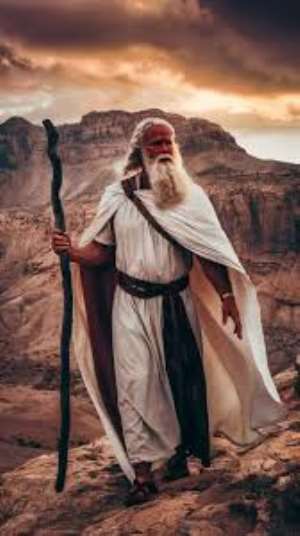
This brings us to the present. The scripts have been consulted, and the scholars have declared that Prophet Moses (Musa) holds the spiritual scepter for the next 12 months.
In Islamic and Abrahamic tradition, the era of Moses is never a quiet one. Historically, a "Moses Year" is characterized by intense spiritual and physical turbulence. The predictions delivered to our chiefs and communities warn of:
- High Mortality: A sobering forecast of many deaths, cutting across both the young and the old.
- Natural and Societal Plagues: Disasters and systemic "plagues" reminiscent of ancient Egypt.
- The Fall of Oppressors: Just as Moses stood unyielding before the mighty Pharaoh, this is predicted to be a year of reckoning. Ordinary people will find the courage to stand up to powerful, corrupt, and oppressive forces. Tyrants and bullies will find themselves vanquished by the very people they sought to suppress.
The Antidote: Charity and Cleansing
In keeping with the ancient business model of the early clerics, a dire prediction always comes with a paid prescription. To ward off these impending disasters, our communities are urged to perform intense acts of charity (sadaka), engage in fasting, and abstain from social vices. The writing and drinking of waliga from washed slates will once again peak as families seek a shield against the heavy hand of the coming year.
My Thoughts: A Living Legacy of Adaptation
Whether one views the annual prophecies as absolute spiritual truth or as the enduring legacy of a historic, brilliant "scheme" designed by early Hausa and Wangara scholars to secure their social standing, one thing is undeniable: it works.
The Fire Festival and its aftermath show the sheer resilience of northern cultural systems. We did not throw away our traditions for a foreign religion; instead, we forced the foreign religion to speak our language, adopt our festivals, and serve our communities.
As we navigate this "Year of Moses," let us hold on to the charity, the fasting, and the community solidarity prescribed by our elders. And most importantly, let those in power take note: if the scripts are correct, the spirit of Moses is in the air, and the ordinary citizen is ready to speak truth to Pharaoh.
FUSEINI ABDULAI BRAIMAH
+233208282575 / +233550558008
[email protected]


 'Your statement never said Miracles cannot be found, hiding, declared wanted; st...
 Miracles Aboagye's bail terms 'cruel and oppressive' — Samuel Atta Akyea
 Miracles Aboagye's arrest: EOCO's statement is a 'disgrace to Ghana's democracy'...
 Ghana Armed Forces begins GH¢190million redevelopment of Burma Camp
 Ato Forson to present 2026 mid-year budget review next week
 Dennis Miracles Aboagye can't meet GH¢50million bail conditions — Lawyers
 GNFS recovers body of 11-year-old boy from drowning incident at Adenta Aviation
 'The elephant will never forget what you’re doing to Miracles Aboagye today' — N...
 NDC govt using 'unfounded arrests' to distract from 'terrible job' — Sylvester T...
 NPP holds constituency elections in 245 constituencies as 31 locked-up in disput...

