




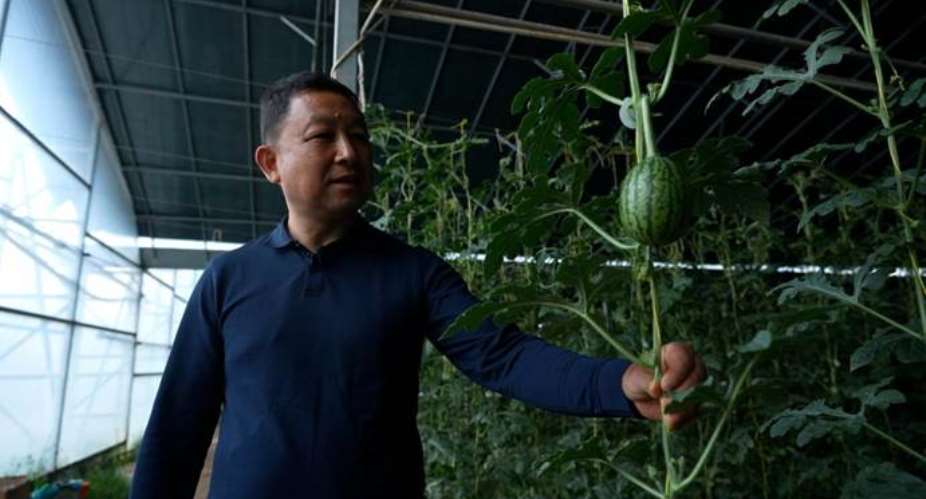
Have you ever paused mid-meal to wonder where your food truly comes from? We enjoy fresh vegetables daily for their taste and nutrition, yet few of us consider the soil they grow in, potential chemical residues, and whether crop production depletes the planet’s limited farmland. For most people, food is an ordinary daily necessity, yet every plate of produce hides a global challenge: how to grow sufficient, safe food for billions while protecting and restoring vulnerable farmland.
Earlier this year, I went to Anqiu, a major vegetable production and export hub in China’s Shandong Province. Through field visits, conversations with frontline farmers, and observations of local planting practices, I witnessed a practical model that combines organic production, soil restoration, and digital technology.
During my visit, one of the most impressive sights was the circular farming system at Zhang Weitao’s 4,000-mu (approximately 267 hectares) Heli Ranch. Instead of relying on chemical inputs to boost yields, the farm operates a closed-loop agricultural system, turning livestock manure into daily biogas and nutrient-rich organic fertilizer. The fertilizer enriches the soil and provides nutrients for grains, vegetables, and fruit crops, while crop straw is processed into feed for livestock.
“Quality produce needs to grow on quality soil, and cycling waste into fertility lets us grow sustainably without draining the land,” Zhang told me. Years of organic fertilization has raised the farm’s soil organic matter above 10%, creating loose, nutrient-dense topsoil ideal for crop growth. It has also steadily lifted local wheat yields from 100 kilograms to 400 kilograms per mu. Touching the soft, dark topsoil, I realized fertile soil is the foundation of high quality food production.
According to the Food and Agriculture Organization (the FAO) of the United Nations, human-induced land degradation affects around 1.7 billion people globally, with Southern Asia and sub-Saharan Africa facing the worst overlap of land degradation, poverty and food insecurity. Restoring just 10 percent of degraded croplands can substantially boost global food supply, proving soil rehabilitation a cost-effective solution to global food pressure. Zhang’s circular design operates with simple, locally accessible resources. Models like his show how regionally tailored closed-loop agriculture can deliver tangible progress against land degradation, without locking farms into resource-heavy intensive farming cycles.
Anqiu’s intelligent farming also overturned my stereotype that green farming demands labor-intensive manual work. At Wang Baojie’s Changshengyuan Farm, smartphone-controlled greenhouses drastically cut manual labor, allowing a single farmer to manage dozens of greenhouses with simple digital operations and eliminate exhausting all-day field work. Cooperating with local Weifang University, Wang set up the whole system, which monitors crop growth and enables irrigation and fertilization with just a click on a smartphone.
In cooperation with the same university, the farm has developed virus-free ginger seedlings, reducing pesticide reliance and raising yields by over 10 percent. Rather than relying on generic industrial farming blueprints that ignore local conditions, researchers tweak technologies and crop varieties to match Anqiu’s unique climate and soil—a collaborative approach that could offer a useful template for agricultural innovation elsewhere.
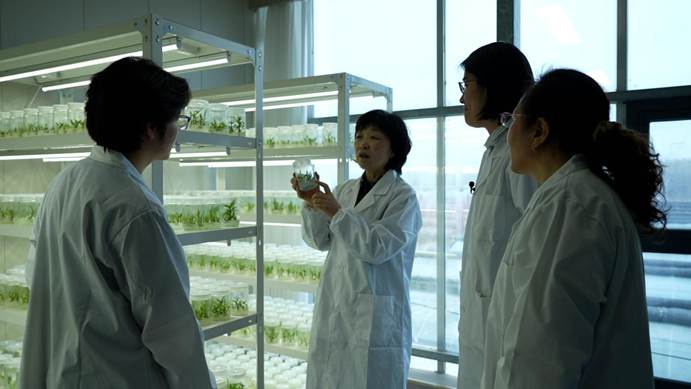
Professor Zhao Yueling of Weifang University works with students to cultivate virus-free seedlings at Changshengyuan Farm. [Photo: CGTN Radio]
The most touching part of my field experience lies in the new vitality brought by young farmers to rural green development. Two college graduates, Li Kai and Li Jinguang, gave up stable urban office jobs to return home and develop organic farming. In his first planting year, Li Jinguang won two gold medals at that year’s World Strawberry Expo., demonstrating the innovative strengths of professional, youth-led farming. The young entrepreneurs' journey was tough, marked by skepticism from family and villagers, steep startup costs, and shaky early returns. But their persistence paid off: their pesticide-free, high-quality produce is now so sought after that orders far outstrip their supply.
Youth outflow remains a persistent struggle for rural regions across the globe. For these young returnees in Anqiu, eco-farming has become both a way to protect the land and a steady, rewarding career path. The county has put robust support systems in place to back their work: all 1,700 local family farms receive ongoing professional guidance to shift to organic fertilization. This coordinated backing from local authorities and research bodies helps lower barriers for young farmers, letting their fresh ideas take root while keeping rural communities active.
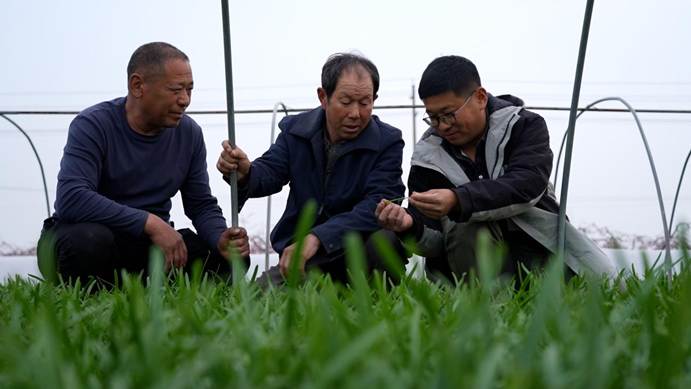
Li Kai shares farming insights with veteran farmers in his field of organic chives. [Photo: CGTN Radio]
Anqiu’s green development extends beyond field planting to integrated processing and global trade, forming a complete eco-friendly industrial chain from farmland to international tables. Local enterprises including Lufeng Group enforce strict ecological and food safety standards throughout production and processing, exporting organic agricultural products to dozens of countries and regions. Global consumers may easily find certified Anqiu produce in local supermarkets, a well-earned recognition stemming from consistent ecological planting, strict residue control, and standardized green processing. For global agricultural industries, this full-chain green transition offers a reference point for building trusted food safety frameworks and sustaining long-term international market confidence.
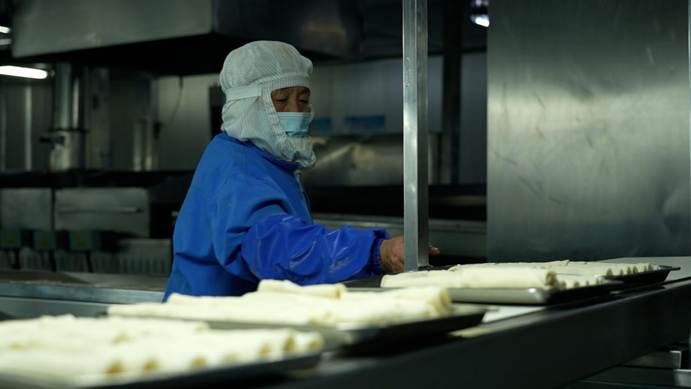
Production line of organic spring rolls at Lufeng Group. [Photo: CGTN Radio]
I do not intend to idealize local green farming, as it still faces universal challenges. High ecological transformation costs keep organic produce relatively pricey. Like many consumers, I sometimes hesitate to buy organic goods due to cost concerns. This is not a local issue, but a shared global barrier. Still, I remain optimistic. As green technologies mature and scaled production lowers costs, supported by popularized ecological concepts and improved industrial systems, safe, green food may gradually become accessible and affordable for more families.
The FAO notes that with less than 10 percent of the world’s arable land, China has supported food security for nearly one-fifth of the global population, while striving to reduce agriculture’s environmental footprint. Instead of pursuing extreme development models, Anqiu explores a balanced, pragmatic path that stabilizes yields, restores soil ecology, protects farmer livelihoods, and expands green trade.
Progress on global food insecurity and land degradation often comes from open, two-way exchange of knowledge across borders. Food binds every person on this planet, and soil sustains every bite we consume. After spending weeks walking Anqiu’s farmlands and talking with its growers, I’ve come to believe that the future of global food systems may hinge less on dazzling breakthroughs, and more on countless persistent, down-to-earth ecological efforts—small, steady changes that nourish both human lives and the fragile planet we all share.
 July 10: Cedi sells at GHS12.20 on forex market, GHS11.47 on BoG interbank
 Eastern Region: Police arrest 258 suspects over violent disturbances at Adoagyir...
 Fault on ECG network causes power outage across Tema, Spintex and surrounding co...
 Central Region: GNFS contains domestic fire in four-bedroom apartment at Apam
 Let's do the right things to protect ourselves from perennial floods — Vice Pres...
 Don't lecture Ghana on constitutional reforms — Ras Mubarak to Swiss Ambassador
 Interpreting two presidential term limit as consecutive terms amounts to Constit...
 Abuakwa South MP Demands Tax Reliefs for Insurers as Flood Claims Hit GH¢500m
 Otumfuo Unveils New Asantehemaa Nana Ama Bonsu in Majestic Manhyia Ceremony
 NPP Sets September 19 for Crucial National Delegates Conference in Kumasi

