




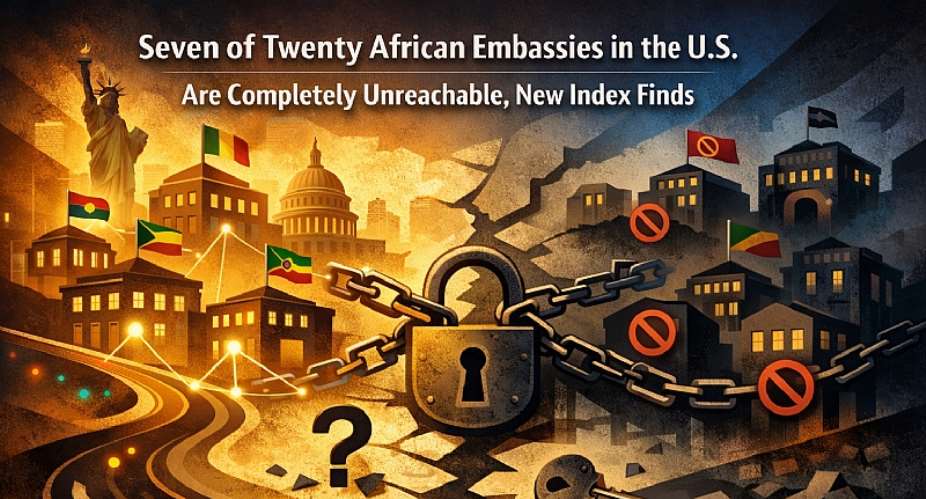
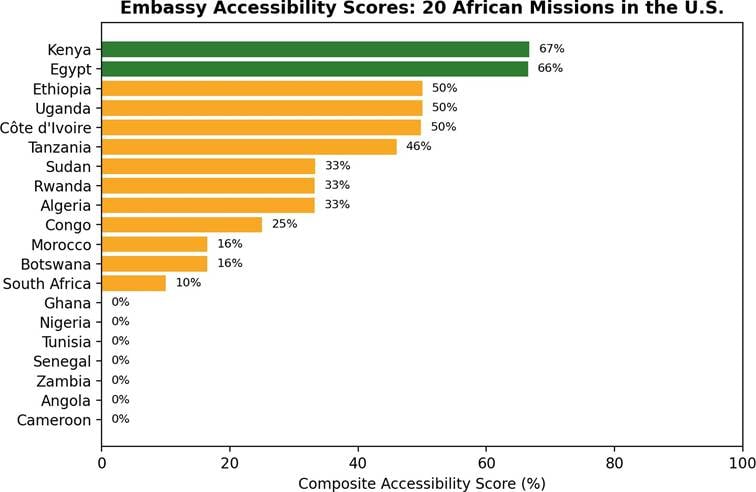
35% of missions were completely unreachable. Seven of the 20 African embassies and consulates tested in the United States, Ghana, Nigeria, Tunisia, Senegal, Zambia, Angola, and Cameroon, recorded a 0% composite accessibility score, meaning no phone call or email attempt succeeded during the entire study period.
Only two missions performed well, and neither did so consistently. Egypt and Kenya were the only missions to score above 60%, but each excelled in just one channel: Egypt answered 100% of emails but only 33% of calls; Kenya answered 100% of calls but only 33% of emails.
Most citizens do not get through on the first try. Across all 20 missions, only 40% of first email attempts and 45% of first phone calls succeeded, meaning a majority of contacts required repeated follow-up before reaching anyone.
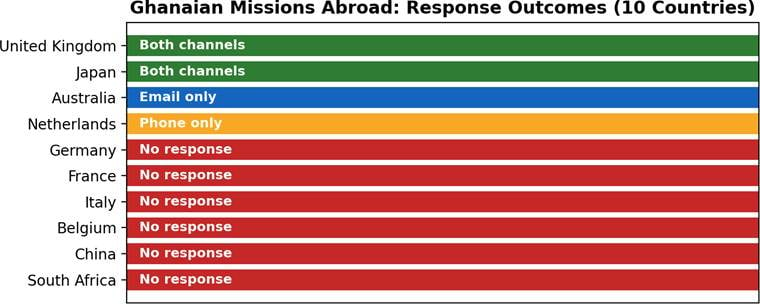
The problem follows Ghana's missions worldwide, not just in the U.S. Of 10 Ghanaian missions tested across Europe, Asia, and Oceania, 6, including missions in Germany, France, and Italy, gave no response to either email or phone contact, and Ghana's own U.S. mission scored 0% as well, pointing to a systemic issue rather than a single unresponsive post.
Poor accessibility is not explained by resources alone. Top and bottom performers operate within comparable budget and staffing environments, pointing to internal management and accountability practices as the more likely drivers of the gap.
Why This Matters
Diaspora communities, travelers, and visa applicants depend on embassies for consular support that cannot be obtained anywhere else: emergency travel documents, legal assistance, and time-sensitive visa processing. When a mission cannot be reached, these needs go unmet, often at the moments people need help most urgently.
A composite score of 0% is not a service delay; it is a complete failure to function as an accessible institution. For the millions of Africans living, working, and traveling abroad, unresponsive missions translate directly into unresolved emergencies, missed opportunities, and eroded trust in government institutions meant to represent them.
Detailed Analysis
 Source: ADAI standardized phone and email contact attempts, officially listed embassy channels.
1. Zero-responsiveness missions represent over a third of the sample.
Seven of 20 missions (35%) scored 0% on the composite accessibility measure: Ghana, Nigeria, Tunisia, Senegal, Zambia, Angola, and Cameroon. Despite repeated contact attempts across a defined observation window, no email or phone contact succeeded for any of these seven missions.
2. Top performers show channel-specific strength, not universal excellence.
Egypt (66.5%) and Kenya (66.7%) led the sample, but each depended on a single channel: Egypt's 100% email response rate paired with only a 33% call answer rate, and Kenya's reverse pattern, showing that even the best-performing missions have significant gaps.
3. A second tier scores near 50%, split evenly by channel dominance.
Ethiopia, Uganda, and Côte d'Ivoire each scored approximately 50%. Ethiopia and Uganda mirror the Egypt-Kenya pattern at a lower level; Côte d'Ivoire showed a more balanced 67% email and 33% call rate.
4. Ghana's global mission network mirrors the U.S. findings.
In a supplementary test of 10 Ghanaian missions abroad, only 4 responded through any channel, and just 2 (the United Kingdom and Japan) responded through both email and phone. Six missions, including those in major partner countries such as Germany and France, gave no response at all. Ghana's own mission in the United States also scored 0% in the primary sample, so this is not a single-post problem: it points to a systemic pattern that follows the institution across postings rather than a one-off failure tied to a specific embassy or region.
5. Persistence, not first-contact reliability, defines the experience.
Only 40% of email attempts and 45% of phone calls succeeded on the first try across the full sample. In many cases, successful contact was achieved only after multiple follow-up attempts, placing the burden of persistence on the citizen rather than the institution.
 Source: ADAI supplementary assessment, 10 Ghanaian missions, five-working-day observation window.
The two missions that responded through both channels, the United Kingdom and Japan, both serve large, established Ghanaian diaspora populations, which may create more day-to-day pressure to maintain functioning contact lines. The six non-responsive missions span a wide range of contexts, from major European capitals to an Asian financial hub, suggesting that host-country prominence and diplomatic significance do not by themselves guarantee accessibility.
Recommendations
■ Publish minimum response-time standards. Foreign affairs ministries should require every mission to commit to, and publicly post, specific response windows for email and phone inquiries.
■ Conduct regular internal accessibility audits. Foreign affairs ministries should periodically test their own missions' responsiveness using a mystery-contact methodology, catching failures before external assessments do.
■ Verify and update published contact information on a fixed schedule. Mission administrative staff should confirm that listed phone numbers and email addresses are active at least quarterly.
■ Adopt this index as a recurring accountability tool. Civil society organizations and research institutions should repeat the ADAI methodology periodically to track whether accessibility is improving or declining over time.
■ Prioritize corrective action at the seven zero-responsiveness missions. The ministries overseeing Ghana, Nigeria, Tunisia, Senegal, Zambia, Angola, and Cameroon's missions should treat 0% responsiveness as an urgent operational failure requiring immediate review.
Methodology Snapshot
Data were collected through direct, standardized contact attempts, not surveys or self-reported records. Twenty African diplomatic missions in the United States were sampled for diaspora presence, economic and tourism significance, regional balance, and population size, plus a supplementary sample of 10 Ghanaian missions across Europe, Asia, and Oceania. Each mission was contacted by phone and email, using only officially listed public contact details, with repeated attempts made within a defined observation window (five working days for the supplementary sample). Three measures were derived: email response rate, call answer rate, and a composite accessibility score averaging the two.
Limitations
- Contact attempts were limited to a fixed observation period and may not reflect seasonal variation, such as holidays or staffing changes.
- All primary missions assessed are located in the United States; findings may not generalize to missions in other host countries.
- Only phone and email were tested; walk-in services, online portals, and social media channels were not assessed.
- Outdated or incorrect listed contact details would depress scores, though this itself reflects a form of inaccessibility.
- This study measures accessibility outcomes only; it does not test the underlying staffing, resource, or structural causes of non-responsiveness.
Authors
- Yussif Mohammed
- Andy Sevordzi
- Rudolph Djirackor
- Franklin Owusu Kwakye
Sources / References
- Hamilton, K., & Langhorne, R. (2011). The Practice of Diplomacy: Its Evolution, Theory and Administration
- (2nd ed.). Routledge.
- Heeks, R. (2002). e-Government in Africa: Promise and practice. Information Polity, 7(2–3), 97–114.
- Ndou, V. (2004). E-Government for developing countries: Opportunities and challenges. Electronic Journal on Information Systems in Developing Countries, 18(1), 1–24.
- Primary data: ADAI original contact-attempt dataset, collected via standardized phone and email outreach to officially listed embassy channels (full underlying dataset available on request).

 Macron promises tough punishments for rioters during nationwide day of action
 Trump endorses embattled Israeli PM Netanyahu ahead of October 27 election
 We are going to provide emergency airstrip in regions without airports — Mahama
 Nana Konadu maiden memorial mass set for October 23
 'Double standards are not helpful, wrong yesterday is wrong today' – Ablakwa on ...
 NPP has resolve internal wrangling — Bawumia
 Ghana, US Virgin Islands agree on recruitment of Ghanaian teachers, nurses
 “Soldiers Will Stay There”—Mahama Declares Permanent Military Presence in Forest...
 ‘No Borrowing Involved’ — Mahama Rolls Out US$10bn New Economy Policy
 “Ask Jean Mensa to resign first”—Tanko-Computer fires back


