




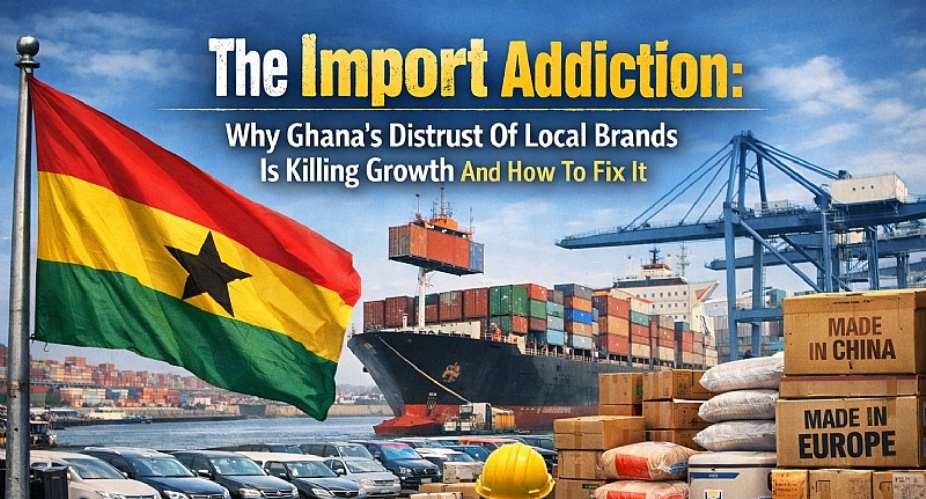
A Ghanaian shopper is often more likely to choose a foreign product or patronize a foreign-owned business than purchase a locally manufactured alternative. This preference has existed for decades and has become deeply rooted in consumer behavior. Many imported brands have earned a reputation for consistency, quality, and reliability, creating a level of trust that many local businesses continue to struggle to achieve. Whether it is household goods from China Mall and Panda Mart, products from Melcom, meals from KFC, or imported rice brands such as Jasmine and Lele, many consumers instinctively associate foreign products with superior quality, even when local alternatives are available.
This growing dependence on imported goods is more than a consumer preference—it has become an economic challenge. Every imported product purchased instead of a locally made one represents income, employment opportunities, and investment leaving the Ghanaian economy. While imported products play an important role in meeting consumer demand, excessive dependence on them weakens domestic industries and slows national economic growth.
Business groups such as the Ghana Union of Traders Association (GUTA) have repeatedly expressed concern over the increasing dominance of foreign-owned retail businesses, arguing that local traders are gradually losing market share. Although precise national market share data remain limited, GUTA maintains that foreign retailers now account for a significant portion of Ghana's retail sector, highlighting the growing competitive pressure on indigenous businesses.
Why Do Ghanaians Prefer Imported Products?
Several factors explain this preference.
The first is consumer perception. Many consumers believe imported products are more durable, safer, and manufactured to higher standards than locally produced goods. This perception has been reinforced over many years through advertising, customer experiences, and word-of-mouth recommendations.
Secondly, branding and packaging significantly influence purchasing decisions. Many foreign companies invest heavily in attractive packaging, product design, and marketing campaigns that create strong brand recognition. In comparison, many Ghanaian small and medium-sized enterprises (SMEs) have limited financial resources for branding, making their products appear less competitive on store shelves.
Price also plays a critical role. Ironically, some imported products are sold at prices equal to or even lower than locally manufactured goods. This is largely due to economies of scale enjoyed by foreign manufacturers, particularly those from countries such as China, where mass production significantly reduces production costs.
Another contributing factor is consumer trust. Many locally produced goods suffer from inconsistent quality. A customer who purchases a local product today may receive a completely different experience the next time. Such inconsistency discourages repeat purchases and makes imported brands appear more dependable.
The Cost to Ghana's Economy
The consequences of excessive dependence on imports extend far beyond shopping habits.
One of the most significant effects is the pressure placed on Ghana's foreign exchange reserves. Since imports must be paid for in foreign currencies such as the US dollar, increasing import demand contributes to higher demand for foreign exchange, placing pressure on the Ghanaian cedi.
Heavy import dependence also contributes to unemployment. When consumers consistently choose imported goods, local manufacturers experience lower sales, limiting their ability to expand production and create new jobs. Manufacturing remains one of the sectors with the greatest potential to absorb Ghana's growing youth population, yet many factories continue to operate below capacity.
Local entrepreneurship also suffers. Many Ghanaian businesses struggle to compete against multinational companies with larger capital, stronger supply chains, and established global brands. As a result, numerous promising local enterprises fail to survive long enough to achieve sustainable growth.
Furthermore, Ghana loses opportunities to build internationally competitive industries. Countries such as South Korea, China, and Japan initially developed their manufacturing sectors by encouraging citizens to support domestic industries before successfully competing on global markets.
Why Local Brands Must Also Improve
While consumers should support Ghanaian businesses, local producers also have responsibilities.
Consumers are increasingly demanding value for money. They expect products that meet international standards, attractive packaging, reliable customer service, and consistent quality. Supporting local businesses should not require consumers to compromise on quality.
Many successful Ghanaian companies—including Kasapreko PLC, FanMilk Ghana, Blue Skies Ghana, and Verna Natural Mineral Water—demonstrate that local businesses can earn consumer trust by consistently delivering quality products while investing in branding and innovation.
How Ghana Can Reverse the Trend
Addressing Ghana's import dependence requires collective action from government, businesses, and consumers.
Government should strengthen policies that promote local manufacturing through tax incentives, improved access to finance, affordable electricity, and infrastructure development. Public procurement policies should also prioritize locally manufactured products where appropriate.
Financial institutions can contribute by offering affordable financing to local manufacturers seeking to expand production and improve product quality.
Educational institutions should promote entrepreneurship and innovation, encouraging young people to build businesses rather than relying solely on imported goods for trade.
Consumers themselves have an equally important role. Choosing locally made products whenever quality and price are competitive helps create jobs, strengthen businesses, and keep wealth circulating within the Ghanaian economy.
Finally, Ghanaian businesses must invest in quality assurance, modern packaging, digital marketing, customer service, and product innovation. Building consumer trust requires consistency over time rather than appealing only to patriotism.
Conclusion
Ghana's growing preference for imported products reflects not only consumer choice but also broader issues of competitiveness, trust, and industrial development. While imported goods will always remain part of a modern economy, excessive dependence on them weakens local production, reduces employment opportunities, and slows economic transformation.
Changing this narrative requires more than campaigns encouraging citizens to "buy Ghana." It requires local businesses to consistently meet consumer expectations while government creates an environment in which domestic industries can compete fairly. When quality, trust, and competitiveness become the hallmarks of Ghanaian brands, consumers will have every reason to choose local products—not merely out of patriotism, but because they represent genuine value.
Supporting local businesses is ultimately an investment in Ghana's future. Every cedi spent on a competitive Ghanaian product strengthens local industries, creates employment, and contributes to a more resilient and self-reliant economy.

 NPP rejects Mahama's appointment of Emelia Agbenyo as EC deputy, demands withdra...
 Excessive consumption of processed meat can expose one to cancer – Health expert...
 Education Minister appeals to University Administrators to call off strike, resu...
 'You're doing yeoman’s job' — Mahama lauds Police over declined unresolved murde...
 Wilmar Africa, De Heus, other food processing companies face CID action over dat...
 NPP’s Baba Amando runs to police over alleged death threats
 Ghana repatriates 120 Nigerians arrested in cybercrime operations
 PIAC unable to verify GH¢21million petroleum-funded projects in Ayawaso West
 Wontumi pleads not guilty to five charges in GH¢30m Exim Bank fraud case
 Ghana among stronger-performing economies in sub-Saharan Africa — IMF


