




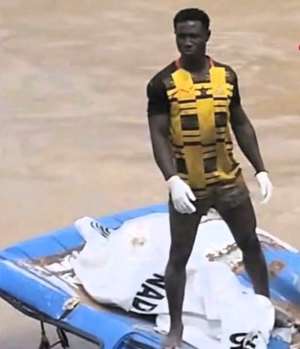
When disaster struck, they did not wait for instructions. They simply stepped forward. Ghana now has an opportunity to ensure that their courage becomes part of our national resilience.
As the floodwaters gradually disappeared from the streets of Accra, another image remained firmly etched in the minds of many Ghanaians.
It was not the submerged vehicles or the collapsed walls.
It was the sight of ordinary citizens risking their own lives to save complete strangers.
Young men formed human chains through fast-moving floodwaters to rescue trapped residents. Others carried children and elderly people on their backs to safety. Some directed traffic through dangerous roads while many worked side by side with officers of the National Disaster Management Organisation (NADMO), the Ghana National Fire Service, the Ghana Police Service and the Ghana Armed Forces.
They did not ask for recognition.
They did not expect payment.
They simply understood that when lives are at risk, every second matters.
Once the floodwaters recede, however, these everyday heroes quietly return to their normal lives. Their courage becomes another inspiring story shared on social media before gradually fading from public memory.
That, perhaps, is one of the greatest opportunities Ghana continues to miss.
While governments around the world invest heavily in emergency response systems, some of the most effective disaster management programmes recognise an important reality: communities are often the first responders long before professional emergency services arrive. A neighbour is usually the first to hear cries for help. A passerby is often the first to pull someone from danger. Community members are frequently the first to organise rescue efforts while official responders are still making their way to affected areas.
Rather than allowing these moments of extraordinary courage to disappear with the floodwaters, Ghana should begin transforming them into a permanent national asset.
This is the time to establish a National Community Emergency Volunteer Corps under the coordination of NADMO and in collaboration with the Ghana National Fire Service, the National Ambulance Service and other emergency response agencies.
Such a programme would identify citizens willing to serve during emergencies and provide them with structured training in first aid, cardiopulmonary resuscitation (CPR), flood and water rescue, evacuation procedures, fire safety, emergency communication and community disaster preparedness.
These volunteers would not replace professional emergency services. Instead, they would strengthen them by creating a network of trained community responders capable of providing immediate assistance before professional teams arrive.
The benefits would extend far beyond disaster response.
At a time when youth unemployment remains a national concern, such a programme would equip thousands of young Ghanaians with valuable life-saving skills, leadership experience and nationally recognised certifications. Participants who consistently demonstrate discipline, competence and commitment could receive additional consideration when applying to institutions such as the Ghana National Fire Service, NADMO, the National Ambulance Service or other public emergency agencies.
This should not be viewed as guaranteed employment.
Rather, it would recognise that individuals who have already demonstrated courage, discipline and selfless service possess qualities every nation should encourage and develop.
The programme could also strengthen civic responsibility.
One of the greatest challenges facing modern societies is declining community participation. Yet the recent floods reminded us that the spirit of volunteerism remains alive in Ghana. Citizens from different political, religious and ethnic backgrounds came together with one common purpose—to save lives.
That spirit should not be allowed to disappear once the emergency ends.
Government could further institutionalise this culture by introducing annual National Civilian Bravery Awards to recognise individuals and communities that demonstrate exceptional courage during disasters. Such recognition would send a powerful message that patriotism is not measured only by words but by service to others.
This is not merely an investment in emergency preparedness.
It is an investment in nation-building.
Countries become stronger not only because of the institutions they build but because of the citizens they empower. Every trained volunteer represents another community that is better prepared for future emergencies. Every citizen equipped with life-saving skills increases Ghana's national resilience.
Recent floods have also reminded us that disasters are becoming more frequent and more complex. Climate change, rapid urbanisation and population growth mean emergency preparedness can no longer be viewed as the sole responsibility of government institutions. Building resilient communities requires partnership between the state and its citizens.
Fortunately, Ghana already possesses one of the most important ingredients.
Its people.
The courage displayed by ordinary Ghanaians during the recent floods cannot be legislated. It cannot be manufactured. It already exists.
What remains is for government to recognise it, develop it and integrate it into our national disaster preparedness strategy.
The next time disaster strikes—and unfortunately, it will—we should not depend solely on spontaneous acts of bravery.
We should be able to count on thousands of trained community volunteers standing ready to support professional emergency responders with competence, discipline and compassion.
When history remembers these floods, it should remember more than the destruction they caused.
It should remember that they inspired Ghana to build a stronger, more prepared and more united nation.
Because the greatest lesson from every disaster is not simply how we recover.
It is how wisely we prepare for the next one.
The heroes have already shown us what courage looks like.
Now it is time for the nation to show them what gratitude looks like.
Email: [email protected]
Contact: (233) 507457889

 Netherlands, Germany pledge return of 2,000 artefacts to Ghana
 Over GH¢3 million lost to online investment fraud in first half of 2026 — CSA
 Gov't retooling Immigration Service with 20 armoured vehicles, 8 new regional of...
 How a 67-year-old grandmother was arrested with 13kg cocaine hidden in fake plan...
 Police arrest 24 suspects in Ashanti anti-crime operation
 Prestea Sankofa Gold Limited workers on sit-down strike
 Second batch of 900 Ghanaians register for evacuation from South Africa followin...
 July 6: Cedi sells at GHS12.25 on forex market, GHS11.40 on BoG interbank
 Attorney General introduces tribunal bill to revive public tribunals
 Unemployed man remanded for spending ex-girlfriend’s GHC114,000 on sports bettin...

