




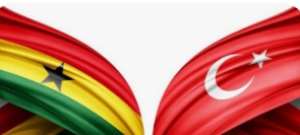
For much of the past two decades, the Ghana-Türkiye economic relationship followed a familiar script: Turkish goods textiles, cosmetics, building materials, electronics flowing into Ghanaian markets, valued locally for being sturdier than Chinese imports and cheaper than European ones. Today, both governments are trying to rewrite that script, pushing the relationship from simple trade toward joint industrial ventures, technology transfer, and strategic co-investment.
The Numbers, and the Ambition Behind Them
Bilateral trade between Ghana and Türkiye reached $888 million in 2023 and was projected to top $900 million by 2025. Both governments have set their sights higher still a target of $1 billion in annual trade by 2027. Modest by the standards of Ghana's largest trading partners, but the trajectory matters more than the raw figure: Turkish investment has migrated well beyond consumer goods into infrastructure, healthcare, aviation, education, construction, and manufacturing, with Ankara increasingly positioning itself as a builder of value chains rather than merely a source of imports.
That shift in ambition was made explicit at the 5th Türkiye-Africa Business and Economic Forum in Istanbul, where Ghana's Deputy Minister for Trade, Agribusiness and Industry, Sampson Ahi, argued that both sides needed to move past the traditional import-export model toward structures built on trust, policy alignment, and genuinely mutual benefit rather than one-sided transactions dressed up as partnership. Agribusiness featured prominently in that pitch: Africa's agribusiness sector, valued at roughly $3.5 trillion in 2024, is projected to approach $5.8 trillion by 2033, and Ghana is angling to be a serious player in that expansion rather than a bystander.
The Institutional Architecture
The relationship rests on more than goodwill and forum speeches. Ghana and Türkiye signed a Bilateral Investment Treaty in 2016, establishing reciprocal protections for investors on both sides covering fair treatment, technology transfer, and mechanisms for enforcing investment rights. Free Trade Agreement negotiations between the two countries are now ongoing, and Ghana sits among Türkiye's priority African markets under Ankara's 2024–2025 targeting framework, alongside Kenya, Senegal, Côte d'Ivoire, Morocco, Tanzania, Mozambique, and Angola.
That institutional groundwork has translated into a steady cadence of high-level engagement. In October 2025, Ghana's Trade Minister held bilateral talks with Türkiye's Deputy Minister for Trade in Istanbul, focused on deepening investment relations and building frameworks for joint industrial development. This past June, the 12th World Cooperation Industries Forum brought Ghanaian and Turkish businesses together in Accra, with First Deputy Speaker of Parliament Bernard Ahiafor urging Ghanaian SMEs to look beyond domestic markets and actively pursue the opportunities the partnership creates arguing that future prosperity depends on economies that "build bridges across nations" rather than operate in isolation.
Why Türkiye, and Why Now
Türkiye's Africa strategy is not improvised. President Recep Tayyip Erdoğan has made fifty-three official visits to thirty-one African countries more than any other world leader and the relationship traces an institutional lineage back to the 3rd Africa-Turkey Partnership Summit in December 2021, which set out a roadmap spanning security and governance, trade and industry, education and technology, and infrastructure development. For Ghana, the appeal lies partly in diversification: at a moment when the country is being encouraged to look beyond its traditional Western partners for capital and technical expertise, Türkiye offers a middle path a G20 economy with manufacturing depth, but without the geopolitical baggage that sometimes complicates deeper engagement with Washington, Brussels, or Beijing.
The Sectors Doing the Work
Turkish companies have found their footing in Ghana precisely where they can build durable value chains: construction, manufacturing, aviation, education, and energy. That sectoral discipline is not incidental it reflects a broader Turkish approach to African engagement that favors licensed, formal enterprise generating taxes, jobs, and technology transfer over extractive shortcuts. It stands in useful contrast to the illicit gold-mining crisis currently consuming Ghana's mining sector, where informal foreign involvement has fuelled corruption rather than industrial capacity.
What Comes Next
The test for this partnership will be whether the rhetoric of "co-investment" and "mutual benefit" survives contact with implementation. Free Trade Agreement negotiations remain unfinished business, and Ghana's own push visible in initiatives like Ghana Investment & Trade Week 2026, running July 7–9 in Accra suggests Accra is trying to position itself as a serious investment gateway for the wider West African market, not just a bilateral partner for Ankara. If the two governments can convert forum communiqués into signed joint ventures and completed infrastructure, the billion-dollar trade target by 2027 may prove to be the more modest achievement, not the ceiling.
Mustapha Bature Sallama.
Medical/ Science Communicator,
Private Investigator, Criminal investigation and Intelligence Analysis.
International Conflict Management and Peace Building.USIP
[email protected]
+233-555-275-880
Sources : MyJoyOnline (June 2026); News Ghana, "Ghana Pushes Beyond Trade, Seeks Strategic Co-Investment Partnership with Türkiye" (October 2025)
ModernGhana.com, "Why Türkiye Does Not Engage in Galamsey" (2026)
International Trade Council, Ghana Investment & Trade Week 2026 coverage
Electronic Database of Investment Treaties (EDIT)
Ghana-Türkiye BIT (2016); Chambers and Partners, International Trade 2026 Ghana.

 Transport Ministry defends purchase of diesel locomotives, rejects NPP criticism
 Outdoor air pollution costs Ghana more than GH¢28 billion - UNDP
 Yagbonwura joins Asantehene for fifth Awukudae celebration
 How US lawmaker Carol Ammons traces ancestry to Paga, enskinned as Queen Mother
 NDC signs cooperation agreement with Russia's United Russia Party
 Canada-Ghana trade rises 56% to US$752 Million
 Foreign Affairs Ministry to replace passports lost, damaged in floods
 Two bodies retrieved after flooding at Adakope near Weija
 Heartbreaking moment as Senegalese fan reportedly passes out after Belgium's dra...
 Elderly man allegedly throws stone at resident after being caught dumping refuse...
