




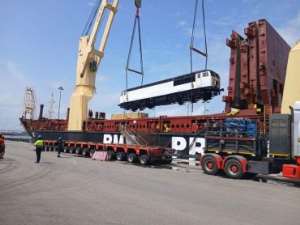
The Ministry of Transport has dismissed criticism from the NPP Minority on Parliament’s Transport Committee over the government’s acquisition of two diesel locomotives and 20 freight wagons, insisting the investment represents “value for money” and is central to efforts to revive Ghana’s railway freight business.
In a press release issued on Thursday, July 2, the Ministry described claims that the locomotives are outdated and unsuitable for service as “factually inaccurate” and based on “a fundamental misunderstanding of railway engineering and locomotive operations.”
The Ministry explained that the two British Rail Class 56 locomotives underwent extensive refurbishment in the United Kingdom before being shipped to Ghana.
According to the statement, the locomotives received “a complete overhaul of the diesel engines, the overhaul of electrical traction equipment, overhaul of traction motors and bogies, complete renewal of the brake system” as well as the installation of modern railway safety equipment before export.
It added that the locomotives come with a five-year warranty and, with routine maintenance, are expected to remain in productive service for at least 15 years before requiring major repairs.
Addressing concerns about maintenance and the availability of spare parts, the Ministry said the Class 56 locomotives are still commercially operated in the United Kingdom and Hungary.
It noted that operators including Colas Rail, DCRail and GB Railfreight continue to use the locomotives in the UK, while Hungary’s Floyd Zrt also operates the same class.
“The Class 56 locomotives are earning commercial revenue in the United Kingdom… The availability of spare and replacement parts are thus, guaranteed,” the statement said.
The Ministry further disclosed that engineers from the suppliers have already arrived in Ghana to provide specialised training and technology transfer for technicians and engineers of the Ghana Railway Development Authority (GRDA).
The Transport Ministry also compared the acquisition with railway purchases made under the previous NPP administration.
It said the former government procured two PESA Diesel Multiple Unit (DMU) passenger trains for approximately US$14.67 million (about GH¢164.7 million), while the current administration acquired two heavy freight locomotives and 20 container wagons for about US$3.18 million (GH¢37.6 million).
“This comparison alone exposes the difference between the two administrations,” the Ministry stated.
It argued that unlike the passenger trains acquired by the previous administration, the newly acquired locomotives are intended to generate revenue by transporting containers and industrial cargo between Tema Port and Mpakadan.
“These are not decorative assets. They are revenue-generating freight assets designed to move containers and industrial cargo… reduce the cost of logistics, ease pressure on Ghana’s roads, support industrialisation and generate sustainable railway income,” the statement said.
Responding to claims that the Tema-Mpakadan railway lacks cargo handling equipment, the Ministry said the assertion is false.
It revealed that the GRDA already possesses two reach stackers and five heavy-duty forklift machines to support container loading, unloading and terminal operations.
It also disclosed plans to procure two gantry cranes to strengthen long-term operational capacity.
“The claim that GRDA lacks lifting equipment is therefore factually inaccurate, technically uninformed and politically mischievous,” the Ministry stated.
The Transport Ministry maintained that demand for freight services on the Tema-Mpakadan corridor has already been established through feasibility studies conducted before construction of the railway line.
It said GRDA is finalising commercial off-take agreements, with one expected to generate approximately US$3.5 million annually
According to the statement, the projected revenue means “the rolling stock investment cost will be recovered within about two (2) years while providing at least fifteen (15) additional years of productive service.”
“That is not waste. That is value for money. That is not propaganda. That is practical railway economics,” the Ministry added.
Government cites broader railway reforms
The Transport Ministry also defended the Mahama administration’s handling of the rail sector, accusing the previous government of leaving major railway infrastructure in poor condition.
It said the current administration has restored passenger rail services between Kojokrom, Sekondi and Takoradi, recommissioned the DMU trains, revived stalled works on the Western Railway Line and addressed technical defects on the Tema-Mpakadan railway.
According to the Transport Ministry, these interventions are repositioning the railway sector as “a key enabler of Ghana’s 24-hour economy.”
The Transport Ministry noted that the government’s approach demonstrates “a clearer vision, stronger leadership and a deeper understanding of railway economics” while positioning rail transport as “a productive economic asset capable of moving freight, reducing logistics costs, supporting industry, easing road congestion, protecting road infrastructure and generating sustainable revenue.”
 Transport Ministry defends purchase of diesel locomotives, rejects NPP criticism
 Outdoor air pollution costs Ghana more than GH¢28 billion - UNDP
 Yagbonwura joins Asantehene for fifth Awukudae celebration
 How US lawmaker Carol Ammons traces ancestry to Paga, enskinned as Queen Mother
 NDC signs cooperation agreement with Russia's United Russia Party
 Canada-Ghana trade rises 56% to US$752 Million
 Foreign Affairs Ministry to replace passports lost, damaged in floods
 Two bodies retrieved after flooding at Adakope near Weija
 Heartbreaking moment as Senegalese fan reportedly passes out after Belgium's dra...
 Elderly man allegedly throws stone at resident after being caught dumping refuse...
