




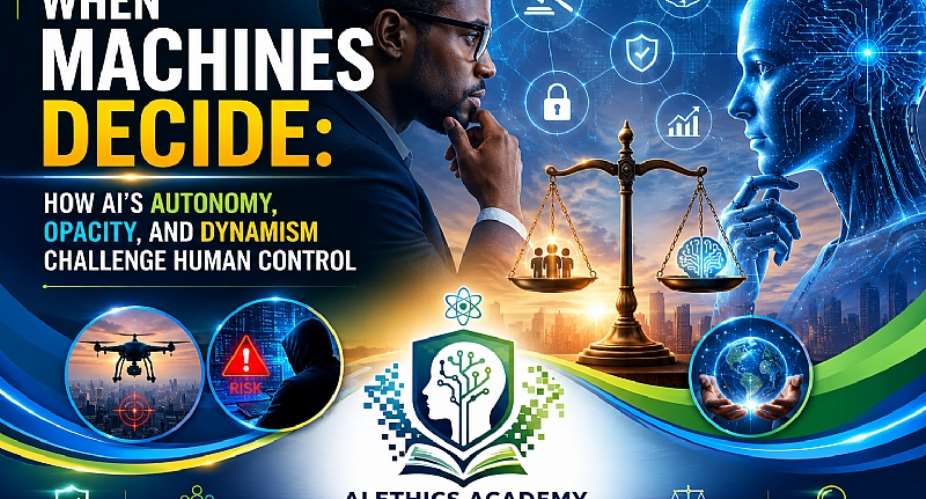
Throughout history, every transformative technology has forced humanity to rethink how society should be governed. Steam engines reshaped industry. Electricity revolutionised modern life. The internet connected billions of people in ways once unimaginable. Artificial Intelligence, however, represents something fundamentally different. Unlike previous technologies that faithfully executed human instructions, modern AI systems can now generate their own recommendations, adapt their behaviour through learning, and influence decisions with remarkable speed. This unprecedented capability offers extraordinary opportunities, but it also raises one of the defining questions of our generation: How do we remain in control of machines that increasingly appear capable of making decisions on our behalf?
The answer cannot be found by relying solely on governance systems designed for a slower, more predictable world. Traditional control mechanisms were built around technologies whose behaviour remained relatively stable after deployment. Policies were written, compliance was checked periodically, and human oversight was expected to be sufficient. AI is changing these assumptions because of three defining characteristics: autonomy, opacity, and dynamism.
AI autonomy is perhaps the most revolutionary and potentially dangerous feature. Many advanced AI systems can perform complex tasks with minimal human intervention. They can recommend medical treatments, approve financial transactions, optimise logistics, monitor infrastructure, detect cyberattacks, and even coordinate autonomous drones. These capabilities improve efficiency, reduce costs, minimise human error, and allow organisations to process information far beyond human capacity.
Yet the very strength of autonomy also creates profound risks. As more decisions are delegated to intelligent systems, humans may gradually lose meaningful oversight. Decision-makers may become overly dependent on AI recommendations without adequately questioning them. This phenomenon, often referred to as automation bias, encourages people to trust machine outputs simply because they are produced by sophisticated algorithms.
The dangers become particularly alarming in military applications. Several countries are rapidly investing in AI-enabled autonomous weapons capable of identifying, tracking, and engaging targets with limited human intervention. Imagine a future battlefield where an autonomous system mistakenly classifies civilians as hostile targets or escalates a military confrontation faster than humans can intervene. Now imagine such systems operating in a world where nuclear weapons still exist. Even a single erroneous decision by an autonomous military AI could trigger catastrophic consequences that extend far beyond national borders. Machines must never be given unrestricted authority over life-and-death decisions without meaningful human control.
Opacity presents another equally serious governance challenge. Many of today's most powerful AI models operate as so-called "black boxes." They often produce highly accurate predictions without providing understandable explanations for how those conclusions were reached. Users may receive an answer, a diagnosis, or a recommendation while remaining completely unaware of the reasoning process behind it.
This lack of transparency undermines one of the basic principles of responsible governance: accountability. If a bank rejects a loan application because of an AI model, or a hospital relies on AI to prioritise patients, individuals deserve to understand why those decisions were made. Without explainability, errors become difficult to detect, biases remain hidden, and responsibility becomes blurred whenever harm occurs. Society should never accept a situation where people are expected to trust systems that even their developers struggle to explain fully.
The third defining characteristic is dynamism. Unlike conventional software that performs the same programmed functions repeatedly, many AI systems continue to evolve through updates, retraining, and exposure to new data. Their behaviour today may differ significantly from their behaviour six months from now. While this adaptability enables continuous improvement and innovation, it also creates governance challenges because risks evolve alongside the technology itself.
Static regulations cannot adequately govern technologies that continuously change. Risk assessments conducted before deployment may quickly become outdated as AI systems encounter new environments, new users, and unexpected situations. This reality demands governance approaches that are equally dynamic and capable of adapting to emerging risks in real time.
None of these concerns suggests that society should reject AI innovation. On the contrary, AI holds enormous promise for healthcare, agriculture, education, scientific research, disaster management, climate action, and economic development. The challenge is not whether AI should continue to advance, but whether governance can keep pace.
The future of AI governance, therefore, lies beyond traditional command-and-control regulation. Effective governance increasingly resembles a living ecosystem rather than a fixed rulebook. It depends on collaboration among governments, researchers, technology companies, civil society organisations, legal experts, and citizens. Inclusive participation ensures that diverse perspectives shape AI development, while continuous monitoring and feedback enable governance frameworks to evolve alongside technological progress.
In this new era, governance must become a continuous process rather than a one-time compliance exercise. Responsible AI requires regular auditing, transparent reporting, independent oversight, robust human involvement in high-risk decisions, and mechanisms that allow society to detect, correct, and learn from failures before they become disasters.
Ultimately, humanity faces a defining choice. We can either remain passive observers as increasingly autonomous systems shape our future, or we can deliberately design governance frameworks that preserve human judgment, democratic accountability, and ethical responsibility. Innovation should never come at the expense of human dignity or public safety. As machines become more capable of making decisions, humanity must become even more capable of governing them wisely. The greatest achievement of artificial intelligence will not be creating machines that think like humans, but ensuring that humans remain responsible for the future that those machines help create.


 Surrogacy: Supreme Court judge warns of citizenship and inheritance challenges f...
 Ghana has a surrogacy law, but… - Supreme Court Justice
 Ghana faces challenge to persuade Brics it deserves a seat at the table
 Stop the Sermon Before the Engine Starts: Why Ghana Regulates Preaching on Movin...
 Don’t let speed of information become your judgement — Chief Justice tells new l...
 ‘Big Push’: Government assures contractors of prompt payments
 GES to develop plan to recover teaching time lost during teachers’ strike – Clem...
 'All human emotions': French astronaut Sophie Adenot's first words since returni...
 French astronaut recounts 'astonishing' emotions after return to Earth
 India's 'cockroach' movement chief detained ahead of major protest


